

This article is part of our complete guide to income tax in India. For this year’s rates, see income tax slabs for FY 2026-27.
The Short Answer
The Income Tax Act 2025 (officially the Income-tax Act, 2025) replaced the Income-tax Act, 1961 on 1 April 2026. It is a rewrite, not a new tax: the slabs, the two regimes, the deductions and the capital gains rates all carried over. What changed is the language, the structure (536 sections instead of more than 800), the section and form numbers, and one idea: the “previous year” and “assessment year” are now a single tax year.
Alongside the new Act, the Income-tax Rules, 2026 and the Finance Act, 2026 brought real changes from the same date: much higher tax-free limits for several employee perks, the 50% HRA rate for four more cities, buybacks taxed as capital gains, and a narrower Sovereign Gold Bond exemption.
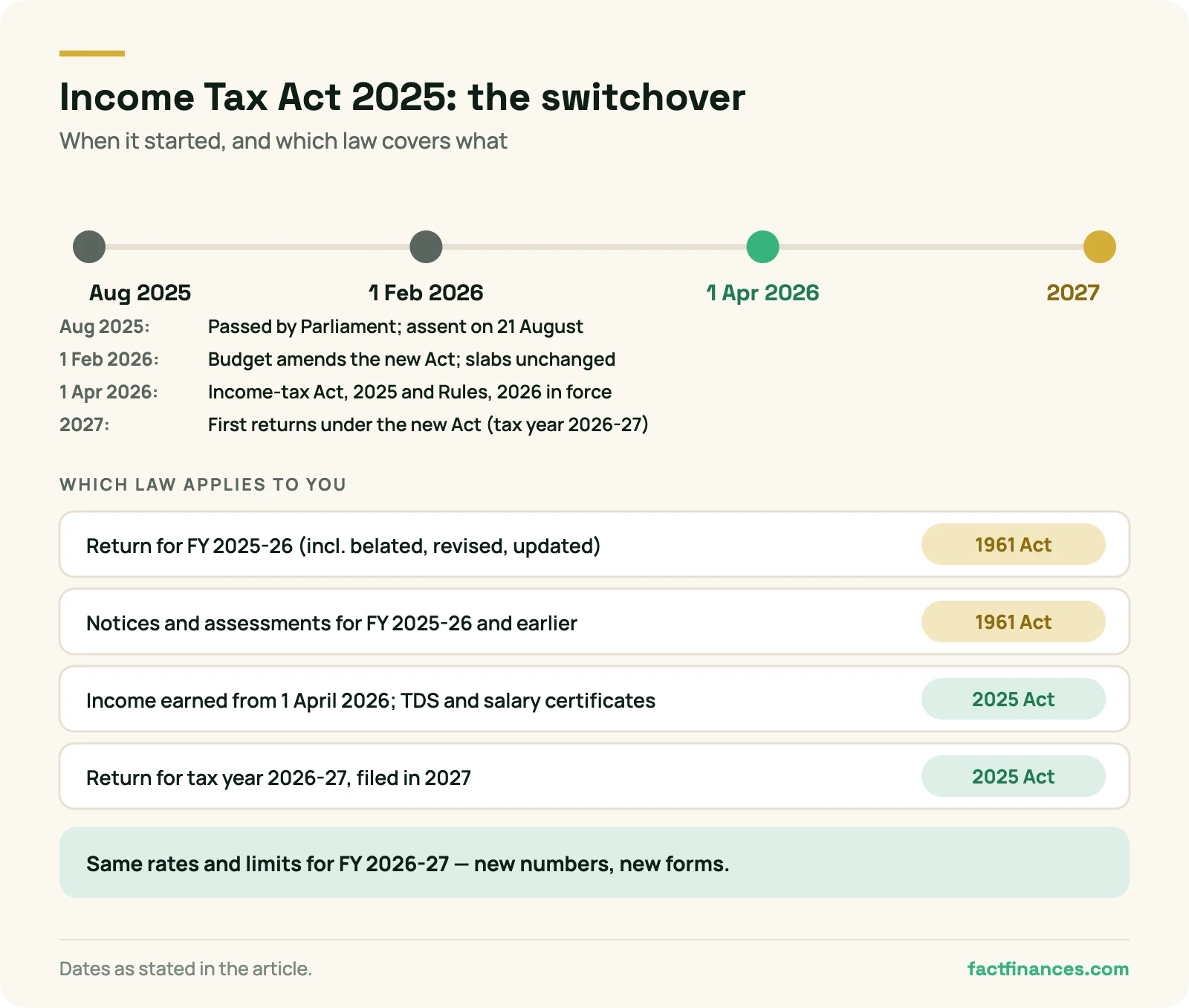
For your return, timing is what matters. Income up to 31 March 2026 is still taxed and filed under the 1961 Act. The first returns under the new Act are for tax year 2026-27, filed in 2027.
The Timeline
Income Tax Act 2025: how we got here
| Date | What happened |
|---|---|
| 11–12 August 2025 | Passed by the Lok Sabha and the Rajya Sabha |
| 21 August 2025 | Presidential assent |
| 1 February 2026 | Budget: Finance Bill amends the new Act; no change to slabs |
| 1 April 2026 | Income-tax Act, 2025 and Income-tax Rules, 2026 come into force |
| 2027 | First returns under the new Act, for tax year 2026-27 |
The new Act has 23 chapters and 16 schedules. Many exemptions that used to sit inside long sections, such as the life insurance exemption in old section 10(10D), now live in schedules.
Which Law Applies
Old Act or new Act: which one applies to you
| Situation | Law that applies |
|---|---|
| Return for FY 2025-26 (filed in 2026), including belated, revised and updated returns | 1961 Act, old ITR forms |
| Notices, assessments and appeals for FY 2025-26 and earlier | 1961 Act provisions, under the repeal and savings clause |
| Income earned from 1 April 2026 | 2025 Act |
| TDS, TCS and salary certificates from 1 April 2026 | 2025 Act, new form numbers |
| Return for tax year 2026-27 (filed in 2027) | 2025 Act, new ITR forms |
In practice, if you are filing a belated or revised return before 31 December 2026, you are still in the 1961 Act world: section 139(4), section 234F, ITR-1 and so on. The new numbers start appearing on payslips, TDS certificates and Form 130 for this year’s income.
The Tax Year
Goodbye to “assessment year”
Under the old Act, income earned in the “previous year” (say FY 2025-26) was assessed in the following “assessment year” (AY 2026-27). Every form and notice carried both labels, and the one-year offset confused almost everyone.
The new Act uses one label: the tax year, the April-to-March year in which you earn the income. Income earned from April 2026 to March 2027 is tax year 2026-27, and the return for it is filed in 2027 for that same tax year. Nothing about when you pay or file has moved; only the name is simpler.
What Did Not Change
What stayed exactly the same
- Tax rates and slabs. New regime: nil to ₹4 lakh, then 5% to 30%. Old regime: unchanged. See this year’s slabs.
- The ₹12 lakh rebate in the new regime, and ₹5 lakh in the old.
- Both regimes, with the new one as default and the same switching rules.
- Deduction limits: ₹1.5 lakh for 80C-type savings, the 80D health insurance limits, ₹2 lakh home loan interest, ₹50,000 extra NPS.
- Capital gains rates: 20% short-term and 12.5% long-term on listed equity, with ₹1.25 lakh a year of long-term gains exempt.
- Due dates: 31 July for most individuals, 31 December for belated returns.
New Numbers
The section numbers you will see now
The Income Tax Department has published a mapping tool for every section. These are the ones individual taxpayers meet most:
| Familiar name (1961 Act) | Income-tax Act, 2025 |
|---|---|
| 80C, 80CCC and the ₹1.5 lakh cap (80CCE) | Section 123 |
| 80CCD (NPS) | Section 124 |
| 80D (health insurance) | Section 126 |
| 80E (education loan interest) | Section 129 |
| 80G (donations) | Section 133 |
| 87A (rebate) | Section 156 |
| 115BAC (new regime) | Section 202 |
| 139 (filing of returns) | Section 263 |
| 16 (standard deduction, professional tax) | Section 19 |
| 24 (house property deductions) | Section 22 |
| 10(10D) (life insurance maturity) | Schedule II, read with section 11 |
Expect to see both sets of numbers for a few years. Product brochures, employer declarations and older articles will keep saying “80C” long after the law stopped using it.
New Forms
Forms you will see under new numbers
| Old form | New form | What it is |
|---|---|---|
| Form 16 | Form 130 | Salary TDS certificate from your employer |
| Form 16A | Form 131 | TDS certificate for non-salary income (interest, rent, fees) |
| Form 12BB | Form 124 | Your declaration of rent, investments and loans to the employer |
| Form 26AS | Form 168 | Annual tax statement of TDS, TCS and taxes paid |
The ITR forms for tax year 2026-27 will be notified before filing opens in 2027. Your Form 16 for FY 2025-26, issued in June 2026, kept the old number because it covers income under the old Act.
For Salaried People
What changed for employees from 1 April 2026
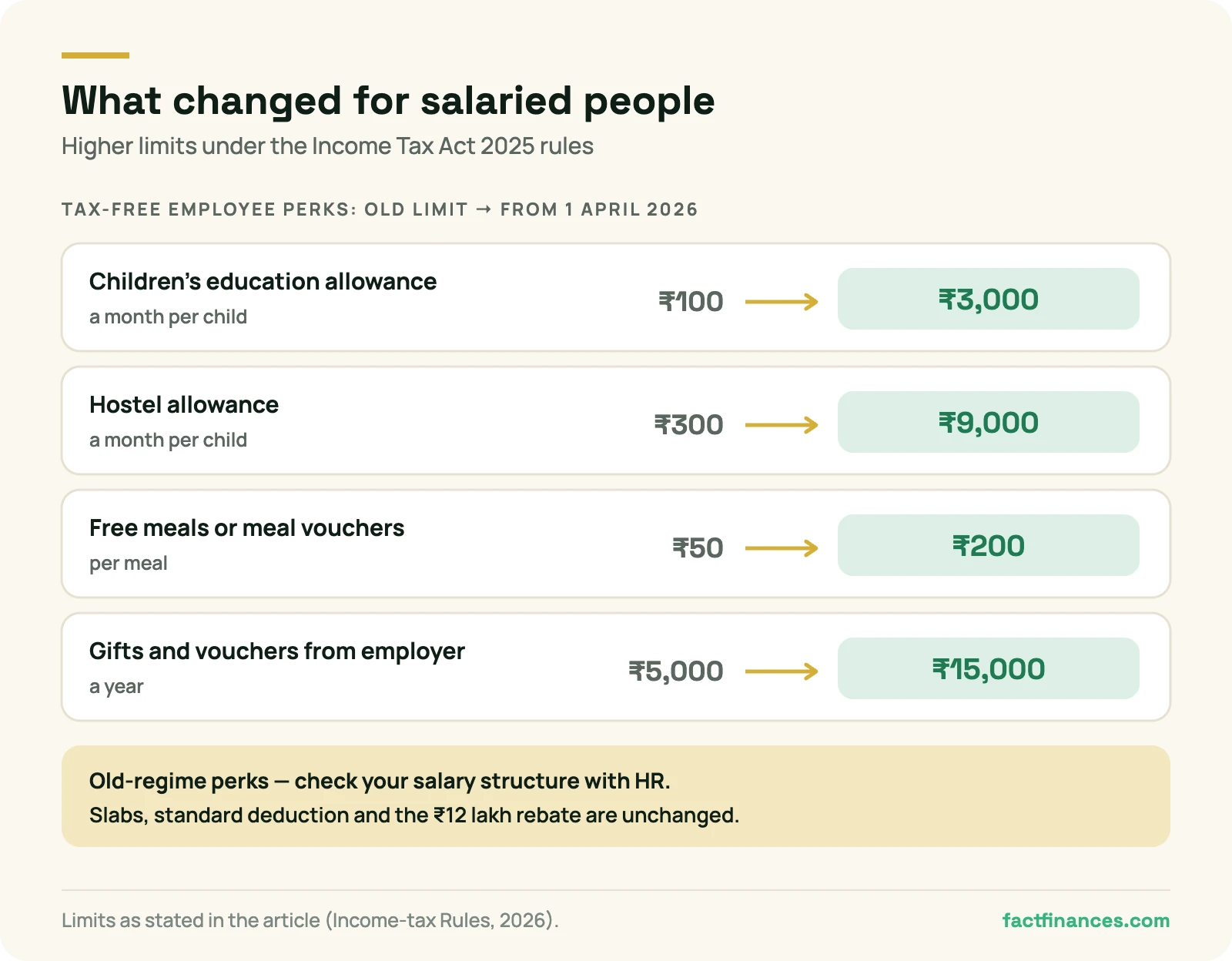
The Income-tax Rules, 2026 raised limits that had not moved in decades. These matter in the old regime, where allowances and perks are exempt within limits, and for perquisite valuation in both.
| Item | Earlier limit | From 1 April 2026 |
|---|---|---|
| Children’s education allowance | ₹100 a month per child | ₹3,000 a month per child |
| Hostel allowance | ₹300 a month per child | ₹9,000 a month per child |
| Free meals or meal vouchers | ₹50 per meal | ₹200 per meal |
| Gifts and vouchers from the employer | ₹5,000 a year | ₹15,000 a year |
Employer-provided cars are valued at higher monthly amounts, with a new method for electric vehicles. If you use a company car, your payslip will show a larger perquisite this year.
HRA in eight cities. The 50%-of-salary HRA limit, earlier only for Delhi, Mumbai, Chennai and Kolkata, now also covers Bengaluru, Hyderabad, Pune and Ahmedabad. If you rent in one of these four cities and stay in the old regime, your HRA exemption may rise. You must now also state whether your landlord is a relative.
For Investors
What changed for investors
- Share buybacks are taxed as capital gains. Earlier, the full buyback amount was taxed as dividend at your slab rate. Now you pay capital gains tax on the gain over your cost, which is usually much lower.
- Sovereign Gold Bonds: the tax-free redemption at maturity now applies only if you bought the bond at its original issue and held it to maturity. Bonds bought on the stock exchange are taxed as capital gains when redeemed.
- No interest deduction against dividends. Interest paid on money borrowed to earn dividends or mutual fund income can no longer be deducted from that income.
- Higher STT on F&O. Futures from 0.02% to 0.05%; options from 0.1% to 0.15% of premium. Delivery and intraday equity rates are unchanged.
- Lower TCS on some foreign remittances. Money sent abroad for education or medical treatment now attracts 2% TCS instead of 5%, and overseas tour packages a flat 2%.
For Your Returns
What changed about filing
- Revised returns get 12 months. You can now revise up to 31 March after the year ends, but revisions after 31 December carry a fee of ₹1,000 (income up to ₹5 lakh) or ₹5,000. This already applies to FY 2025-26 returns.
- Business without audit: 31 August. ITR-3 and ITR-4 filers who do not need an audit now have until 31 August, a month more than salaried people.
- Belated returns still close on 31 December.
What To Do Now
A short checklist
- File any pending return for FY 2025-26 by 31 December 2026, under the old Act.
- Tell your employer which regime you want for TDS this year, and submit Form 124 (the old 12BB) with your rent and investment proofs if you choose the old regime.
- If you rent in Bengaluru, Hyderabad, Pune or Ahmedabad, ask your payroll team to apply the 50% HRA limit.
- Check your payslip for meal, education and gift limits; the higher exemptions should show up in your TDS.
- If you hold SGBs bought on the exchange, plan for capital gains tax at redemption.
Common Mistakes
Misunderstandings about the Income Tax Act 2025
1. “The new Act changed my tax rates”
It did not. Rates were left untouched for FY 2026-27. Any change in your tax this year comes from your income, your regime choice, or the perquisite and HRA rules.
2. “80C has been abolished”
It has been renumbered as section 123, with the same ₹1.5 lakh limit. It is still available only in the old regime.
3. “I must file last year’s return under the new Act”
Returns for FY 2025-26 and earlier stay under the 1961 Act, with the old forms.
4. “Revised returns are free until March”
The window is longer, but revisions from 1 January cost ₹1,000 or ₹5,000.
Talk It Through
Not sure how the new rules affect your return?
Tell us about your salary, investments and any pending returns. We will explain what applies to you this year and help you file your ITR. Ranchi, Deoghar and across India online.
Chat on WhatsApp Send a message · Old vs new regime calculator
Key takeaways
→ The Income-tax Act, 2025 replaced the 1961 Act on 1 April 2026: simpler, renumbered, with a single “tax year”.
→ Tax rates, regimes and deduction limits did not change for FY 2026-27.
→ Income up to 31 March 2026 is still taxed and filed under the 1961 Act; new-Act returns start in 2027.
→ Real changes this year: higher limits for meals, gifts and children’s allowances, 50% HRA in eight cities, buybacks as capital gains, a narrower SGB exemption.
→ Form 16 is now Form 130, 12BB is Form 124, 26AS is Form 168.
Questions
Frequently asked questions
When did the Income Tax Act 2025 come into force?
On 1 April 2026. It was passed by Parliament in August 2025 and received presidential assent on 21 August 2025.
Does the Income Tax Act 2025 change tax rates?
No. The slabs, the ₹12 lakh rebate, surcharge and cess for FY 2026-27 are the same as FY 2025-26. The Act rewrote and renumbered the law.
What is a tax year?
The April-to-March year in which you earn the income. It replaces the separate “previous year” and “assessment year” of the old Act.
Which Act applies to my return for FY 2025-26?
The Income-tax Act, 1961. Returns, revisions, notices and assessments for FY 2025-26 and earlier years continue under the old law and its forms.
What is section 80C called now?
Section 123 of the Income-tax Act, 2025. The ₹1.5 lakh limit and the eligible investments are the same, and it is available only in the old regime.
What is the new name for Form 16?
Form 130. Form 16A becomes Form 131, Form 12BB becomes Form 124, and Form 26AS becomes Form 168.
Which cities get 50% HRA exemption now?
Delhi, Mumbai, Chennai, Kolkata, Bengaluru, Hyderabad, Pune and Ahmedabad, from 1 April 2026. HRA exemption is available only in the old regime.
Keep Learning
Next steps: Income tax slabs FY 2026-27 · Old vs new tax regime · Missed the ITR deadline?
The bigger picture: The complete guide to income tax in India
About the author
Ujjwal Tiwary
ARN-144500 · NISM Series V-A certified since 2018 · Ranchi & Deoghar, Jharkhand
Ujjwal Tiwary is an AMFI-registered mutual fund distributor (ARN-144500) based in Ranchi and Deoghar, Jharkhand, and has held the NISM Series V-A certification since 2018. He works with families on mutual funds, insurance and income tax returns, and writes or personally reviews every article on FactFinances. He is not a SEBI-registered investment adviser; nothing on this site is personalised advice.
Disclaimer: FactFinances provides educational content only. This article is general information and is not tax, legal or financial advice. It is based on the Income-tax Act, 1961 (which still governs returns for FY 2025-26 and earlier) and the Income-tax Act, 2025 (in force from 1 April 2026), as understood at the time of writing. Tax law, due dates and their interpretation can change, and your tax depends on your full facts; check the current position on the Income Tax Department portal or consult a chartered accountant before acting. FactFinances offers ITR filing assistance; reading this article places you under no obligation to use it.