

This article is part of our complete guide to income tax in India. It covers returns for FY 2025-26 (assessment year 2026-27), which are still filed under the Income-tax Act, 1961.
The Short Answer
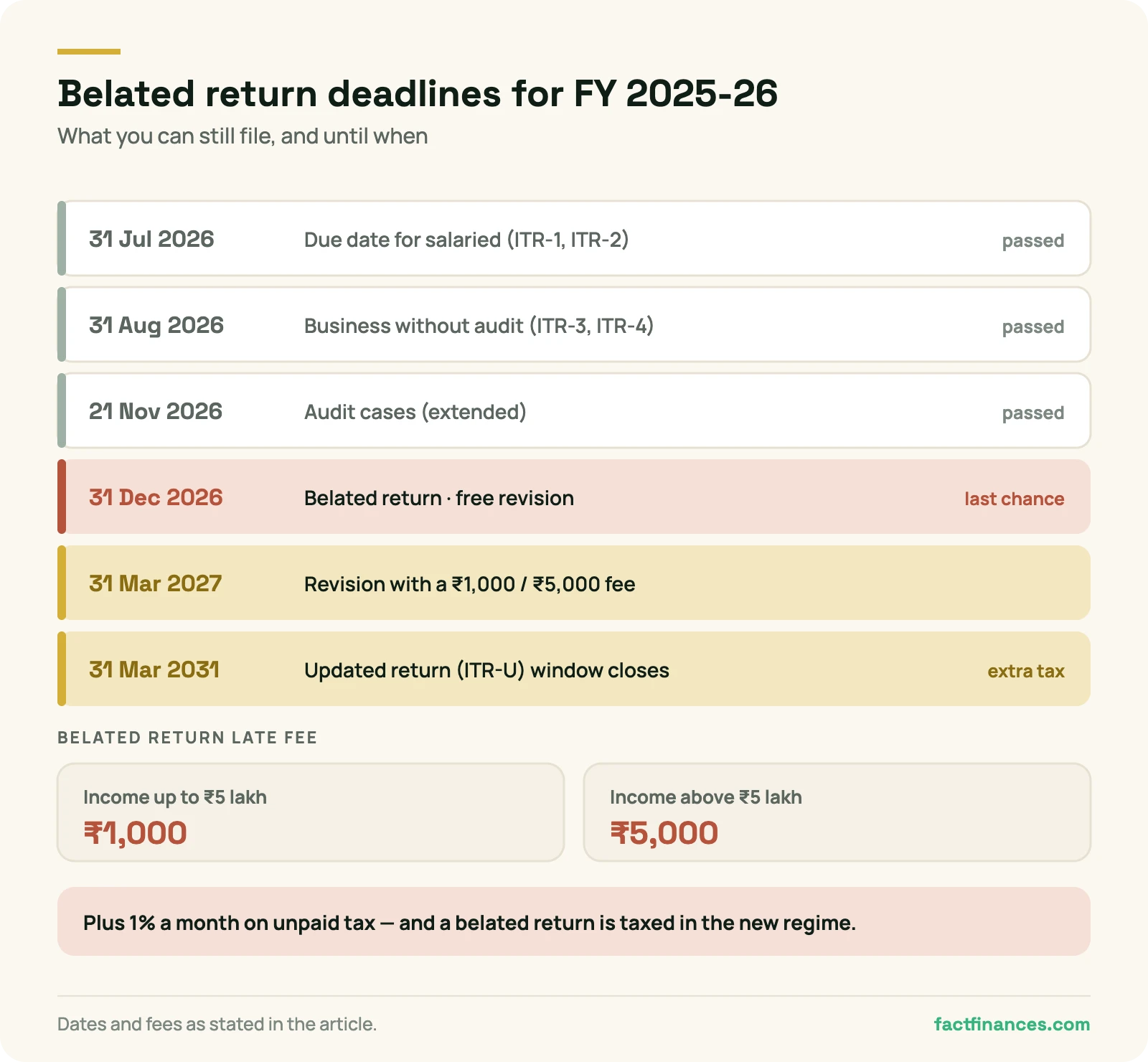
If you missed the deadline for your FY 2025-26 income tax return, you can still file a belated return until 31 December 2026. It costs a late fee of ₹1,000 if your total income is up to ₹5 lakh and ₹5,000 above that, plus 1% a month interest on any tax still unpaid.
Two other costs are easy to miss. A salaried person filing late is taxed under the new regime, even if the old one would have been cheaper. And most losses from shares, F&O or business cannot be carried forward from a late return.
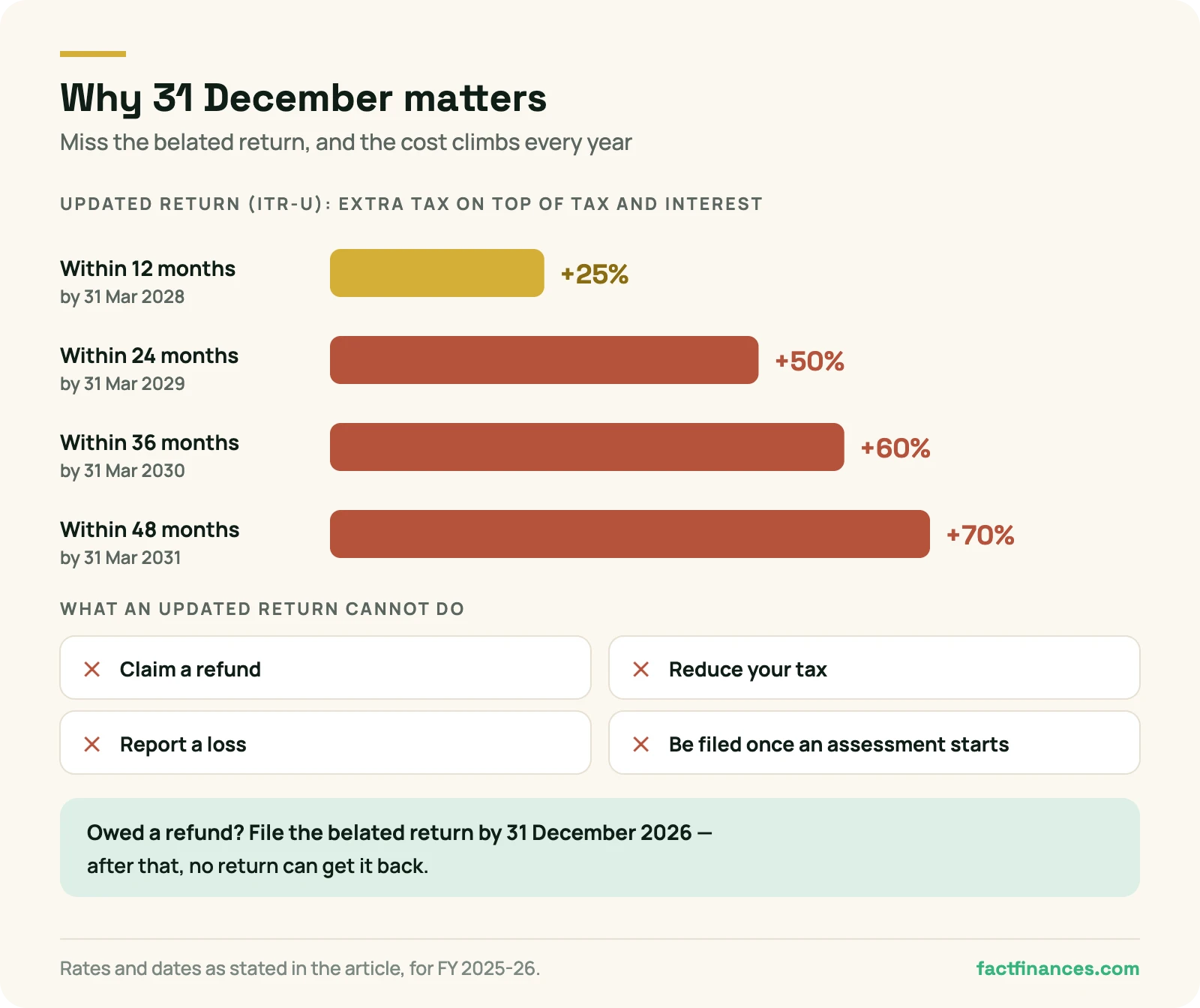
If you filed on time but made a mistake, a revised return fixes it: free until 31 December 2026, and with a fee until 31 March 2027. After 31 December, a return you never filed can only come in as an updated return (ITR-U), which means paying extra tax of 25% to 70%, and cannot get you a refund. So if you are reading this before 31 December, file now.
The Dates
The deadlines for FY 2025-26 at a glance
| What | Who | Last date |
|---|---|---|
| Original return | Salaried, pensioners, ITR-1 and ITR-2 | 31 July 2026 (passed) |
| Original return | Business or profession without audit, ITR-3 and ITR-4 | 31 August 2026 (passed) |
| Original return | Accounts that need a tax audit | 21 November 2026 (extended from 31 October) |
| Belated return, s.139(4) | Anyone who missed their date | 31 December 2026 |
| Revised return, s.139(5), no fee | Anyone who filed and needs a correction | 31 December 2026 |
| Revised return, with fee | Same | 31 March 2027 |
| Updated return (ITR-U), s.139(8A) | Anyone with extra income to disclose | 31 March 2031, with extra tax rising every year |
These dates apply to income earned from April 2025 to March 2026. For the current year (tax year 2026-27), the same rules carry over into section 263 of the Income-tax Act, 2025, so next year’s dates will follow the same pattern.
Belated Return
Filing a belated return: what it costs
A belated return is an ordinary return filed after the due date. You file it on the same portal with the same form (ITR-1, ITR-2 and so on), and choose “139(4) belated” as the filing section. Three costs come with it.
1. Late fee under section 234F
| Total income | Late fee |
|---|---|
| Up to ₹5 lakh | ₹1,000 |
| Above ₹5 lakh | ₹5,000 |
| Below the basic exemption limit, and not otherwise required to file | Nil |
The fee is paid before filing, through the portal’s e-Pay Tax option as self-assessment tax, and shown in the return. The return cannot be submitted until it is paid.
2. Interest under section 234A
If any tax is still due after TDS and advance tax, you pay 1% a month on it from the day after your due date (1 August for most salaried people) until the day you file. A part month counts as a full month. If your TDS covers your tax, there is no 234A interest at all. Interest under 234B and 234C for missing advance tax applies whether you file late or not.
3. Smaller refund interest
If you are owed a refund, you still get it. But interest on the refund runs only from the date you file, not from 1 April as it does for a return filed on time.
The Hidden Costs
What you lose by filing late
You are taxed under the new regime. If you have no business income, the old regime can be chosen only in a return filed by the due date. A belated return is processed under the new regime. For someone with a large HRA exemption and a home loan, that can cost more than the late fee. Check the difference with our regime calculator; if the new regime is cheaper for you anyway, you have lost nothing here.
- Loss carry-forward. Capital losses (including on shares and mutual funds), business losses and F&O or speculative losses from FY 2025-26 cannot be carried forward to set off against future gains. A house property loss is the one exception.
- Some deductions. A few profit-linked deductions for businesses are allowed only in a return filed on time.
- Business taxpayers and the regime. If you have business income and wanted the old regime, the opt-out form also had to be filed by the due date.
None of this stops you from filing. It is simply why filing on time matters next year.
Revised Return
Filed on time but made a mistake? Revise it
A revised return replaces your earlier return completely. Use it to add interest income you forgot, correct a deduction, report capital gains you missed, fix bank details, or change regimes.
- Free until 31 December 2026. From 1 January to 31 March 2027 you can still revise, but a fee under the new section 234I applies: ₹1,000 if total income is up to ₹5 lakh, ₹5,000 above.
- You can revise more than once. Each revision replaces the last.
- A belated return can also be revised, within the same window.
- Switching regimes in a revision is allowed only if your original return was filed by the due date.
- Processed returns can still be revised within the time limit, as long as no assessment is pending.
If the Income Tax Department has already sent you an intimation or a notice about a mismatch, revising quickly is usually the cleanest answer. Compare your return with the Annual Information Statement (AIS) first so you correct everything in one go.
Updated Return
After 31 December: the updated return (ITR-U)
If 31 December passes and you still have not filed, or you later discover income you left out, the updated return is the only door left. It is meant for paying more tax, not less.
| Filed within (from the end of the assessment year) | Extra tax on top of tax and interest | For FY 2025-26, by |
|---|---|---|
| 12 months | 25% | 31 March 2028 |
| 24 months | 50% | 31 March 2029 |
| 36 months | 60% | 31 March 2030 |
| 48 months | 70% | 31 March 2031 |
The extra tax is a percentage of the additional tax and interest you owe, not of your income. You cannot file an ITR-U to claim a refund, to reduce your tax, or to report a loss, and you cannot file one once a search, survey or assessment has begun for that year.
If you are owed a refund and miss 31 December an updated return will not help. The only route left is an application to the tax department to condone the delay, which is slow and not guaranteed. That is the strongest reason to file a belated return now, even if you think you owe nothing.
Should You Still File?
Do you even need to file?
You must file if your income before deductions is above the basic exemption limit (₹4 lakh in the new regime for FY 2025-26; ₹2.5 lakh to ₹5 lakh in the old regime depending on age). Even below that, you must file if, during the year, you:
- deposited ₹1 crore or more in current accounts, or ₹50 lakh or more in savings accounts;
- spent more than ₹2 lakh on foreign travel, or more than ₹1 lakh on electricity;
- had TDS or TCS of ₹25,000 or more (₹50,000 for senior citizens);
- had business turnover above ₹60 lakh or professional receipts above ₹10 lakh;
- held foreign assets or signing authority in a foreign account.
And even when you do not have to, filing is worth it if TDS was deducted on your FD interest or salary and you are due a refund, if you need a return for a loan or visa, or if you want to carry forward a loss in future years.
Step by Step
How to file a belated return before 31 December
- Download your AIS and Form 26AS from the e-filing portal and your Form 16 from your employer. Check every interest, dividend and sale entry.
- Work out your tax. If anything is due after TDS, pay it as self-assessment tax along with the late fee (and 234A interest, which the utility calculates).
- Log in to incometax.gov.in, choose File Income Tax Return, assessment year 2026-27, and select 139(4) belated.
- Pick the right form. Salary, pension and interest with total income up to ₹50 lakh usually means ITR-1; capital gains usually mean ITR-2; business or professional income means ITR-3 or ITR-4. The portal will stop you if the form does not fit. See which ITR form to file.
- Enter the challan details, submit, and e-verify within 30 days (Aadhaar OTP is quickest). An unverified return is treated as not filed.
Common Mistakes
Mistakes people make when filing late
1. Waiting because “no tax is due”
If TDS covers your tax, a belated return costs only the fee, but missing 31 December can cost you a refund you can no longer claim through a return.
2. Claiming the old regime in a belated return
The return will be processed under the new regime anyway, and the demand that follows will include interest. Compute your tax under the new regime from the start.
3. Ignoring income in the AIS
Savings interest, FD interest, dividends and mutual fund redemptions all show up in the AIS. Leaving them out is the most common reason for a notice.
4. Forgetting to e-verify
Filing is only half the job. A return not verified within 30 days is treated as never filed, which puts you back where you started, with the deadline possibly gone.
5. Revising after 31 December without checking the fee
A revision in January to March 2027 now costs ₹1,000 or ₹5,000. Check your return against the AIS before 31 December so one revision is enough.
Talk It Through
Missed the deadline, or not sure your return is right?
Tell us what you earned in FY 2025-26 and whether you have filed. We will check your AIS and Form 26AS, work out what you owe or are owed, and help you file your belated or revised return before 31 December. If the deadline has passed, we will tell you whether an updated return makes sense. Ranchi, Deoghar and across India online.
Chat on WhatsApp Send a message · Old vs new regime calculator
Key takeaways
→ For FY 2025-26, a belated return can be filed until 31 December 2026, with a late fee of ₹1,000 (income up to ₹5 lakh) or ₹5,000, plus 1% a month on unpaid tax.
→ Filing late puts salaried people in the new regime and stops most losses from being carried forward.
→ A revised return is free until 31 December 2026 and costs ₹1,000 or ₹5,000 from January to 31 March 2027.
→ After 31 December, only an updated return (ITR-U) is possible, with 25% to 70% extra tax and no refunds.
→ E-verify within 30 days, or the return counts as not filed.
Questions
Frequently asked questions
What is the last date to file a belated return for FY 2025-26?
31 December 2026. It applies to everyone who missed their due date, including salaried people (due date 31 July 2026), non-audit businesses (31 August) and audit cases (21 November).
What is the penalty for filing ITR after the due date?
A late fee under section 234F of ₹1,000 if total income is up to ₹5 lakh and ₹5,000 above that, plus interest at 1% a month under section 234A on any tax that remains unpaid. There is no fee if your income is below the basic exemption limit and you were not otherwise required to file.
Can I choose the old tax regime in a belated return?
Not if you have no business income. The old regime is available only in a return filed by the due date, so a belated return is taxed under the new regime.
Will I still get my refund if I file late?
Yes, as long as you file by 31 December 2026. Interest on the refund runs from the date of filing instead of from 1 April. After 31 December, an updated return cannot be used to claim a refund.
What happens if I do not file my ITR at all?
If tax was due, the department can issue a notice to file, assess your income on the basis of AIS data, charge interest, and levy penalties. You also lose refunds and loss carry-forward, and you will not have a return to show for loans or visas.
What is the last date to revise my ITR for FY 2025-26?
You can revise free of fee until 31 December 2026. From 1 January to 31 March 2027 you can still revise, but with a fee of ₹1,000 or ₹5,000.
Can I file an ITR-U if I never filed a return?
Yes, if it results in additional tax. You pay the tax, interest and an extra 25% to 70% depending on how late you are. It cannot be used to claim a refund or report a loss.
Keep Learning
Next steps: Old vs new tax regime calculator · Old vs new tax regime: which to choose · How mutual funds are taxed
The bigger picture: The complete guide to income tax in India
About the author
Ujjwal Tiwary
ARN-144500 · NISM Series V-A certified since 2018 · Ranchi & Deoghar, Jharkhand
Ujjwal Tiwary is an AMFI-registered mutual fund distributor (ARN-144500) based in Ranchi and Deoghar, Jharkhand, and has held the NISM Series V-A certification since 2018. He works with families on mutual funds, insurance and income tax returns, and writes or personally reviews every article on FactFinances. He is not a SEBI-registered investment adviser; nothing on this site is personalised advice.
Disclaimer: FactFinances provides educational content only. This article is general information and is not tax, legal or financial advice. It is based on the Income-tax Act, 1961 (which still governs returns for FY 2025-26 and earlier) and the Income-tax Act, 2025 (in force from 1 April 2026), as understood at the time of writing. Tax law, due dates and their interpretation can change, and your tax depends on your full facts; check the current position on the Income Tax Department portal or consult a chartered accountant before acting. FactFinances offers ITR filing assistance; reading this article places you under no obligation to use it.