

This article is part of our complete guide to income tax in India.
The Short Answer
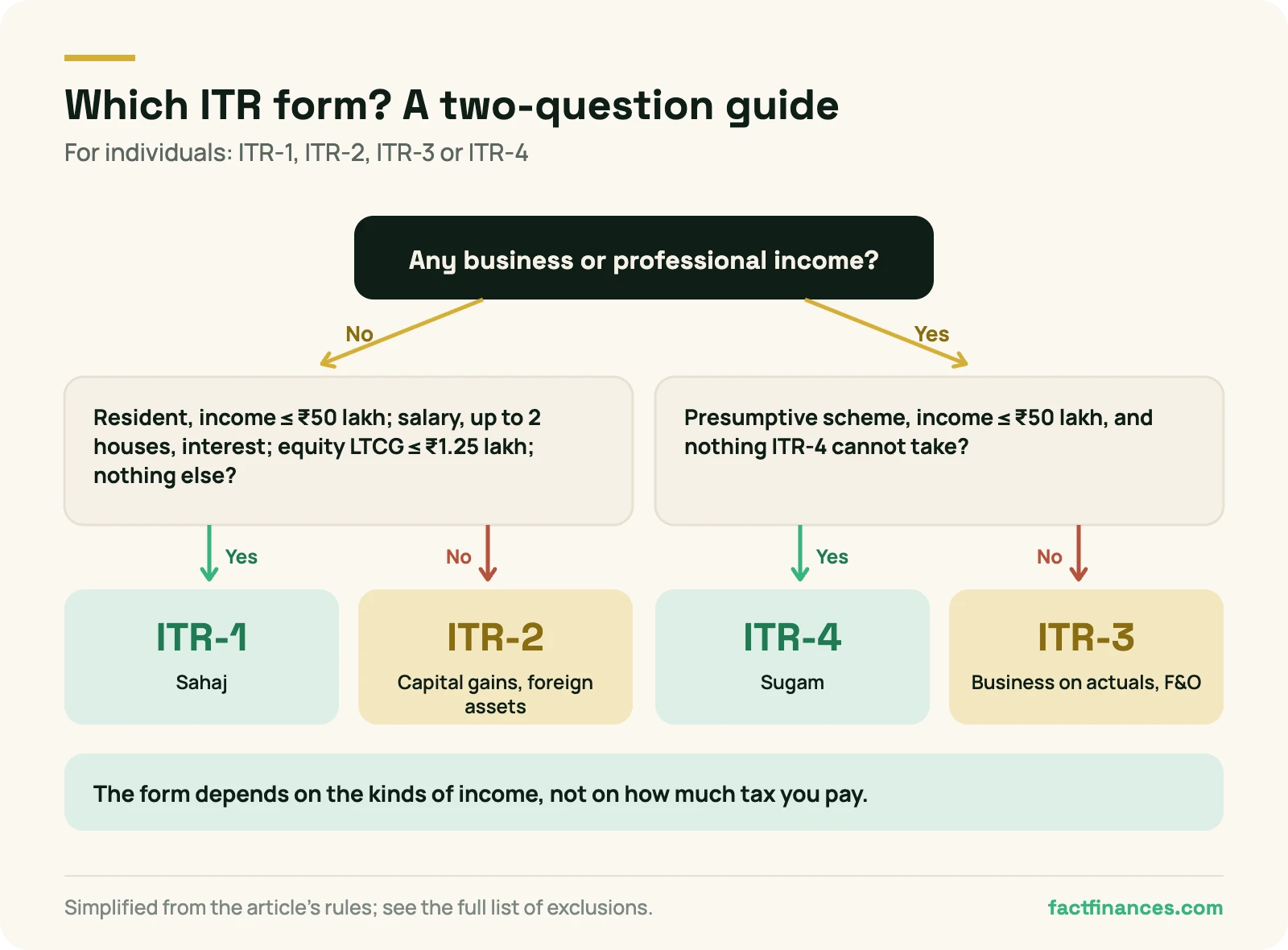
Which ITR form you file depends on the kinds of income you had, not how much tax you pay. For most individuals it comes down to four forms:
- ITR-1 (Sahaj): salary or pension, up to two house properties, interest and dividends, and long-term equity gains up to ₹1.25 lakh. Total income up to ₹50 lakh, residents only.
- ITR-2: everything ITR-1 covers plus any other capital gains, income above ₹50 lakh, foreign assets, more than two houses, or being a company director. No business income.
- ITR-3: business or professional income on actual figures, including F&O and intraday trading.
- ITR-4 (Sugam): business or professional income under the presumptive scheme, total income up to ₹50 lakh.
If you are filing a belated or revised return for FY 2025-26 before 31 December 2026, these are the forms. Returns for FY 2026-27, the first under the Income-tax Act, 2025, will use new forms expected early in 2027; this guide will be updated when they are notified.
Quick Guide
Which ITR form for your income
| Your income in the year | Form |
|---|---|
| Salary or pension, savings and FD interest, total up to ₹50 lakh | ITR-1 |
| Same, plus rent from one or two houses | ITR-1 |
| Same, plus long-term gains on shares or equity funds up to ₹1.25 lakh | ITR-1 |
| Any short-term capital gain, or long-term gain above ₹1.25 lakh | ITR-2 |
| Sale of property, gold, debt funds or unlisted shares | ITR-2 |
| Crypto (virtual digital assets) held as investment | ITR-2 |
| Total income above ₹50 lakh, with no business income | ITR-2 |
| Foreign shares, ESOPs of a foreign employer, foreign bank account | ITR-2 |
| Company director, or holding unlisted shares at any time in the year | ITR-2 |
| Non-resident or not ordinarily resident | ITR-2 |
| Freelancer or professional under the presumptive scheme | ITR-4 |
| Small business under the presumptive scheme | ITR-4 |
| F&O or intraday trading, even alongside salary | ITR-3 |
| Business or profession with books of accounts | ITR-3 |
| Partner in a firm (share of profit, salary or interest from the firm) | ITR-3 |
If more than one row applies, use the more detailed form. ITR-2 covers everything ITR-1 does, and ITR-3 covers everything. Presumptive income plus anything ITR-4 cannot take, such as short-term gains, means ITR-3.
ITR-1
ITR-1 (Sahaj): for most salaried people and pensioners
ITR-1 is the simplest form, and most of it comes pre-filled from your Form 130 (old Form 16), Form 168 (old 26AS) and AIS.
You can use it if
- You are a resident individual with total income up to ₹50 lakh.
- Your income is from salary or pension, up to two house properties, and other sources such as interest, dividends and family pension.
- Your only capital gain is long-term gain on listed shares or equity funds up to ₹1.25 lakh.
- Agricultural income, if any, is ₹5,000 or less.
You cannot use it if
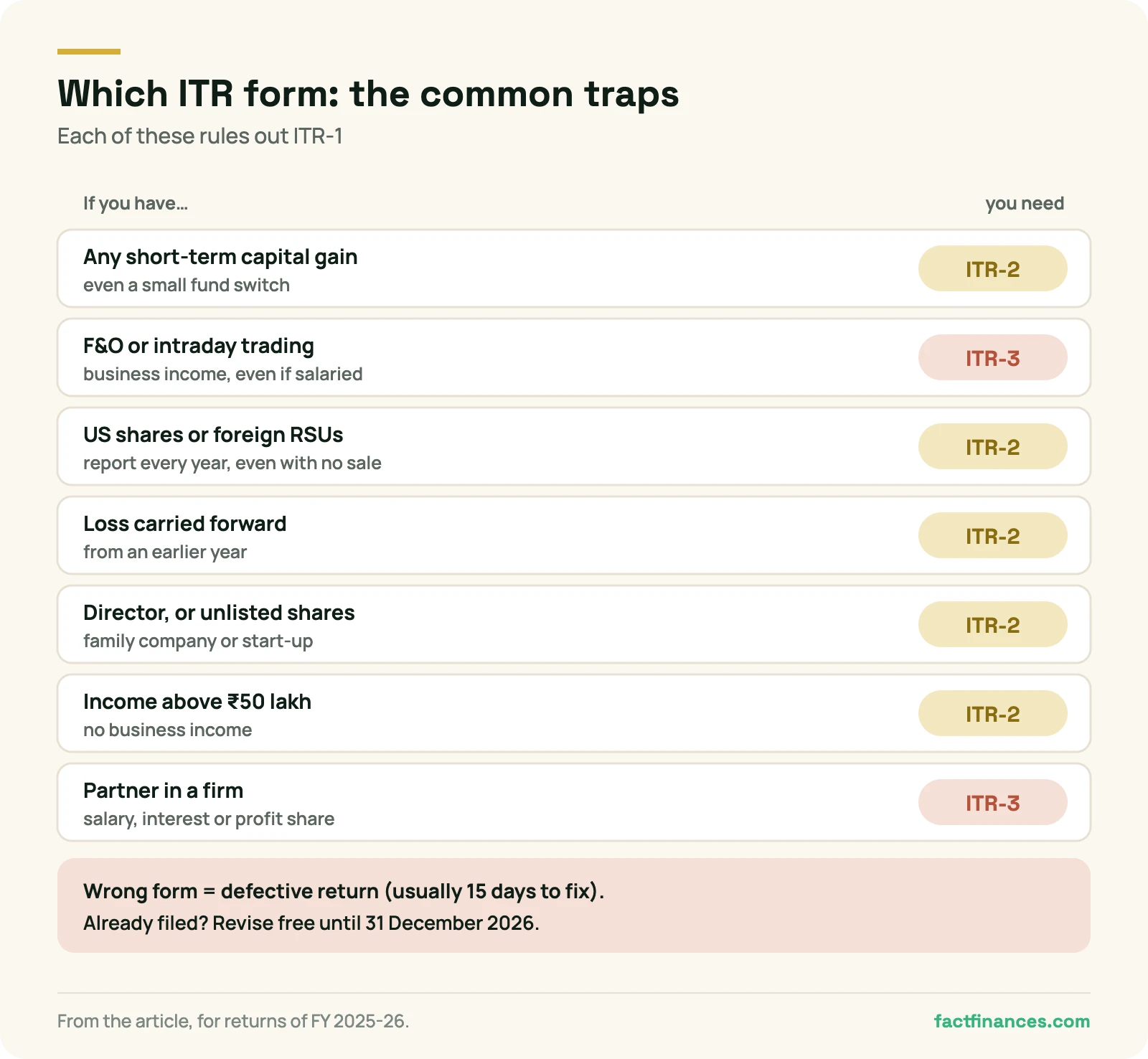
- You have any short-term capital gain, or any other kind of capital gain.
- You are a company director, or held unlisted equity shares at any time in the year.
- You have assets or income outside India, including foreign shares and ESOPs.
- You have losses to carry forward or set off from earlier years.
- You have lottery or betting winnings, or tax on ESOPs from a start-up has been deferred.
A change in this year’s forms helps many families: owning two houses (one self-occupied and one let out, say) no longer pushes you to ITR-2.
ITR-2
ITR-2: capital gains, high income and foreign assets
ITR-2 is for individuals and HUFs with no business or professional income who cannot use ITR-1. The most common reason is capital gains: selling shares or funds held under a year, redeeming debt funds, or selling a house or gold.
It asks for more detail: each sale with dates and cost, a schedule of foreign assets if you have any, and a list of your assets and liabilities if your income is above ₹50 lakh. Your broker’s and CAMS/KFintech’s capital gains statements give most of what the capital gains schedule needs. See capital gains tax on every asset.
Foreign assets are a common miss. US shares bought through an app, RSUs from a foreign parent company or an old bank account abroad all have to be reported in ITR-2 every year, even with no income from them. Leaving them out can attract a penalty under the black money law. See investing in US stocks from India.
ITR-3 and ITR-4
ITR-3 and ITR-4: business and professional income
ITR-4 (Sugam): the presumptive scheme
Small businesses and professionals can declare income as a fixed share of receipts instead of keeping full accounts (44AD and 44ADA under the old Act):
| Who | Receipts limit | Income declared |
|---|---|---|
| Business | ₹2 crore, or ₹3 crore if cash receipts are within 5% | At least 8% of turnover (6% of digital receipts) |
| Professionals: doctors, lawyers, architects, consultants, designers and similar | ₹50 lakh, or ₹75 lakh if cash receipts are within 5% | At least 50% of receipts |
ITR-4 is for residents with total income up to ₹50 lakh. It can also take salary, up to two house properties and long-term equity gains up to ₹1.25 lakh, but not other capital gains, foreign assets, directorships or unlisted shares; those push you to ITR-3. If you declare income under the presumptive scheme, the whole of your advance tax is due by 15 March. See advance tax.
ITR-3: everything else with business income
ITR-3 is for business or professional income on actual profits, with a profit and loss account and balance sheet. Two groups often do not realise it applies to them:
- Traders. F&O and intraday trading are business income, not capital gains. A salaried person who trades even a little F&O files ITR-3, not ITR-2. See how equity income is taxed.
- Partners in a firm. Salary, interest or profit share from a partnership firm needs ITR-3.
A tax audit may be needed if turnover is high, or if you declare less than the presumptive rate. That is a separate question to check before filing.
Other Forms
The other forms
ITR-5 is for partnership firms, LLPs and associations of persons; ITR-6 for companies; ITR-7 for trusts, political parties and institutions. Individuals and HUFs use only ITR-1 to ITR-4.
Wrong Form
What happens if you choose the wrong form
The portal blocks some wrong choices: it will not let you enter capital gains in ITR-1, for example. Others get through and lead to a notice treating the return as defective, usually with 15 days to refile in the correct form. If you do not respond, the return is treated as never filed.
If you realise the form was wrong, file a revised return in the right form. For FY 2025-26 that is free until 31 December 2026 and costs ₹1,000 or ₹5,000 until 31 March 2027. See belated, revised and updated returns.
Common Mistakes
Mistakes people make choosing an ITR form
1. Filing ITR-1 with short-term gains
Even a small short-term gain from a fund switch needs ITR-2.
2. Filing ITR-2 with F&O trading
F&O is business income. ITR-2 has no place for it, so the return is defective.
3. Ignoring foreign RSUs and US shares
They need ITR-2 or ITR-3 and the foreign assets schedule, even with no sale.
4. Using ITR-1 with a carried-forward loss
Losses from earlier years need ITR-2 or ITR-3 to be set off or carried forward.
5. Forgetting unlisted shares and directorships
Shares in a family company or a start-up, or being a director of one, rule out ITR-1 and ITR-4.
Talk It Through
Not sure which form fits your income?
Tell us what you earned this year: salary, rent, interest, investments, business or trading. We will tell you which ITR form applies, check your AIS, and help you file your ITR. Ranchi, Deoghar and across India online.
Key takeaways
→ ITR-1: salary, up to two houses, interest, and equity gains up to ₹1.25 lakh, for residents with income up to ₹50 lakh.
→ ITR-2: any other capital gains, income above ₹50 lakh, foreign assets, directorships or unlisted shares; no business income.
→ ITR-3: business or professional income on actual figures, including F&O and intraday trading.
→ ITR-4: presumptive business or professional income, with total income up to ₹50 lakh.
→ Choosing the wrong form makes the return defective; fix it with a revised return in the right form.
Questions
Frequently asked questions
Which ITR form should a salaried person file?
ITR-1 if income is up to ₹50 lakh and comes from salary, up to two house properties, interest, and long-term equity gains up to ₹1.25 lakh. ITR-2 if there are other capital gains, foreign assets or income above ₹50 lakh. ITR-3 if there is any F&O or intraday trading.
Can I file ITR-1 if I sold mutual funds?
Only if the gain is long-term on equity funds or listed shares, within ₹1.25 lakh in total, and you have no losses to carry forward. Any short-term gain, or any gain on debt funds, needs ITR-2.
Which ITR form for F&O trading?
ITR-3, because F&O is business income. This applies even if you are salaried and the trading was small or loss-making.
Which ITR form for freelancers?
ITR-4 if you use the presumptive scheme for professionals and your total income is up to ₹50 lakh; otherwise ITR-3.
Which ITR form for an NRI?
ITR-2 for income such as rent, interest and capital gains in India; ITR-3 if there is business income in India. NRIs cannot use ITR-1 or ITR-4.
What if I filed the wrong ITR form?
File a revised return in the correct form. For FY 2025-26 this is free until 31 December 2026 and possible with a fee until 31 March 2027. If you receive a defective return notice, respond within the time it gives, usually 15 days.
Keep Learning
Next steps: Belated, revised and updated returns · Capital gains tax on every asset · Tax on salary and Form 130
The bigger picture: The complete guide to income tax in India · Income tax slabs FY 2026-27
About the author
Ujjwal Tiwary
ARN-144500 · NISM Series V-A certified since 2018 · Ranchi & Deoghar, Jharkhand
Ujjwal Tiwary is an AMFI-registered mutual fund distributor (ARN-144500) based in Ranchi and Deoghar, Jharkhand, and has held the NISM Series V-A certification since 2018. He works with families on mutual funds, insurance and income tax returns, and writes or personally reviews every article on FactFinances. He is not a SEBI-registered investment adviser; nothing on this site is personalised advice.
Disclaimer: FactFinances provides educational content only. This article is general information and is not tax, legal or financial advice. It is based on the Income-tax Act, 1961 (which still governs returns for FY 2025-26 and earlier) and the Income-tax Act, 2025 (in force from 1 April 2026), as understood at the time of writing. Tax law, due dates and their interpretation can change, and your tax depends on your full facts; check the current position on the Income Tax Department portal or consult a chartered accountant before acting. FactFinances offers ITR filing assistance; reading this article places you under no obligation to use it.