

This article is part of our complete guide to income tax in India. To see what you owe by each date, use the advance tax calculator.
The Short Answer
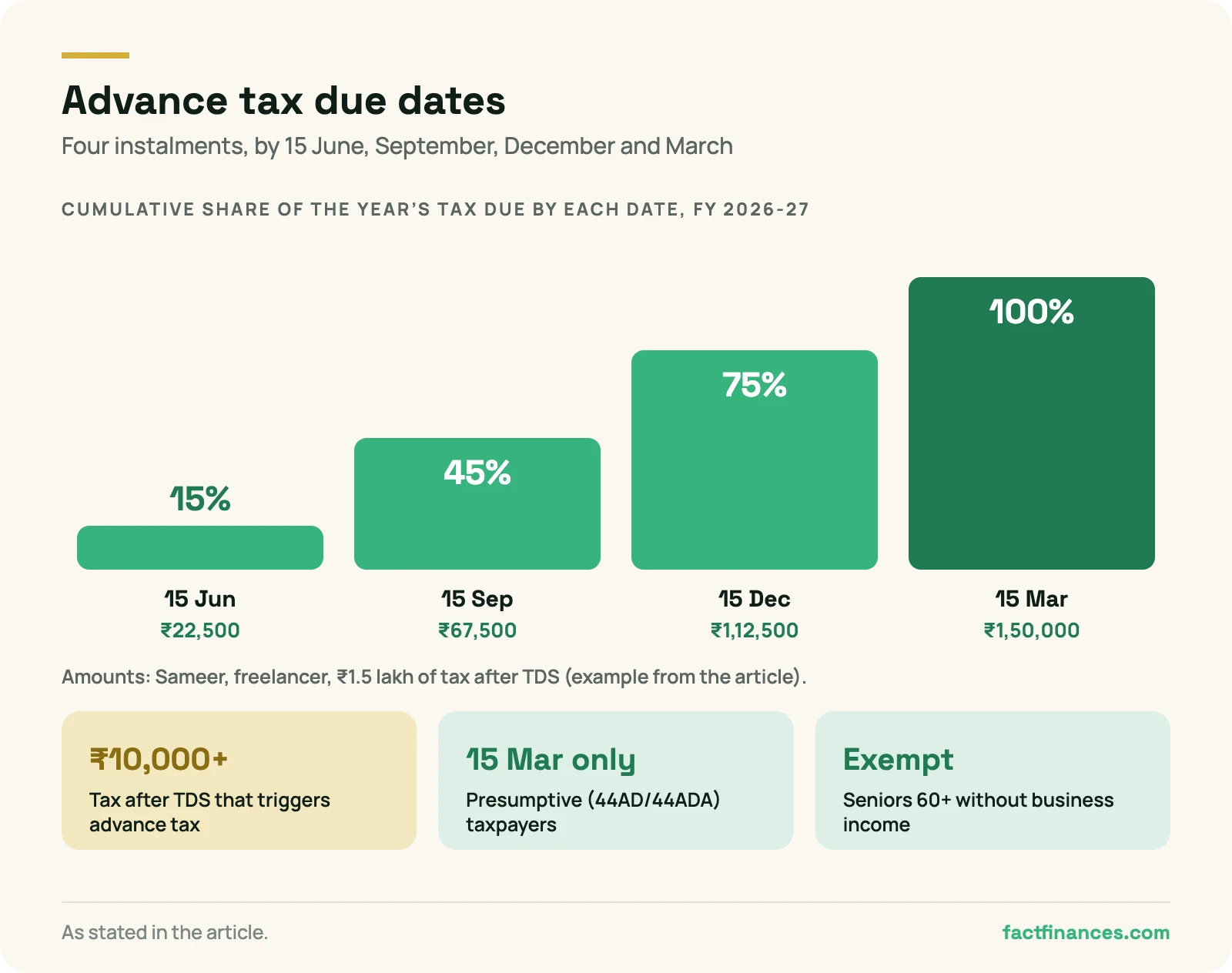
Advance tax means paying your income tax during the year instead of in one lump when you file. You must pay it if your tax for the year, after TDS and TCS, will be ₹10,000 or more. It is due in four instalments: 15% by 15 June, 45% by 15 September, 75% by 15 December and 100% by 15 March.
Most salaried people never need to think about it, because their employer’s TDS covers their tax. It catches freelancers and business owners, landlords, investors with large interest or capital gains, and salaried people with sizeable income on the side.
Miss an instalment and you pay simple interest of 1% a month on the shortfall, usually for three months. Pay less than 90% by 31 March and another 1% a month runs until you pay. The next date is 15 December 2026, by which 75% of the year’s tax should be paid.
Who Pays
Who has to pay advance tax
- Freelancers, consultants and business owners, whose income has no TDS or only partial TDS.
- Investors with capital gains, dividends or interest above what TDS covers. TDS on FD interest is 10%; if you are in the 20% or 30% slab, the rest is your liability.
- Landlords with rent where the tenant does not deduct TDS.
- Salaried people with other income: rent, interest, gains or a side business on top of salary.
Who is exempt: resident senior citizens (60 and above) with no income from business or profession need not pay advance tax at all; they pay any balance as self-assessment tax before filing. And anyone whose tax after TDS is under ₹10,000 is outside the rules.
The Dates
Advance tax due dates for FY 2026-27
| Due by | Cumulative amount due | If the shortfall is not paid |
|---|---|---|
| 15 June 2026 | 15% of the year’s tax | 1% a month for 3 months (none if you paid at least 12%) |
| 15 September 2026 | 45% | 1% a month for 3 months (none if you paid at least 36%) |
| 15 December 2026 | 75% | 1% a month for 3 months |
| 15 March 2027 | 100% | 1% for one month |
If you use the presumptive scheme for business or profession (44AD or 44ADA under the old Act), you pay the whole amount in a single instalment by 15 March.
How Much
Working out how much to pay
- Estimate your income for the whole year from every source: salary, business, rent, interest, dividends, capital gains so far.
- Work out the tax on it in the regime you will use, including surcharge and 4% cess. Our regime calculator helps.
- Subtract the TDS and TCS you expect for the year.
- If the balance is ₹10,000 or more, pay the instalment share by each date.
Example
Sameer is a freelance designer. He expects ₹2.5 lakh of tax for the year, and clients will deduct about ₹1 lakh as TDS. His advance tax is ₹1.5 lakh: ₹22,500 by 15 June, a total of ₹67,500 by 15 September, ₹1,12,500 by 15 December and ₹1,50,000 by 15 March.
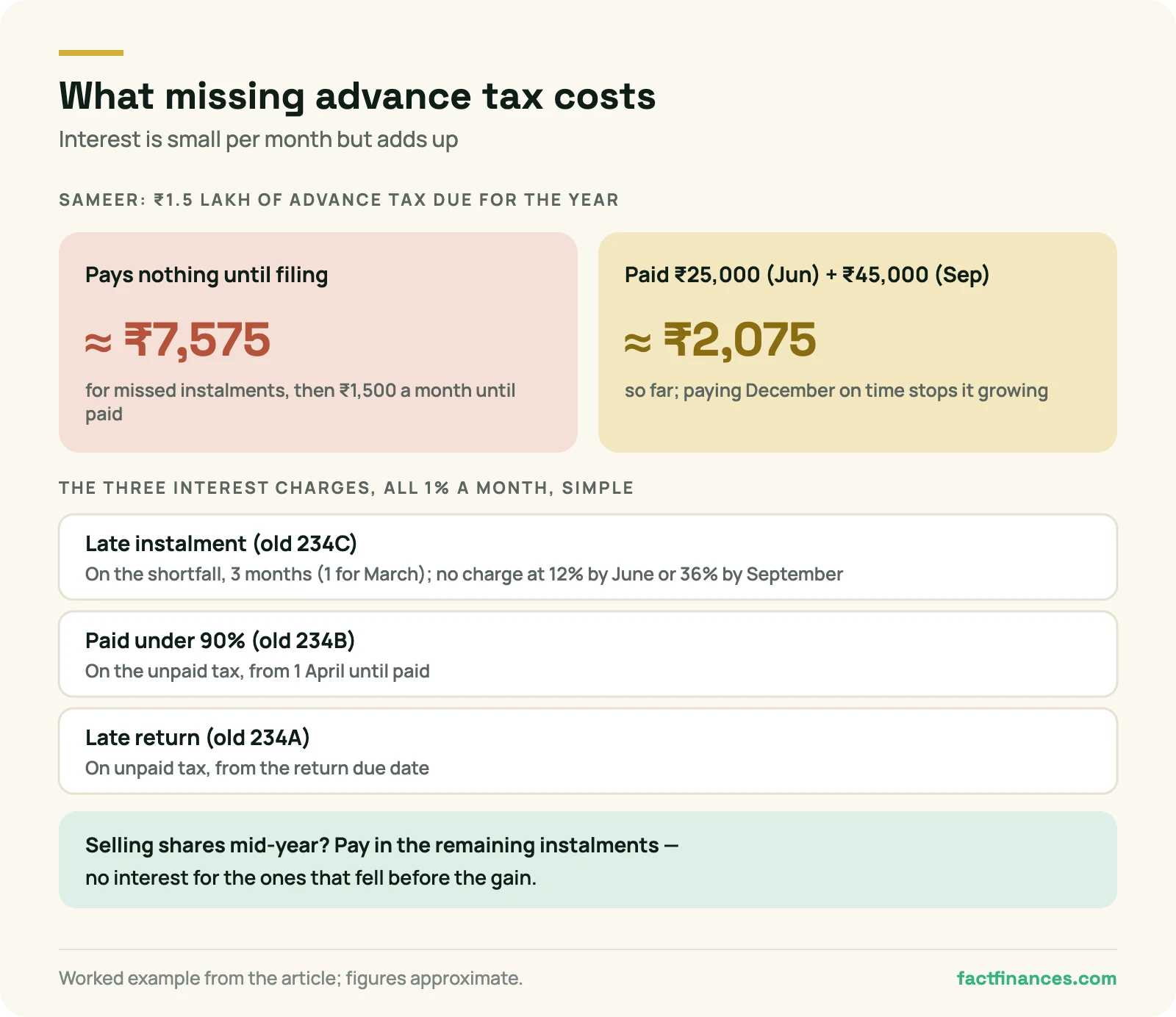
If he pays nothing until he files, the interest for missed instalments comes to about ₹7,575, and then ₹1,500 a month on top until he pays. If he paid ₹25,000 in June and ₹45,000 in September but nothing since, the interest is about ₹2,075 so far, and paying the December instalment on time stops it growing.
Estimates can be revised at each instalment. If your income rises in the year, pay more in the next instalment; if it falls, pay less.
Interest
Interest if you pay late or too little
Two kinds of interest apply, both simple interest at 1% a month and both calculated automatically when you file.
- For late instalments (old section 234C): on the shortfall at each due date, for three months (one month for March). There is a margin: no interest for June if you paid 12%, or for September if you paid 36%.
- For paying too little in the year (old section 234B): if advance tax and TDS together cover less than 90% of your tax, 1% a month on the unpaid tax from 1 April until you pay.
- For filing late (old section 234A): another 1% a month on unpaid tax from the due date of the return.
Gains you could not plan for. If you sell shares or property, or receive a large dividend, after an instalment date, you are not charged interest for the earlier instalments on that income. You only need to pay the tax on it in the instalments still remaining. The same applies to lottery winnings and business income that arises for the first time during the year.
Selling something this year? Our capital gains tax calculator works out the tax to add to your next instalment.
How To Pay
How to pay advance tax
- Log in to the income tax e-filing portal (or use it without login with your PAN and mobile number).
- Choose e-Pay Tax, the correct year, and the payment type Advance tax.
- Pay through net banking, debit card, UPI or at a bank counter.
- Save the challan. Its details (BSR code, date, serial number) go into your return, and the payment appears in Form 168 (the old 26AS) within a few days.
Choosing the wrong year or “self-assessment tax” instead of “advance tax” is a common slip. If it happens, the portal has a correction request for challans.
Common Mistakes
Mistakes people make with advance tax
1. Assuming TDS covers everything
TDS on interest, rent and professional fees is a flat rate. If your slab is higher, the difference is advance tax.
2. Forgetting capital gains
A large sale of shares or property in the year usually means advance tax in the next instalment.
3. Paying everything in March
Unless you are in the presumptive scheme, a single March payment still attracts interest for June, September and December.
4. Wrong challan type or year
Use “advance tax” and the current year; a wrong choice delays your credit.
5. Thinking seniors with pension and FDs must pay
Residents aged 60 or more with no business income are exempt from advance tax.
Talk It Through
Freelancer, landlord or investor with tax beyond TDS?
Tell us your expected income for the year. We will estimate your tax, set out what to pay by each date, and help you file your ITR with the challans correctly claimed. Ranchi, Deoghar and across India online.
Key takeaways
→ Pay advance tax if your tax after TDS will be ₹10,000 or more for the year.
→ Due by 15 June (15%), 15 September (45%), 15 December (75%) and 15 March (100%); presumptive taxpayers pay it all by 15 March.
→ Missed instalments cost 1% a month on the shortfall; less than 90% by 31 March costs 1% a month until paid.
→ Senior citizens without business income are exempt.
→ Capital gains and dividends that come mid-year can be covered in the remaining instalments without interest.
Questions
Frequently asked questions
Who has to pay advance tax?
Anyone whose tax for the year, after TDS and TCS, is ₹10,000 or more, except resident senior citizens with no income from business or profession.
What are the advance tax due dates for FY 2026-27?
15 June 2026 (15%), 15 September 2026 (45%), 15 December 2026 (75%) and 15 March 2027 (100%). Presumptive business and professional taxpayers pay 100% by 15 March 2027.
Do salaried people need to pay advance tax?
Usually not, because TDS covers their salary. They do if they have other income, such as rent, interest, capital gains or freelance earnings, that leaves ₹10,000 or more of tax uncovered.
What is the interest for not paying advance tax?
1% a month on the shortfall at each instalment, usually for three months, plus 1% a month from April until paid if less than 90% of the tax was paid by 31 March.
Do I need to pay advance tax on capital gains?
Yes, if it takes your tax after TDS to ₹10,000 or more. You pay it in the instalments that fall after the sale, and no interest is charged for the earlier ones.
I missed the September instalment. What now?
Pay the shortfall as soon as you can. Interest for September runs for three months on the shortfall regardless, but paying now keeps the December instalment on track and avoids further interest.
Keep Learning
Next steps: Advance tax calculator · Capital gains tax · Tax on FD interest
The bigger picture: The complete guide to income tax in India · Income tax slabs FY 2026-27
About the author
Ujjwal Tiwary
ARN-144500 · NISM Series V-A certified since 2018 · Ranchi & Deoghar, Jharkhand
Ujjwal Tiwary is an AMFI-registered mutual fund distributor (ARN-144500) based in Ranchi and Deoghar, Jharkhand, and has held the NISM Series V-A certification since 2018. He works with families on mutual funds, insurance and income tax returns, and writes or personally reviews every article on FactFinances. He is not a SEBI-registered investment adviser; nothing on this site is personalised advice.
Disclaimer: FactFinances provides educational content only. This article is general information and is not tax, legal or financial advice. It is based on the Income-tax Act, 1961 (which still governs returns for FY 2025-26 and earlier) and the Income-tax Act, 2025 (in force from 1 April 2026), as understood at the time of writing. Tax law, due dates and their interpretation can change, and your tax depends on your full facts; check the current position on the Income Tax Department portal or consult a chartered accountant before acting. FactFinances offers ITR filing assistance; reading this article places you under no obligation to use it.