

This article is part of our complete guide to income tax in India.
The Short Answer
Tax on FD interest works the same way as on other interest: interest from fixed deposits, recurring deposits, savings accounts and post office schemes is added to your income and taxed at your slab rate, in both regimes. It counts towards the ₹12 lakh limit in the new regime.
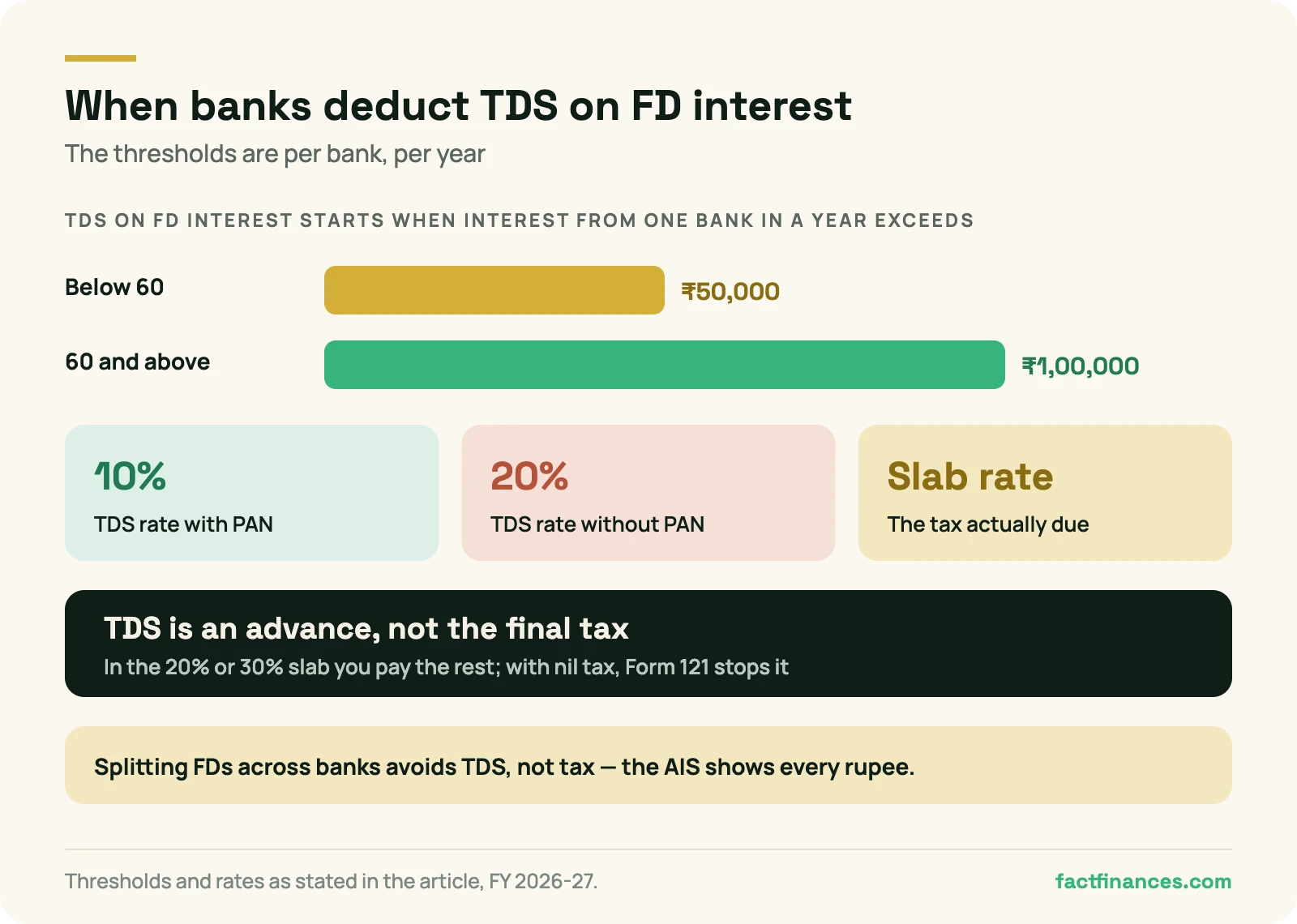
Banks deduct TDS at 10% once your interest from that bank crosses ₹50,000 in a year (₹1 lakh for senior citizens). TDS is only an advance: if your slab is higher you pay the rest, and if your tax is nil you can stop the deduction in advance with Form 121, which replaced Forms 15G and 15H in April 2026, or claim it back as a refund.
Two rules catch people most: interest on a cumulative FD is taxable every year as it builds up, not at maturity; and every rupee of interest shows up in your Annual Information Statement, so leaving it out invites a notice.
How It Is Taxed
How tax on FD interest and other interest works
| Type of interest | How it is taxed | TDS? |
|---|---|---|
| Savings account | Slab rate | No |
| Fixed and recurring deposits (bank, post office) | Slab rate, every year as it accrues | Yes, above the threshold |
| NSC, SCSS, post office MIS, KVP | Slab rate | SCSS yes; others mostly no |
| PPF, Sukanya Samriddhi | Tax-free | No |
| Corporate deposits and bonds | Slab rate | Usually yes |
Cumulative FDs: on a five-year FD that pays everything at maturity, the interest still has to be shown each year as it accrues. Banks deduct TDS on that yearly accrual. Declaring five years of interest in the final year means paying interest for late tax, and it will not match the AIS for the earlier years.
TDS on Interest
When banks deduct TDS on FD interest
| Who | TDS starts when interest from one bank in a year exceeds | Rate |
|---|---|---|
| Below 60 | ₹50,000 | 10% |
| 60 and above | ₹1,00,000 | 10% |
| No PAN given to the bank | Same thresholds | 20% |
The threshold is per bank, not per branch or per deposit. Interest from three banks can each stay below the threshold and attract no TDS at all; the tax is still due, and you pay it with your return or as advance tax.
The TDS shows in Form 168 (formerly 26AS) and the AIS. Claim it as a credit in your return; if your tax is less, the excess comes back as a refund.
Form 121
Form 121: stopping TDS when you owe no tax
If your total tax for the year will be nil, you can ask the bank not to deduct TDS by giving it Form 121 at the start of the year, or before the first interest is credited. It replaced Form 15G (below 60) and Form 15H (60 and above) under the Income-tax Rules, 2026.
- Who can file: resident individuals and HUFs whose estimated tax on total income for the year is nil. PAN is compulsory; non-residents cannot use it.
- Below 60: in practice your total income must also be below the basic exemption limit, so check carefully before filing.
- 60 and above: you can file if your tax is nil after the rebate, even if your income is above the exemption limit. Many retired people with pension and interest up to ₹12 lakh qualify in the new regime.
- Every year, every bank: give it to each bank or institution separately, each tax year.
A false declaration is an offence. If you are unsure whether your tax will be nil, let the bank deduct and claim the refund.
Senior Citizens
Rules that help senior citizens
- Higher TDS threshold: ₹1 lakh of interest per bank per year.
- ₹50,000 deduction for interest on bank, co-operative bank and post office deposits (80TTB under the old Act). Old regime only.
- No advance tax if you have no business income, so you pay any balance with your return.
- Aged 75 or more, with only pension and interest from the same bank that pays the pension: the bank works out your tax and deducts it, and you need not file a return.
Which regime suits a retired person?
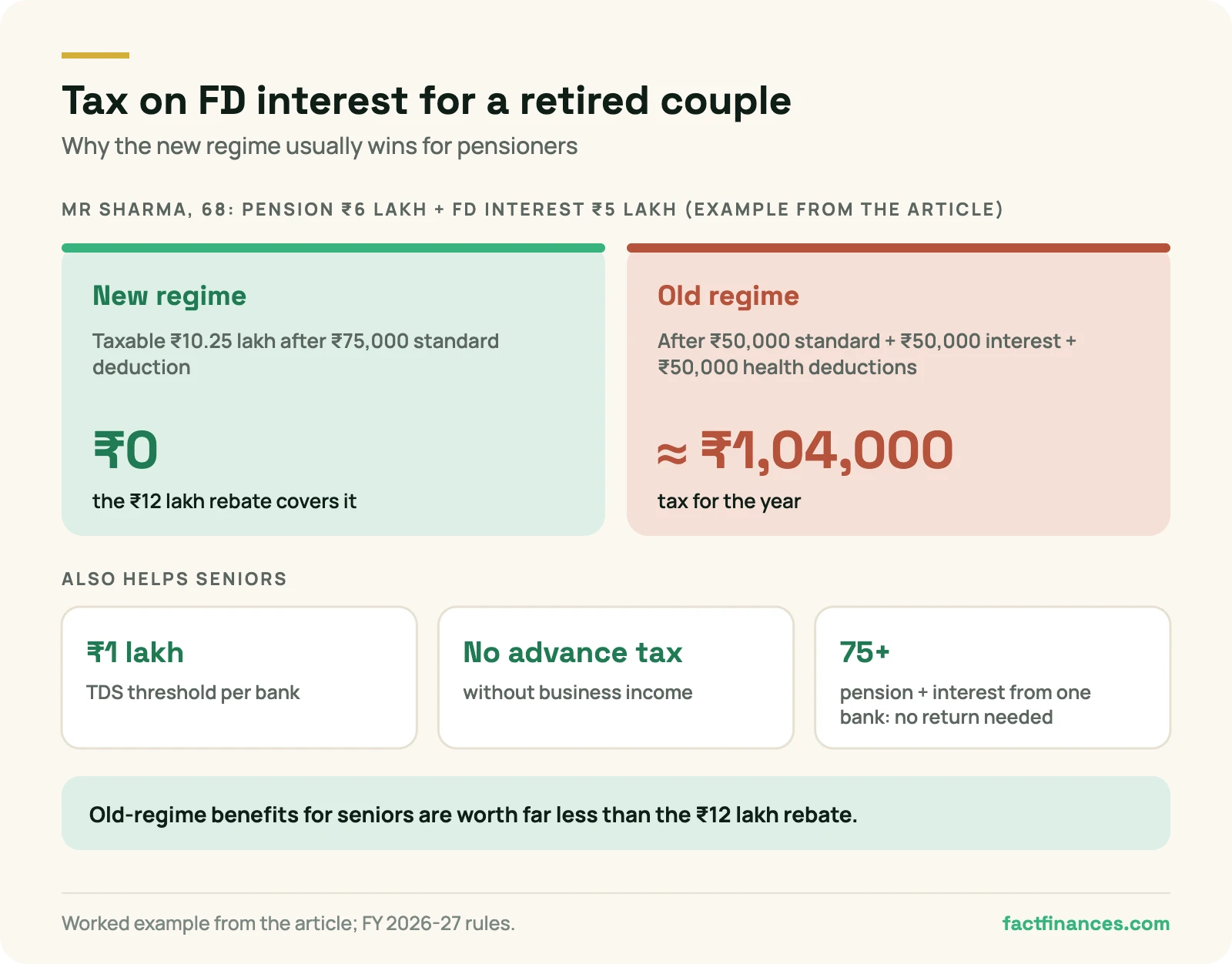
Usually the new one. Take Mr Sharma, 68, with a pension of ₹6 lakh and FD interest of ₹5 lakh. In the new regime his taxable income after the ₹75,000 standard deduction is ₹10.25 lakh, and the rebate makes his tax nil. In the old regime, even after the ₹50,000 standard deduction, ₹50,000 for interest and ₹50,000 for health insurance, his tax is about ₹1,04,000. Old-regime benefits for seniors are worth far less than the ₹12 lakh rebate.
Check your own figures with the regime calculator; choose “60 to 79” or “80 or above” for age.
Below 60
Savings interest for everyone else
In the old regime, up to ₹10,000 of savings account interest is deductible (80TTA under the old Act). FD interest gets no deduction. In the new regime there is no deduction for any interest, but the ₹12 lakh rebate covers interest along with salary.
Interest can push you over ₹12 lakh. A salary of ₹12.75 lakh is tax-free on its own; add ₹30,000 of FD interest and the tax becomes ₹31,200 after marginal relief. See how the slabs and marginal relief work.
Common Mistakes
Mistakes people make with tax on FD interest
1. Thinking TDS settles the tax
TDS is 10%. If you are in the 20% or 30% slab, the balance is due with your return, with interest if it is late.
2. Ignoring savings account interest
There is no TDS on it, but it is taxable and appears in your AIS.
3. Declaring cumulative FD interest only at maturity
It must be reported every year as it accrues.
4. Splitting deposits to avoid TDS
Keeping each bank below ₹50,000 avoids TDS, not tax. The AIS still shows every bank’s interest.
5. Filing Form 121 when tax is not nil
A wrong declaration can bring penalties. If in doubt, let TDS be deducted and claim the refund.
Talk It Through
Pension, FDs and TDS getting confusing?
Send us your pension details, bank interest certificates and Form 168. We will work out whether you owe tax, whether Form 121 makes sense, which regime is cheaper, and help you file your ITR. Ranchi, Deoghar and across India online.
Chat on WhatsApp Send a message · Old vs new regime calculator
Key takeaways
→ FD, RD, savings and post office interest is taxed at your slab rate in both regimes; PPF and Sukanya Samriddhi interest is tax-free.
→ Banks deduct 10% TDS above ₹50,000 of interest a year per bank, or ₹1 lakh for seniors; 20% without PAN.
→ Form 121 (old 15G/15H) stops TDS only when your tax for the year is nil.
→ Cumulative FD interest is taxable every year as it accrues.
→ Many retired people pay nothing in the new regime: pension plus interest up to ₹12.75 lakh, after the standard deduction.
Questions
Frequently asked questions
Is FD interest taxable?
Yes. It is added to your income and taxed at your slab rate, in both the old and new regimes.
What is the TDS limit on FD interest for FY 2026-27?
₹50,000 of interest a year from one bank for people below 60, and ₹1 lakh for senior citizens. TDS is 10%, or 20% if the bank does not have your PAN.
What replaced Form 15G and 15H?
Form 121, under the Income-tax Rules, 2026. One form now serves both age groups, with the same idea: you declare that your tax for the year will be nil so the bank does not deduct TDS.
Is savings account interest taxable?
Yes, at your slab rate. In the old regime, up to ₹10,000 is deductible for people below 60, and seniors can deduct up to ₹50,000 of bank and post office interest.
Do senior citizens have to file a return?
Those aged 75 or more whose only income is pension and interest from the bank that pays the pension need not file, because the bank deducts the tax. Others file as usual.
Does FD interest count towards the ₹12 lakh tax-free limit?
Yes. Interest is normal income, so it is added to salary or pension in deciding whether you are within ₹12 lakh.
Keep Learning
Next steps: Old vs new regime calculator · Income tax slabs FY 2026-27 · Tax on salary and Form 130
The bigger picture: The complete guide to income tax in India · Section 123 deductions
About the author
Ujjwal Tiwary
ARN-144500 · NISM Series V-A certified since 2018 · Ranchi & Deoghar, Jharkhand
Ujjwal Tiwary is an AMFI-registered mutual fund distributor (ARN-144500) based in Ranchi and Deoghar, Jharkhand, and has held the NISM Series V-A certification since 2018. He works with families on mutual funds, insurance and income tax returns, and writes or personally reviews every article on FactFinances. He is not a SEBI-registered investment adviser; nothing on this site is personalised advice.
Disclaimer: FactFinances provides educational content only. This article is general information and is not tax, legal or financial advice. It is based on the Income-tax Act, 1961 (which still governs returns for FY 2025-26 and earlier) and the Income-tax Act, 2025 (in force from 1 April 2026), as understood at the time of writing. Tax law, due dates and their interpretation can change, and your tax depends on your full facts; check the current position on the Income Tax Department portal or consult a chartered accountant before acting. FactFinances offers ITR filing assistance; reading this article places you under no obligation to use it.