

Part of our complete guide to mutual funds in India — when a parent or spouse dies, the money in mutual funds is safe — but the family has to find it and claim it. This is educational content, not investment advice.
When someone in the family dies, their mutual fund units do not vanish and nobody else can quietly take them. But they do not move on their own either. Someone has to find every folio, prove who is entitled to it, and file a claim with each fund house. This guide explains the three ways units pass on — to a joint holder, a nominee or the legal heirs — what each route asks for, how the units are taxed afterwards, and how to trace investments the family did not know about.
If you are dealing with this now: you do not have to do everything at once. Start by listing every folio you can find (the steps are below). Nothing is lost by taking a few weeks; mutual fund units keep their value while a claim is pending.
Step One
Find every investment first
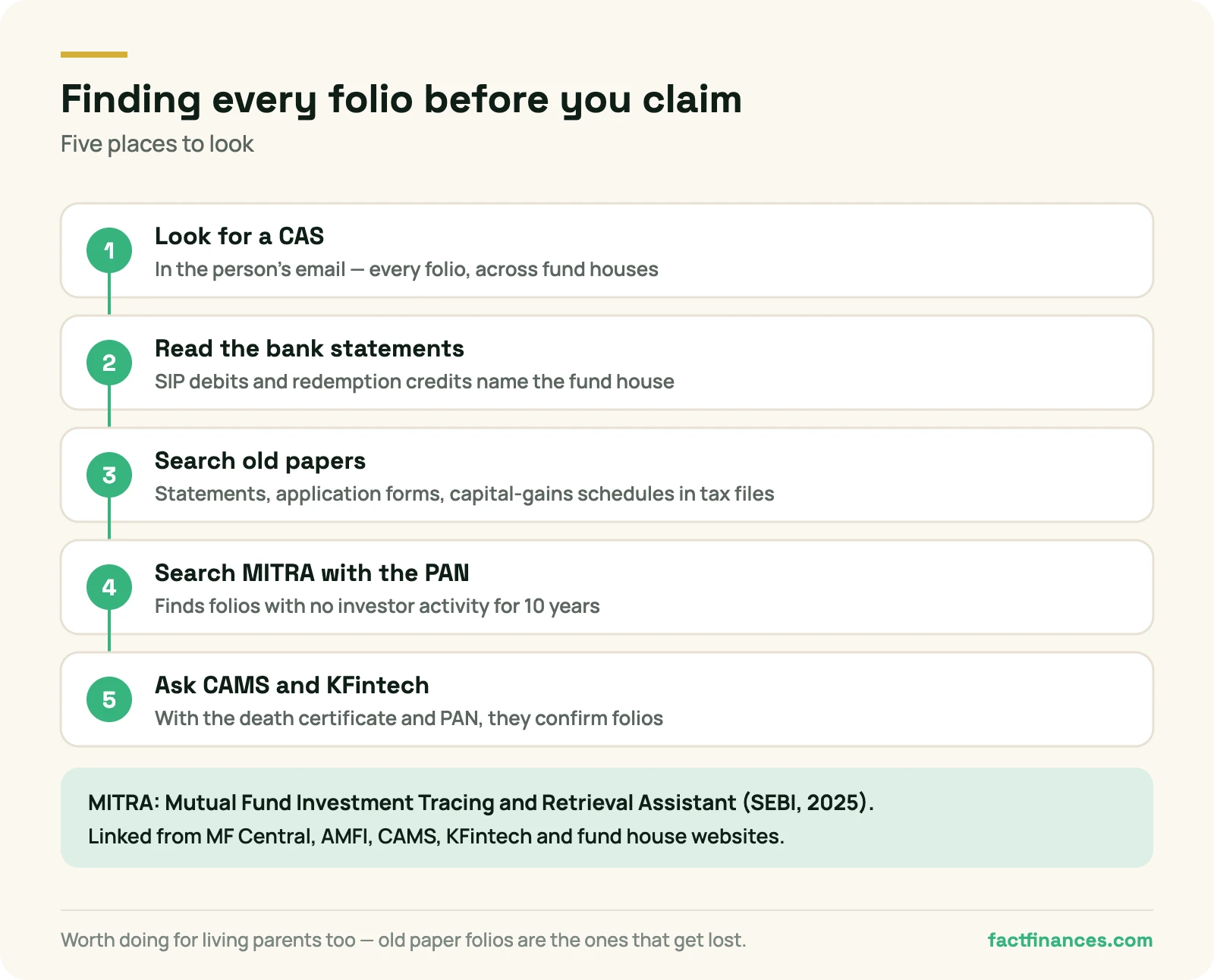
Families usually know about one or two funds and miss the rest. Before filing any claim, build a complete list:
- Look for a Consolidated Account Statement (CAS) in the person’s email. It lists every folio across fund houses on one statement — see how to read a CAS.
- Check bank statements for SIP debits and for redemption or dividend credits; each one names the fund house.
- Search old papers — account statements, application forms, tax files. Capital-gains statements attached to income-tax returns are especially useful.
- Search MITRA for folios that have been inactive for years (explained below).
- Ask the registrars. CAMS and KFintech service almost all fund houses; with the death certificate and the PAN, they can tell a claimant which folios exist.
Three Routes
Who gets the units, and how
Which route applies depends on how the folio was held. A family can have different folios on different routes.
| How the folio was held | Who claims | What it usually involves |
|---|---|---|
| Joint holding | The surviving joint holder(s) | The simplest route: a transmission request and the death certificate. The survivor carries on as holder. |
| Single holder, nominee registered | The nominee | A transmission request form, the death certificate, and the nominee’s KYC and bank details. No court papers are needed, whatever the amount. |
| Single holder, no nominee | The legal heirs | The heaviest route: affidavits, no-objection letters from other heirs and an indemnity, and for larger amounts a legal heirship certificate, succession certificate or probate. |
The nominee route, step by step
- Complete your own KYC if you have not already — the units will be held in your name. Our guide to KYC status and nomination shows how to check it.
- Fill in the transmission request form from the fund house or registrar, one for each fund house.
- Attach the death certificate (a verified copy), your PAN, and proof of your bank account.
- Submit at a fund house or registrar office, online where the fund house allows it, or through your distributor.
- Decide what to do next. The units are moved into your own folio. You can keep them invested or redeem them; there is no rule that you must sell.
A nominee receives the units so that the fund house can transfer them quickly. Who finally owns the money is decided by the will or by succession law, so a nominee may have to share it with other heirs. The fund house’s job ends once it has transferred the units to the nominee.
The legal heir route
Without a nominee or joint holder, the fund house has to be satisfied about who the legal heirs are. For small amounts that usually means affidavits, an indemnity and no-objection letters from the other heirs. For larger amounts, the fund house can ask for a legal heirship certificate, a succession certificate or a probated will — documents that can take months to obtain. This is the main reason a nomination on every folio matters.

Tax
How the units are taxed after a death
- Receiving the units is not taxed. A transmission to a nominee, joint holder or heir is not a sale.
- When you later redeem, the gain is worked out from what the original investor paid, and the holding period includes the time they held the units. Most inherited equity fund units are therefore long-term from day one.
- The gain is yours for tax purposes in the year you redeem, at the rates in mutual fund taxation in India. Large holdings can be redeemed across financial years to use the ₹1.25 lakh equity exemption more than once — see tax harvesting.
- The deceased’s own last return still has to be filed by the legal representative for income up to the date of death.
Lost Folios
Finding forgotten folios with MITRA
SEBI launched MITRA — the Mutual Fund Investment Tracing and Retrieval Assistant — in February 2025. It is a single search across all fund houses for folios that have gone quiet. A folio is treated as inactive when there has been no investor-initiated transaction, financial or otherwise, for ten years while units are still held.
- Where to find it: through a link on the MF Central, AMFI, CAMS and KFintech websites, and on fund house websites.
- What you need: the PAN (or PEKRN, for investors who never had a PAN) of the person whose investments you are tracing.
- What it shows: inactive or unclaimed folios linked to those details, and which fund house holds each one.
- What happens next: the folio is claimed through the normal route — by the investor if alive (usually after updating KYC), or by the nominee or legal heirs if not.
It is worth a search even for living relatives. Folios from the 2000s, opened with paper forms and an old address, are exactly the ones that end up forgotten.
In Practice
An example from Ranchi
Suman’s father, a retired teacher in Ranchi, died in 2025. The family knew about one equity fund, where he had named Suman as nominee. Her claim for it was settled in about three weeks with the transmission form, death certificate and her KYC.
A MITRA search on his PAN then turned up two more folios bought in 2008 through a bank branch, with no nominee and his old address. Those went through the legal heir route: Suman, her mother and her brother signed affidavits, and the others gave no-objection letters in favour of their mother. It took about three months, mostly in collecting documents.
Illustration based on common cases; names and details are changed. The same three folios with nominees registered would all have taken the three-week route.
Our Approach
How we help families with claims
As an AMFI-registered mutual fund distributor, we help families through this whether or not the investments were made through us:
- We trace the holdings — CAS, MITRA and the registrars — so nothing is left behind.
- We prepare the paperwork for each fund house, check it before submission and follow up until the units are transferred.
- We help decide what comes next — whether to keep the units, consolidate them or redeem them for a need — and how to spread redemptions for tax.
- We fix the gaps for the living: nominees on every folio, updated KYC and contact details, so the next claim in the family is the easy one.
This is general information, not legal advice. Where heirs disagree or the amount is large, take advice from a lawyer on succession.
FAQ
Frequently asked questions
What happens to mutual funds when the investor dies?
The units stay invested and keep their value. They pass to the surviving joint holder, the registered nominee, or — if there is neither — the legal heirs, once a transmission claim is made to the fund house.
What documents does a nominee need to claim mutual funds?
Usually a transmission request form, a verified copy of the death certificate, the nominee’s PAN and KYC, and proof of the nominee’s bank account. No court documents are needed on the nominee route.
How do legal heirs claim mutual funds without a nominee?
They file a transmission request with affidavits, an indemnity and no-objection letters from the other heirs. For larger amounts, the fund house can also ask for a legal heirship certificate, succession certificate or probate. Check the current form and limits with the fund house.
Is tax payable when mutual fund units are inherited?
No tax is payable on receiving the units. When the heir later redeems them, the gain is calculated from the original investor’s cost and the holding period includes the time the investor held them.
How can I find mutual funds my father forgot about?
Search his PAN on SEBI’s MITRA platform, available through MF Central, AMFI, CAMS and KFintech. Also look for a CAS in his email, SIP debits in his bank statements, and old account statements.
Does the nominee become the owner of the mutual funds?
The nominee receives the units so the transfer is quick, but final ownership follows the will or succession law. A nominee may have to share the money with other legal heirs.
Do the units have to be sold after a death?
No. The units are moved to the claimant’s own folio and can stay invested. Redeem only when the money is needed or the investment no longer fits.
Keep learning: Make sure your own folios are in order with KYC status and nomination, learn to read your CAS, see how mutual funds are taxed, or return to the main mutual funds guide.
Free · Printable · 10 minutes
Your 5-point money check-up
A 10-minute printable that shows where your family’s money is protected and where it isn’t. Plus one useful money article a month. No spam.
General information only, not personalised advice. Ujjwal Tiwary, AMFI-registered Mutual Fund Distributor, ARN-144500.
About the author
Ujjwal Tiwary
ARN-144500 · NISM Series V-A certified since 2018 · Ranchi & Deoghar, Jharkhand
Ujjwal Tiwary is an AMFI-registered mutual fund distributor (ARN-144500) based in Ranchi and Deoghar, Jharkhand, and has held the NISM Series V-A certification since 2018. He works with families on mutual funds, insurance and income tax returns, and writes or personally reviews every article on FactFinances. He is not a SEBI-registered investment adviser; nothing on this site is personalised advice.
FactFinances is an educational platform. We are an AMFI-registered mutual fund distributor (ARN-144500). We do not provide investment advice or recommend specific securities. All figures are illustrations at assumed rates and are not guarantees or forecasts of returns. Mutual fund investments are subject to market risks; read all scheme-related documents carefully.