

Part of our complete guide to mutual funds in India — your CAS is the one document that shows all your funds in one place. This is educational content, not investment advice.
Every mutual fund investor in India gets the same document, usually as a password-protected PDF that lands in email and is never opened: the Consolidated Account Statement, or CAS. It is the single most useful page you own as an investor. It lists every fund you hold, across every fund house, under your PAN — what you paid, what it is worth, and what has happened to it. This guide explains who sends it, how to get one whenever you want, and how to read it line by line.
Have your CAS open? Read along section by section below. Or upload your Detailed CAS — from MFCentral, NSDL or CDSL — to our free FactFinances Android app, which lists every folio across all fund houses, values them at AMFI-published NAVs and shows XIRR. It is a tracking tool, not investment advice.
The Basics
What a CAS is, and who sends it
A CAS is one statement that brings together all your mutual fund folios — across every fund house — that are linked to your PAN. If you also have a demat account, it can include your shares, bonds and ETFs too. Before it existed, you received a separate statement from each fund house and had to piece the picture together yourself.
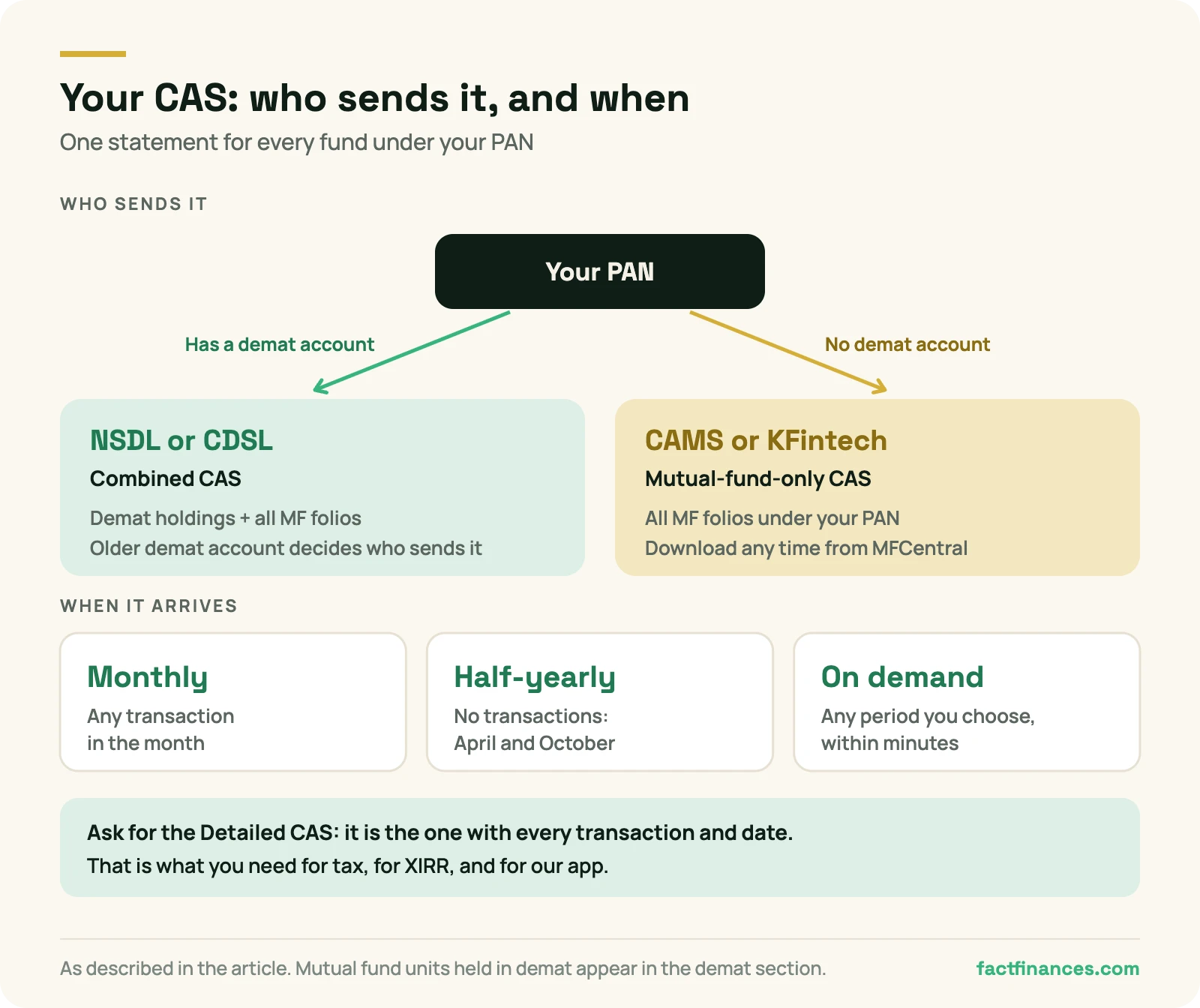
Who sends it depends on whether you have a demat account:
- You have a demat account: the depositories, NSDL or CDSL, send a combined CAS covering both your demat holdings and your mutual fund folios. If you have demat accounts with both, the depository holding the older account is the one that sends it.
- You have no demat account: the mutual fund registrars, CAMS and KFintech, send a mutual-fund-only CAS.
One subtlety: mutual fund units held inside a demat account appear in the demat section of the depository CAS, not in the folio section. If a fund seems to be “missing”, check where it is held.
When it arrives
| Your activity | What you receive | When |
|---|---|---|
| Any transaction in the month (SIP, purchase, redemption, switch) | Monthly CAS | Shortly after the month ends |
| Holdings but no transactions for six months | Half-yearly CAS | By mid-April and mid-October (for the half-years ending March and September) |
| You want one now | On-demand CAS | Within minutes, by email, for a period you choose |
The statement goes to the email address registered against your folios or demat account. If your folios carry an old email ID or no email at all, that is the first thing to fix.
Getting One
How to download your CAS on demand
You do not have to wait for the monthly email. You can generate a CAS online for free:
- MFCentral (run jointly by CAMS and KFintech) or either registrar’s own website, for a mutual-fund-only CAS. Choose Detailed (every transaction) or Summary (holdings only), pick a period, and set a password for the PDF.
- NSDL’s or CDSL’s CAS portal, if you have a demat account and want demat and mutual funds together.
The statement arrives as a password-protected PDF. For statements you request online, the password is the one you choose; for statements sent automatically, it is usually built from your PAN — the covering email says which. Ask for the Detailed version whenever you can: it is the only one that shows each transaction with its date, which is what you need for tax and for working out your real return. It is also the version our free FactFinances app reads, whether it comes from MFCentral or from NSDL or CDSL.
Reading It
Reading your CAS, section by section
Layouts differ slightly between NSDL, CDSL and the registrars, but every CAS carries the same building blocks.
| Section | What it shows | What to check |
|---|---|---|
| Investor details | Name, PAN, email, mobile, address; KYC status | Email and mobile are current; KYC shows as valid |
| Portfolio summary | Total cost and current value, often split by fund house | The total matches what you think you own |
| Folio and scheme header | Fund house, folio number, scheme name, plan (Direct or Regular), option (Growth or IDCW), ISIN, nominee status | Plan and option are the ones you intended; a nominee is registered |
| Transactions | Date, type (purchase, SIP, redemption, switch, dividend), amount, NAV, units, stamp duty | Every line is something you did; no unexpected redemptions |
| Closing balance | Units held, NAV and its date, cost value, market value | Market value = units × NAV; cost value is what you actually paid |
| Half-yearly cost disclosure | Average total expense ratio of the plan for the half-year, and the gross commission paid to your distributor in rupees (Regular plans only) | What you are paying, in plain numbers |
That last row surprises people the first time they see it. Since 2016, SEBI has required the September and March statements to show, for each scheme you hold, the average expense ratio of your plan and the commission the fund house paid to your distributor for that half-year, in rupees. It is already inside the expense ratio, not an extra charge. The idea is simple: you should be able to see what you pay and judge whether the service you get is worth it. For more on costs, see our guide to how to invest in mutual funds, which explains Direct and Regular plans.
What the commission pays for
Every scheme comes in two versions. A Direct plan has no distributor and a lower expense ratio. A Regular plan has a slightly higher expense ratio because part of it pays a mutual fund distributor — like us — and the half-yearly CAS shows you exactly how much, in rupees. Nothing about this is hidden, and nothing should be.
What that commission pays for is not the fund itself — the same fund is available Direct — but the work around it:
- Choosing what fits. Matching the fund category, plan and option to your goal, time horizon and tax position, rather than chasing last year’s top performer.
- Staying invested when it is hardest. For most investors the biggest cost is not the expense ratio; it is selling in a crash or stopping a SIP at the bottom. A steady, experienced voice at those moments is often worth more than the fee.
- The paperwork. KYC, nominations, bank-mandate changes, consolidating folios and redemptions done correctly.
- Your family, later. If something happens to you, someone who already knows every folio can help your family claim the units — a process that can otherwise drag on for months.
- A yearly review. Checking the portfolio against your goals and rebalancing when the mix drifts.
If you are confident doing all of that yourself, a Direct plan costs less, and you deserve to know it. If you value that help, the commission in a Regular plan is how it is paid for. Either way, the CAS lets you see the cost and decide with full information — which is exactly why it is worth reading.
Worked Example
A worked example: Sunita’s CAS
Sunita, a bank officer in Ranchi, opens her half-yearly CAS. Stripped of the headers, the closing balances read like this (scheme names are generic; the structure is what matters):
| Folio | Scheme · plan · option | Units | NAV | Cost value | Market value |
|---|---|---|---|---|---|
| A | Flexi cap fund · Regular · Growth | 1,250.432 | ₹68.40 | ₹70,000 | ₹85,530 |
| B | Large cap index fund · Direct · Growth | 3,410.115 | ₹24.12 | ₹75,000 | ₹82,252 |
| C | Liquid fund · Direct · Growth | 18.226 | ₹3,120.50 | ₹55,000 | ₹56,874 |
| Total | ₹2,00,000 | ₹2,24,656 |
What she can read straight off the page: her total gain is ₹24,656, or 12.3% on what she put in. Folio A is up 22.2%, B 9.7% and C 3.4%. About a quarter of her money (₹56,874 of ₹2.25 lakh) sits in a liquid fund — which is her emergency money, so that is intended. Folio A is a Regular plan, so her half-yearly statement also shows the commission paid on it.
What she cannot read off the page is whether 12.3% is good. Folio A was a SIP over three years; folio C was a single deposit eight months ago. Percentages on cost ignore when the money went in. For that she needs the transaction dates from the detailed CAS and an XIRR calculation — which is exactly what our app does from the same PDF. To judge the funds themselves, compare each against its benchmark, as our guide to evaluating mutual fund performance explains.
Checklist
Five things to check every time it arrives
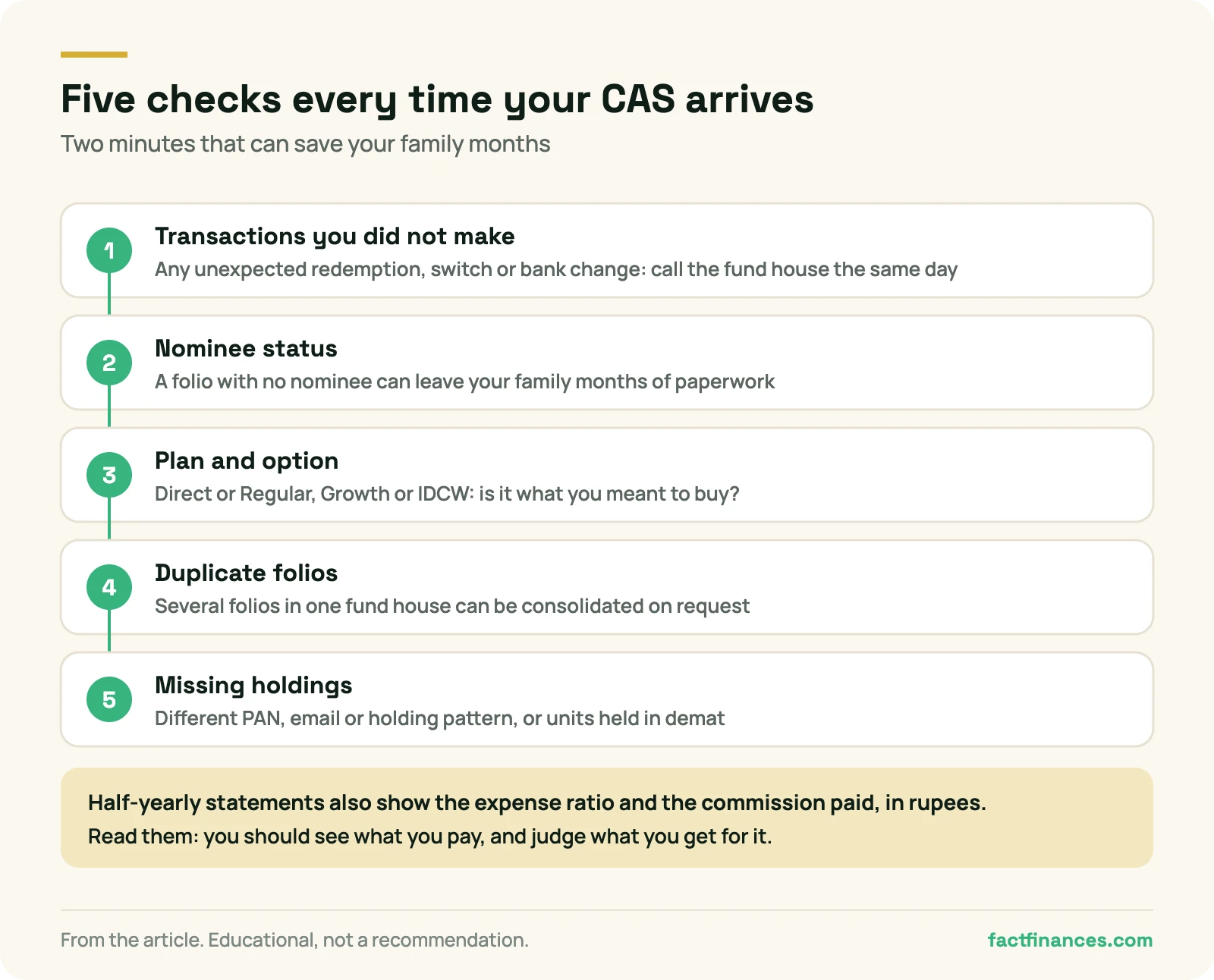
- Transactions you do not recognise. Any redemption, switch or change of bank you did not ask for needs a call to the fund house the same day.
- Nominee status. A folio with no nominee can turn a simple claim into months of paperwork for your family.
- Plan and option. “Direct” or “Regular”, “Growth” or “IDCW” — check each one matches what you meant to buy. IDCW pays out part of your money and is taxed at your slab rate.
- Duplicate folios. Several folios in the same fund house make tracking harder; the fund house can consolidate them on request.
- Missing holdings. If a fund you own is not there, its folio may carry a different PAN, email or holding pattern — or the units may sit in your demat account.
What a CAS does not show
It covers mutual funds and demat holdings only. Your EPF, PPF, NPS, bank deposits, insurance policies and gold are not in it. It also does not show your annualised return (XIRR) or which lots are short-term and long-term for tax — those you work out from the detailed transactions. Our guide to mutual fund taxation shows how; common mutual fund mistakes lists what the statement often reveals.
FAQ
Frequently asked questions
What is a CAS in mutual funds?
A Consolidated Account Statement (CAS) is a single statement listing all your mutual fund folios, across every fund house, linked to your PAN — with units, NAV, cost and current value, and the transactions in the period. If you have a demat account, it can also include your demat holdings.
Who sends the CAS — NSDL, CDSL, CAMS or KFintech?
If your PAN is linked to a demat account, NSDL or CDSL sends a combined CAS (the depository with your older demat account, if you have both). If not, the registrars CAMS and KFintech send a mutual-fund-only CAS.
How often will I get a CAS?
Monthly, for any month in which you had a transaction; otherwise half-yearly, in April and October. You can also generate one on demand at any time.
How do I download my CAS?
Request it online from MFCentral or the CAMS or KFintech websites for a mutual-fund-only statement, or from the NSDL or CDSL CAS portals if you have a demat account. It is emailed to your registered address as a password-protected PDF, usually within minutes.
Which CAS does the FactFinances app accept?
The app reads the Detailed CAS, either from MFCentral (CAMS and KFintech) or from NSDL or CDSL. The Summary version does not carry the transaction dates the app needs to work out XIRR.
What is the password for the CAS PDF?
For a CAS you request online, it is the password you set while requesting it. For statements sent automatically, the password is usually based on your PAN; the covering email states the exact format.
Why does my CAS show a commission?
SEBI requires the half-yearly CAS to show the commission paid by the fund house to your distributor in rupees, along with the plan’s average expense ratio. It is part of the expense ratio already charged in Regular plans, not an extra deduction. It pays for the distributor’s work — helping you choose, keeping your paperwork and nominations in order, and staying with you through market falls. A Direct plan has no commission and a lower expense ratio.
Keep learning: Understand how a SIP works and how XIRR measures it, see how mutual funds are taxed, learn to evaluate fund performance, or return to the main mutual funds guide.
Free · Printable · 10 minutes
Your 5-point money check-up
A 10-minute printable that shows where your family’s money is protected and where it isn’t. Plus one useful money article a month. No spam.
General information only, not personalised advice. Ujjwal Tiwary, AMFI-registered Mutual Fund Distributor, ARN-144500.
About the author
Ujjwal Tiwary
ARN-144500 · NISM Series V-A certified since 2018 · Ranchi & Deoghar, Jharkhand
Ujjwal Tiwary is an AMFI-registered mutual fund distributor (ARN-144500) based in Ranchi and Deoghar, Jharkhand, and has held the NISM Series V-A certification since 2018. He works with families on mutual funds, insurance and income tax returns, and writes or personally reviews every article on FactFinances. He is not a SEBI-registered investment adviser; nothing on this site is personalised advice.
FactFinances is an educational platform. We are an AMFI-registered mutual fund distributor (ARN-144500). We do not provide investment advice or recommend specific securities. All figures are illustrations at assumed rates and are not guarantees or forecasts of returns. Mutual fund investments are subject to market risks; read all scheme-related documents carefully.