

This article is part of our complete guide to income tax in India. Want your own numbers first? Use the old vs new tax regime calculator; it shows both figures side by side.
The Short Answer
For most salaried people in FY 2026-27, the new tax regime costs less. Income up to ₹12 lakh is tax-free under it (₹12.75 lakh for a salaried person, after the ₹75,000 standard deduction), and its slabs are lower all the way up.
The old regime still wins for some people, and it comes down to one number: how much you can claim in deductions. At a salary of ₹15 lakh you need about ₹5.4 lakh of deductions before the old regime is cheaper. At ₹20 lakh you need about ₹7.1 lakh. Few people reach that without a large HRA exemption, a home loan on the house they live in, or both.
If your income is salary, pension, interest or rent, you can choose afresh every year when you file your return. So the question is not which regime is better in general, but which one is cheaper for you this year.
The Basics
Old vs new tax regime: what the two regimes are
India has two ways to calculate income tax for individuals. The new regime (section 202 of the Income-tax Act, 2025; section 115BAC under the old Act) has lower slab rates but takes away almost all deductions and exemptions. The old regime has higher rates but lets you subtract HRA, 80C investments, health insurance, home loan interest and more before the tax is worked out.
Since FY 2023-24, the new regime is the default. If you do nothing, your employer deducts TDS under it and your return is processed under it. You have to choose the old regime actively.
The Income-tax Act, 2025 replaced the 1961 Act from 1 April 2026 and renamed the financial year a “tax year”, but it carried both regimes over unchanged. The Budget in February 2026 left the slabs, rebate, surcharge and cess exactly as they were for FY 2025-26.
The Rates
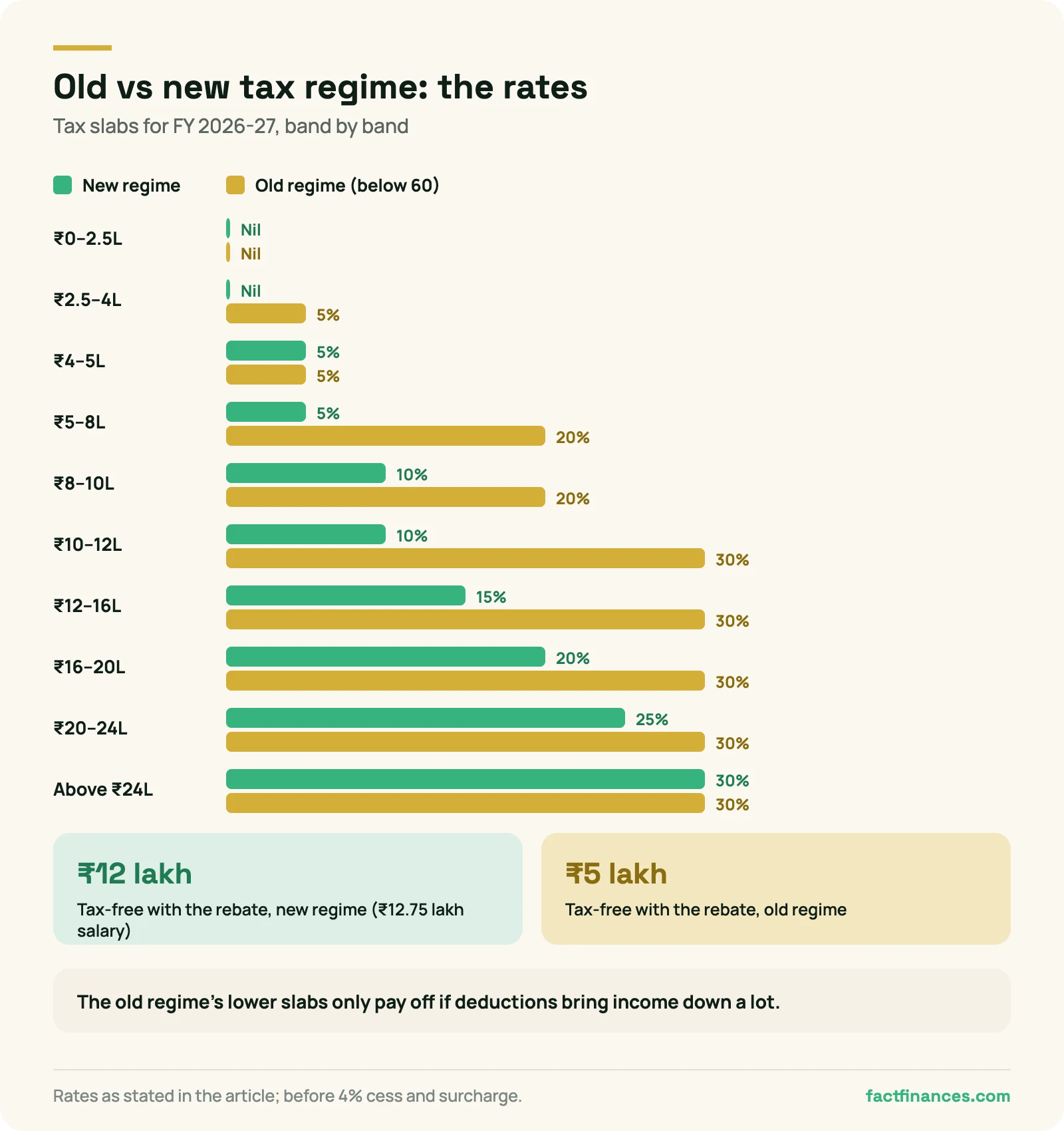
Tax slabs for FY 2026-27, side by side
| Taxable income | New regime | Old regime (below 60) |
|---|---|---|
| Up to ₹2.5 lakh | Nil | Nil |
| ₹2.5–4 lakh | Nil | 5% |
| ₹4–5 lakh | 5% | 5% |
| ₹5–8 lakh | 5% | 20% |
| ₹8–10 lakh | 10% | 20% |
| ₹10–12 lakh | 10% | 30% |
| ₹12–16 lakh | 15% | 30% |
| ₹16–20 lakh | 20% | 30% |
| ₹20–24 lakh | 25% | 30% |
| Above ₹24 lakh | 30% | 30% |
In the old regime, the nil band is higher for older people: up to ₹3 lakh for those aged 60 to 79, and up to ₹5 lakh for those 80 and above. The new regime has one set of slabs for everyone. Our guide to income tax slabs for FY 2026-27 explains the rebate and marginal relief in detail.
On top of the slab tax, both regimes add a 4% health and education cess. Surcharge applies above ₹50 lakh (10%), ₹1 crore (15%) and ₹2 crore (25%). The old regime has one more step, 37% above ₹5 crore; the new regime stops at 25%.
The ₹12 lakh rule. In the new regime, a rebate of up to ₹60,000 makes tax nil if taxable income is ₹12 lakh or less. If you earn slightly more, marginal relief limits the tax to the amount by which your income crosses ₹12 lakh, so ₹12.1 lakh does not suddenly cost ₹61,500. The rebate does not cover capital gains taxed at special rates. In the old regime the rebate is ₹12,500, which makes income up to ₹5 lakh tax-free.
What You Give Up
Deductions: what each regime allows
The new regime keeps only a handful of deductions. The old regime keeps the long list most people grew up with.
| Deduction or exemption | New regime | Old regime |
|---|---|---|
| Standard deduction (salary, pension) | ₹75,000 | ₹50,000 |
| Employer’s NPS contribution, 80CCD(2) | Yes, up to 14% of basic + DA | Yes, up to 10% |
| Family pension deduction | ₹25,000 | ₹15,000 |
| Gratuity, leave encashment, VRS exemptions | Yes | Yes |
| HRA and LTA exemption | No | Yes |
| 80C (EPF, PPF, ELSS, life premium, tuition, principal), now s.123 | No | Up to ₹1.5 lakh |
| 80D health insurance, now s.126 | No | Up to ₹25,000 + ₹50,000 |
| Own NPS, 80CCD(1B) | No | Up to ₹50,000 |
| Home loan interest, self-occupied house | No | Up to ₹2 lakh |
| Home loan interest, let-out house | Against that rent only | Yes, loss set-off up to ₹2 lakh |
| 80E education loan, 80G donations, 80TTA/TTB interest | No | Yes |
| Professional tax | No | Up to ₹2,500 |
Two of these matter more than the rest. HRA is often the single biggest exemption for people who rent in a city; from FY 2026-27 the 50% city rate covers eight cities (Delhi, Mumbai, Chennai, Kolkata, Bengaluru, Hyderabad, Pune and Ahmedabad). Home loan interest on a house you live in is the other. Without at least one of the two, the old regime rarely wins.
The Break-Even
How much in deductions makes the old regime worth it
The useful way to compare is to ask: how much would I need to claim, beyond the standard deduction, for the old regime to cost the same as the new? Below that figure, the new regime is cheaper. We ran this for a salaried person below 60:
| Gross salary | Tax in new regime | Old regime needs deductions of about |
|---|---|---|
| ₹10 lakh | Nil | ₹4.5 lakh (only to reach nil tax) |
| ₹12.75 lakh | Nil | ₹7.25 lakh (only to reach nil tax) |
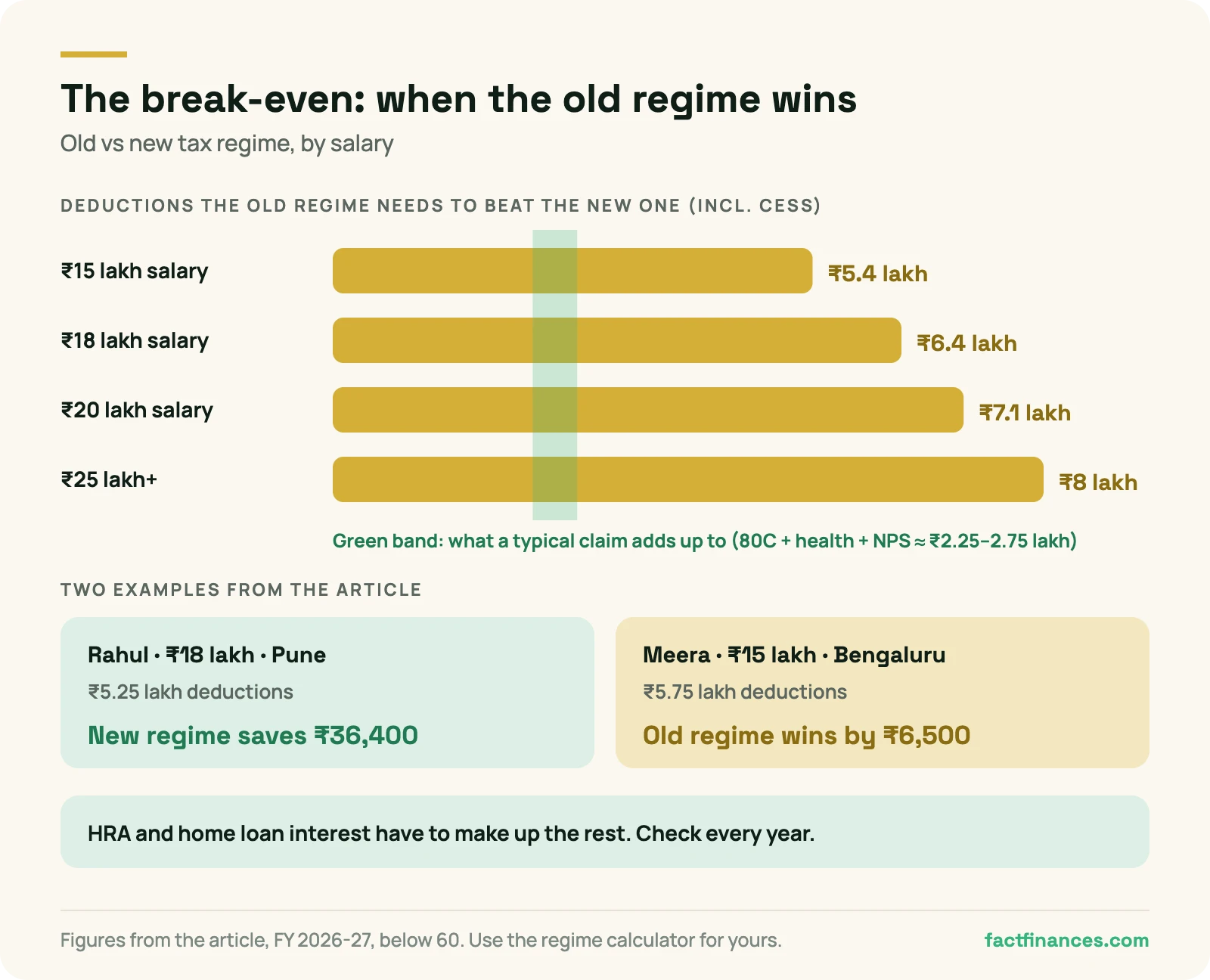
| ₹15 lakh | ₹97,500 | ₹5.4 lakh |
| ₹18 lakh | ₹1,50,800 | ₹6.4 lakh |
| ₹20 lakh | ₹1,92,400 | ₹7.1 lakh |
| ₹25 lakh and above (to ₹50 lakh) | ₹3,19,800 at ₹25 lakh | ₹8 lakh |
Figures include 4% cess. The break-even stops rising at about ₹8 lakh because both regimes tax income above ₹24 lakh at 30%; from there, the gap between them is fixed.
Now compare that with what a typical salaried person can claim: ₹1.5 lakh under 80C, ₹25,000 to ₹75,000 for health insurance, ₹50,000 in NPS. That adds up to ₹2.25 to ₹2.75 lakh. HRA and home loan interest have to make up the rest.
A worked example
Rahul earns ₹18 lakh and rents a flat in Pune. His HRA exemption is ₹3 lakh, and he claims ₹1.5 lakh under 80C, ₹25,000 for health insurance and ₹50,000 in NPS. That is ₹5.25 lakh of deductions, short of the ₹6.4 lakh break-even. New regime tax: ₹1,50,800. Old regime tax: ₹1,87,200. The new regime saves him ₹36,400.
Meera earns ₹15 lakh and pays ₹31,250 a month in rent in Bengaluru, which gives her an HRA exemption of ₹3 lakh. She also claims ₹1.5 lakh under 80C, ₹75,000 for health insurance for herself and her senior-citizen parents, and ₹50,000 in NPS: ₹5.75 lakh in all, just above the ₹5.4 lakh break-even. Old regime tax: ₹91,000. New regime tax: ₹97,500. The old regime wins, but by only ₹6,500, and only if every receipt holds up.
Notice what it took: rent in a big city, full 80C, health cover for parents and NPS on top. Change one of those, or move into a house of your own, and the answer flips. That is why the choice is worth checking every year.
Who Should Pick What
Old vs new tax regime: a quick way to decide
- Taxable income up to ₹12 lakh (₹12.75 lakh salary): new regime. Tax is nil, and no set of deductions can beat nil.
- Renting, no home loan, salary ₹13–25 lakh: usually new regime, unless your HRA exemption alone is above ₹3 lakh or so. Run the numbers.
- Home loan on the house you live in plus big HRA or full 80C/80D/NPS: the old regime is worth checking seriously.
- Senior citizens with pension and interest: often new regime now, because the ₹12 lakh rebate is larger than the old regime’s senior benefits (₹50,000 interest deduction and ₹50,000 health insurance). Check if you have large medical premiums.
- Business or professional income: decide carefully. You can leave the new regime and return to it only once in your life (see below).
The regime calculator does this for your exact figures, including the break-even for your salary.
Switching Rules
Can you change regimes every year?
It depends on whether you have business income.
- Salary, pension, interest, rent, capital gains only: yes, every year. You make the choice in your income tax return. What you told your employer for TDS does not bind you; if you told them “new” and the old regime turns out cheaper, you claim it in the return and get a refund.
- Business or professional income: you opt out of the new regime by filing a form before the return due date. You can come back to the new regime once; after that you can never opt out again while you have business income.
The deadline trap. If you do not have business income, the old regime is available only in a return filed by the due date (31 July for most salaried people). A belated return is processed under the new regime, whatever you would have chosen. If you missed the deadline this year, read our guide to belated, revised and updated returns before you file.
Common Mistakes
Mistakes people make with the old vs new tax regime choice
1. Investing just to save tax
Buying a low-return policy for an 80C deduction makes no sense if the new regime is cheaper anyway. Choose investments on their merit; the tax break is a bonus only in the old regime.
2. Comparing with the wrong numbers
People compare the old regime with all deductions against the new regime without the ₹75,000 standard deduction, or forget that employer NPS is allowed in both. Compare like for like.
3. Claiming deductions they cannot prove
HRA needs rent receipts, and from FY 2026-27 you must also state whether the landlord is a relative. 80C and 80D need receipts. If a claim is rejected later, the old regime can end up costing more than the new one would have, with interest added.
4. Letting the employer’s choice stand
Your employer deducts TDS using whatever regime you told them at the start of the year. That is not the final word. Recheck when you file.
5. Filing late
Missing 31 July locks a salaried person into the new regime for that year. If the old regime would have saved you money, that lost saving is the real cost of filing late, often more than the late fee.
Talk It Through
Not sure which regime gives you the lower tax?
Send us your Form 16 (Form 130 from this tax year) or salary details and your deduction proofs. We will work out both regimes, help you file your ITR under the cheaper one, and check that your TDS, interest and capital gains match the Annual Information Statement. Salaried people, pensioners and small businesses in Ranchi, Deoghar and across India online.
Key takeaways
→ The new regime is the default and is cheaper for most salaried people: income up to ₹12 lakh (₹12.75 lakh salary) is tax-free.
→ The old regime wins only if your deductions beyond the standard deduction exceed the break-even: about ₹5.4 lakh at ₹15 lakh salary, ₹7.1 lakh at ₹20 lakh, ₹8 lakh at ₹25 lakh and above.
→ HRA and home loan interest on a self-occupied house usually decide it; 80C, 80D and NPS alone rarely do.
→ Without business income you can switch every year in your return, but only if you file by the due date.
→ Recheck every year; a new home loan, a move or a raise can flip the answer.
Questions
Frequently asked questions
Which is better, the old or new tax regime, for FY 2026-27?
For most people, the new regime, because income up to ₹12 lakh is tax-free and the slabs are lower. The old regime is better only if your deductions and exemptions (HRA, 80C, 80D, home loan interest, NPS) exceed the break-even for your income, which is about ₹5.4 lakh at ₹15 lakh salary.
Is the new tax regime compulsory?
No. It is the default, so it applies unless you choose the old regime. Salaried people can choose the old regime in their return each year, as long as they file by the due date.
Can I switch from the new regime to the old regime while filing my ITR?
Yes, if you have no business income. The choice you gave your employer only affects TDS. You can pick the old regime in a return filed by the due date and claim any extra tax deducted as a refund.
Is 80C allowed in the new tax regime?
No. 80C (now section 123), 80D (now section 126), HRA, LTA and home loan interest on a self-occupied house are not allowed. The new regime does allow the ₹75,000 standard deduction and your employer’s NPS contribution up to 14% of basic plus DA.
Is salary up to ₹12.75 lakh really tax-free?
In the new regime, yes, if all of it is salary or pension and taxed at slab rates. ₹12.75 lakh minus the ₹75,000 standard deduction is ₹12 lakh, which the rebate makes tax-free. Capital gains taxed at special rates are not covered by the rebate.
Did the 2026 Budget change the tax slabs?
No. The slabs, rebate, standard deduction, surcharge and cess for FY 2026-27 are the same as FY 2025-26. The Income-tax Act, 2025 changed section numbers and form names, not the rates.
I filed late. Can I still choose the old regime?
Not if you have no business income. A belated return is taxed under the new regime. Our guide to belated, revised and updated returns explains what you can still do.
Keep Learning
Next steps: Old vs new tax regime calculator · Missed the ITR deadline? · Section 80D: health insurance deduction
The bigger picture: The complete guide to income tax in India
About the author
Ujjwal Tiwary
ARN-144500 · NISM Series V-A certified since 2018 · Ranchi & Deoghar, Jharkhand
Ujjwal Tiwary is an AMFI-registered mutual fund distributor (ARN-144500) based in Ranchi and Deoghar, Jharkhand, and has held the NISM Series V-A certification since 2018. He works with families on mutual funds, insurance and income tax returns, and writes or personally reviews every article on FactFinances. He is not a SEBI-registered investment adviser; nothing on this site is personalised advice.
Disclaimer: FactFinances provides educational content only. This article is general information and is not tax, legal or financial advice. It is based on the Income-tax Act, 1961 (which still governs returns for FY 2025-26 and earlier) and the Income-tax Act, 2025 (in force from 1 April 2026), as understood at the time of writing. Tax law, due dates and their interpretation can change, and your tax depends on your full facts; check the current position on the Income Tax Department portal or consult a chartered accountant before acting. FactFinances offers ITR filing assistance; reading this article places you under no obligation to use it.