

This article is part of our complete guide to income tax in India. To see your own tax under both regimes, use the old vs new tax regime calculator.
The Short Answer
For FY 2026-27, the income tax slabs in the new tax regime are: nil up to ₹4 lakh, then 5%, 10%, 15%, 20% and 25% for each ₹4 lakh band, and 30% above ₹24 lakh. They are the same as FY 2025-26; the Budget in February 2026 did not change them.
On top of the slabs, a rebate of up to ₹60,000 wipes out the tax entirely if your taxable income is ₹12 lakh or less. For a salaried person, the ₹75,000 standard deduction pushes that to a salary of ₹12.75 lakh. Earn slightly more and marginal relief stops the tax from jumping, so you never pay more in tax than the amount by which you crossed ₹12 lakh.
Two things the ₹12 lakh rule does not cover: capital gains taxed at special rates, and anyone in the old regime, where the tax-free limit is ₹5 lakh.
The Slabs
New regime income tax slabs for FY 2026-27
| Taxable income | Rate | Tax on this band | Total tax at top of band |
|---|---|---|---|
| Up to ₹4 lakh | Nil | ₹0 | ₹0 |
| ₹4–8 lakh | 5% | ₹20,000 | ₹20,000 |
| ₹8–12 lakh | 10% | ₹40,000 | ₹60,000 |
| ₹12–16 lakh | 15% | ₹60,000 | ₹1,20,000 |
| ₹16–20 lakh | 20% | ₹80,000 | ₹2,00,000 |
| ₹20–24 lakh | 25% | ₹1,00,000 | ₹3,00,000 |
| Above ₹24 lakh | 30% | on the excess | ₹3,00,000 + 30% of the excess |
The last column is the useful one. It tells you the tax before rebate and cess at the top of each band, so you can work out your own tax in one step: take the figure for the band below yours and add the rate on the excess.
The new regime is the default under section 202 of the Income-tax Act, 2025. It has one set of slabs for everyone, whatever your age.
How Slabs Work
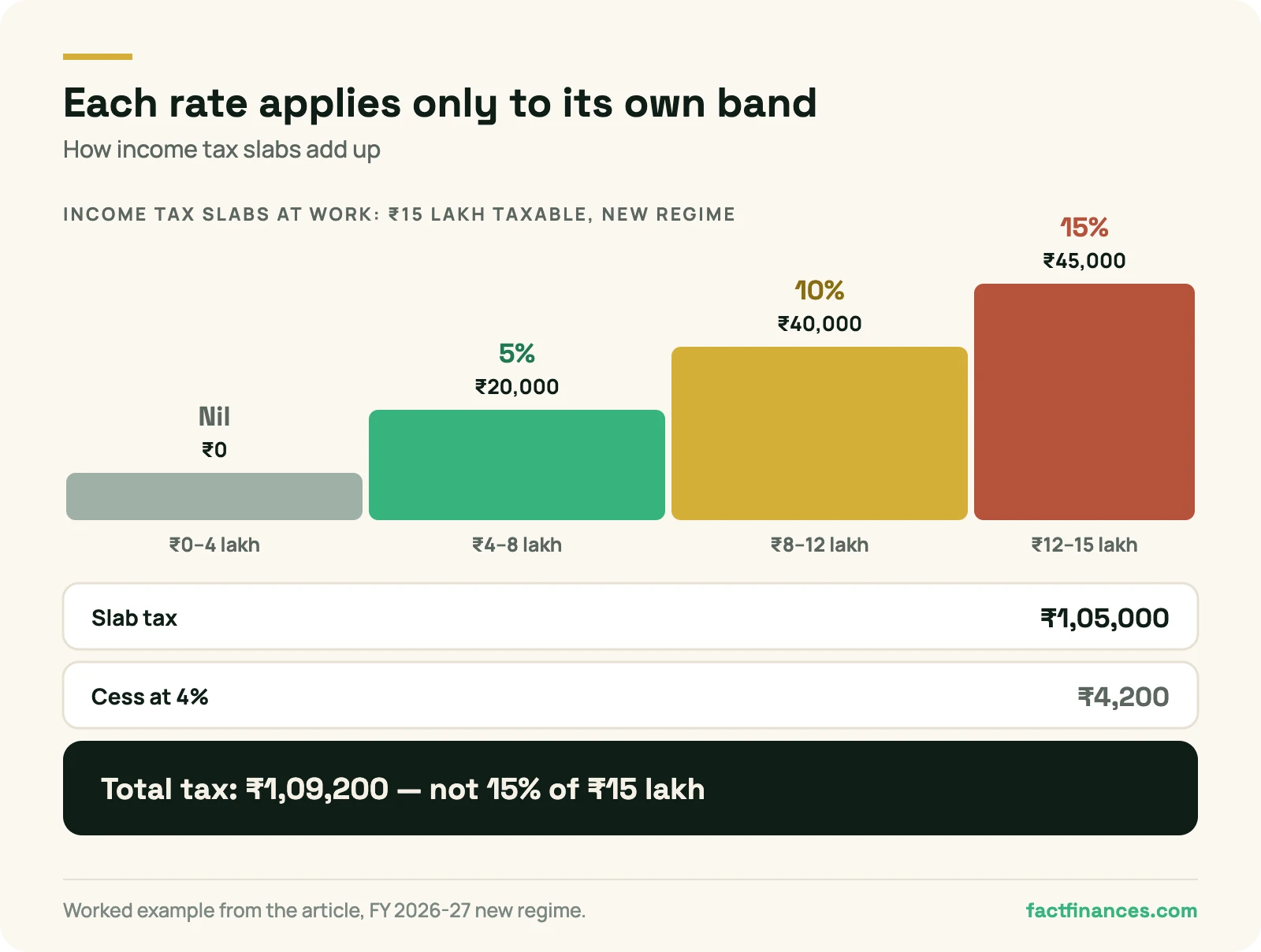
Each rate applies only to its own band
The most common misunderstanding about income tax slabs is that crossing into a higher band raises the tax on all your income. It does not. Each rate applies only to the slice of income inside that band.
Take a taxable income of ₹15 lakh in the new regime:
| Band | Income in band | Rate | Tax |
|---|---|---|---|
| ₹0–4 lakh | ₹4,00,000 | Nil | ₹0 |
| ₹4–8 lakh | ₹4,00,000 | 5% | ₹20,000 |
| ₹8–12 lakh | ₹4,00,000 | 10% | ₹40,000 |
| ₹12–15 lakh | ₹3,00,000 | 15% | ₹45,000 |
| Slab tax | ₹1,05,000 | ||
| Cess at 4% | ₹4,200 | ||
| Total tax | ₹1,09,200 |
That is 7.3% of the income, even though the top rate touched is 15%. The rate on your last rupee (the marginal rate) and the share of income you pay as tax (the effective rate) are different numbers, and the second one is what you actually feel.
The ₹12 Lakh Rebate
How the ₹12 lakh rebate works
The rebate (section 87A of the old Act, now section 156) is a deduction from the tax itself, not from income. In the new regime it is up to ₹60,000, available when taxable income is ₹12 lakh or less. Look at the slab table: the tax on exactly ₹12 lakh is ₹60,000. So the rebate cancels it in full, and no cess is due because there is no tax left to apply it to.
For salaried people and pensioners, the ₹75,000 standard deduction comes first. ₹12,75,000 of salary minus ₹75,000 is ₹12,00,000 of taxable income: zero tax. Your employer’s NPS contribution (up to 14% of basic plus DA) is also deductible in the new regime, which can push the tax-free salary higher still.
What the rebate does not cover
Income taxed at special rates sits outside the rebate. The main ones for individuals are short-term gains on listed shares and equity funds (20%), long-term gains on them above ₹1.25 lakh a year (12.5%), and winnings from lotteries or games (30%).
An example. Ankit has a salary of ₹10.75 lakh and books a short-term gain of ₹1.5 lakh on shares. His total income is ₹11.5 lakh, under ₹12 lakh, so he gets the rebate, but only against the tax on his salary. The ₹40,000 slab tax on his ₹10 lakh taxable salary is wiped out. The ₹30,000 tax on the short-term gain is not; with cess he pays ₹31,200.
Just Above ₹12 Lakh
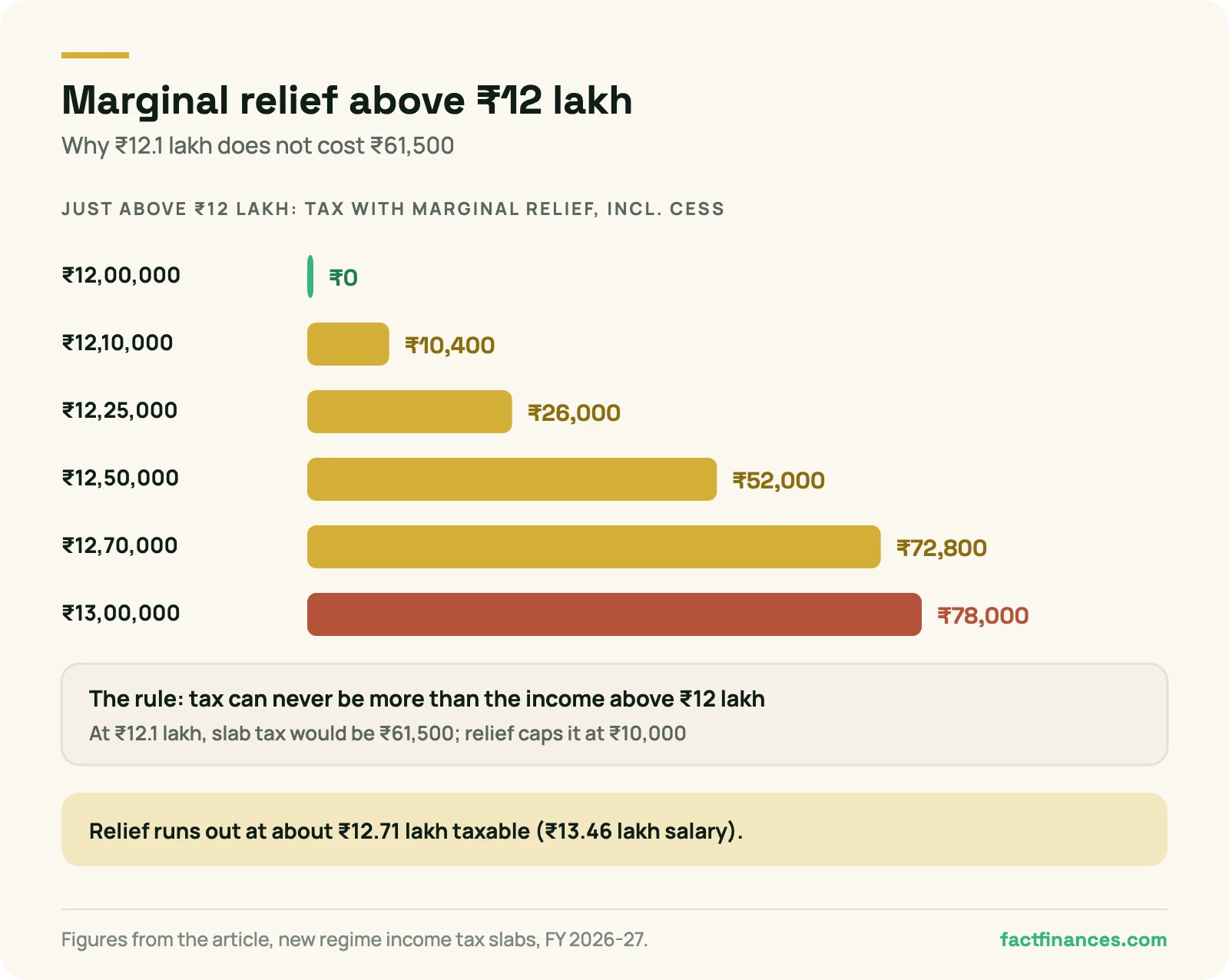
Marginal relief: why ₹12.1 lakh does not cost ₹61,500
Without a safety net, earning ₹10,000 more than ₹12 lakh would cost you ₹61,500 in tax. Marginal relief prevents that: the tax cannot be more than the amount by which your taxable income exceeds ₹12 lakh.
| Taxable income | Slab tax | Tax after marginal relief | Total with cess |
|---|---|---|---|
| ₹12,00,000 | ₹60,000 | ₹0 | ₹0 |
| ₹12,10,000 | ₹61,500 | ₹10,000 | ₹10,400 |
| ₹12,25,000 | ₹63,750 | ₹25,000 | ₹26,000 |
| ₹12,50,000 | ₹67,500 | ₹50,000 | ₹52,000 |
| ₹12,70,000 | ₹70,500 | ₹70,000 | ₹72,800 |
| ₹13,00,000 | ₹75,000 | No relief | ₹78,000 |
The relief runs out at a taxable income of about ₹12.71 lakh (a salary of about ₹13.46 lakh), where the normal slab tax becomes the smaller figure. In this zone, each extra rupee of income costs close to a rupee of tax. If you are here, an employer NPS contribution that brings you back to ₹12 lakh is worth a lot.
The Old Regime
Old regime income tax slabs, by age
| Taxable income | Below 60 | 60 to 79 | 80 and above |
|---|---|---|---|
| Up to ₹2.5 lakh | Nil | Nil | Nil |
| ₹2.5–3 lakh | 5% | Nil | Nil |
| ₹3–5 lakh | 5% | 5% | Nil |
| ₹5–10 lakh | 20% | 20% | 20% |
| Above ₹10 lakh | 30% | 30% | 30% |
In the old regime the rebate is up to ₹12,500, so taxable income up to ₹5 lakh is tax-free for everyone. There is no marginal relief here: at ₹5.1 lakh the full ₹14,500 of slab tax becomes payable, ₹15,080 with cess. The standard deduction for salary and pension is ₹50,000.
The old regime makes sense only with large deductions such as HRA and home loan interest. Our guide to choosing between the old and new regime shows the break-even for each salary level.
Surcharge and Cess
What gets added on top
| Taxable income | Surcharge (new regime) | Surcharge (old regime) |
|---|---|---|
| Up to ₹50 lakh | Nil | Nil |
| ₹50 lakh to ₹1 crore | 10% | 10% |
| ₹1 crore to ₹2 crore | 15% | 15% |
| ₹2 crore to ₹5 crore | 25% | 25% |
| Above ₹5 crore | 25% | 37% |
Surcharge is a percentage of the tax, not of income, and it also has marginal relief at each step. A 4% health and education cess then applies to the tax plus surcharge, in both regimes and at every income level where tax is payable.
At a Glance
Tax at common income levels
Total tax including cess, for an individual below 60. The old regime figure is before deductions like 80C and HRA, so treat it as the starting point that deductions must bring down.
| Taxable income | New regime | Old regime (no deductions) |
|---|---|---|
| ₹8 lakh | ₹0 | ₹75,400 |
| ₹10 lakh | ₹0 | ₹1,17,000 |
| ₹12 lakh | ₹0 | ₹1,79,400 |
| ₹15 lakh | ₹1,09,200 | ₹2,73,000 |
| ₹20 lakh | ₹2,08,000 | ₹4,29,000 |
| ₹25 lakh | ₹3,43,200 | ₹5,85,000 |
| ₹30 lakh | ₹4,99,200 | ₹7,41,000 |
| ₹50 lakh | ₹11,23,200 | ₹13,65,000 |
Common Mistakes
Mistakes people make with income tax slabs
1. Thinking the top rate applies to all income
At ₹15 lakh you are in the 15% band, but your tax is 7.3% of income. Do not turn down a raise because it “moves you into a higher slab”.
2. Forgetting interest and other income
The ₹12 lakh test uses your total income, not just salary. ₹30,000 of FD interest on top of a ₹12.75 lakh salary takes taxable income to ₹12.3 lakh and the tax from nil to ₹31,200. Your employer’s TDS will not catch this; your return must. See tax on FD and savings interest.
3. Assuming capital gains are covered
Gains on shares and equity funds are taxed at their own rates, and the rebate does not reach them, even if your total income is under ₹12 lakh.
4. Leaving out cess
Every tax figure you compare should include the 4% cess. Online slab tables usually show it separately.
5. Applying the old regime’s senior slabs to the new regime
The higher exemption for those aged 60 and 80 exists only in the old regime. In the new regime, everyone starts at ₹4 lakh.
Talk It Through
Want your tax worked out properly before you file?
Tell us your salary, interest, rent and any capital gains. We will work out your tax under both regimes, check whether marginal relief or the rebate applies, and help you file your ITR. Ranchi, Deoghar and across India online.
Chat on WhatsApp Send a message · Old vs new regime calculator
Key takeaways
→ New regime slabs for FY 2026-27: nil to ₹4 lakh, then 5% to 25% in ₹4 lakh steps, and 30% above ₹24 lakh. Unchanged from last year.
→ The ₹60,000 rebate makes taxable income up to ₹12 lakh tax-free; a salary up to ₹12.75 lakh pays nothing.
→ Marginal relief caps the tax just above ₹12 lakh at the amount of the excess, until about ₹12.71 lakh.
→ Capital gains at special rates are outside the rebate. Interest and rent count towards the ₹12 lakh.
→ Old regime: tax-free only up to ₹5 lakh, with higher nil bands for those aged 60 and 80.
Questions
Frequently asked questions
What are the income tax slabs for FY 2026-27?
In the new regime: nil up to ₹4 lakh, 5% from ₹4 to 8 lakh, 10% from ₹8 to 12 lakh, 15% from ₹12 to 16 lakh, 20% from ₹16 to 20 lakh, 25% from ₹20 to 24 lakh and 30% above ₹24 lakh, plus 4% cess. They are the same as FY 2025-26.
Is income up to ₹12 lakh tax-free?
In the new regime, yes, if the income is taxed at slab rates. The rebate of up to ₹60,000 cancels the tax. Capital gains taxed at special rates are not covered.
Why do people say ₹12.75 lakh is tax-free?
Because salaried people and pensioners get a ₹75,000 standard deduction first. ₹12.75 lakh of salary becomes ₹12 lakh of taxable income, which the rebate makes tax-free.
What happens if my income is ₹12.2 lakh?
Marginal relief applies. Your tax is capped at ₹20,000, the amount by which you crossed ₹12 lakh, plus cess: ₹20,800 in all, instead of ₹65,520 without relief.
Are there different slabs for senior citizens?
Only in the old regime, where the nil band is ₹3 lakh for those aged 60 to 79 and ₹5 lakh for those 80 and above. The new regime uses one set of slabs for everyone.
Did the Income-tax Act, 2025 change the slabs?
No. It changed the law’s structure and section numbers. The new regime is now section 202 and the rebate is section 156, but the rates for FY 2026-27 are the same as before.
Keep Learning
Next steps: Old vs new tax regime calculator · Old vs new regime: which to choose · What the Income-tax Act, 2025 changed
The bigger picture: The complete guide to income tax in India
About the author
Ujjwal Tiwary
ARN-144500 · NISM Series V-A certified since 2018 · Ranchi & Deoghar, Jharkhand
Ujjwal Tiwary is an AMFI-registered mutual fund distributor (ARN-144500) based in Ranchi and Deoghar, Jharkhand, and has held the NISM Series V-A certification since 2018. He works with families on mutual funds, insurance and income tax returns, and writes or personally reviews every article on FactFinances. He is not a SEBI-registered investment adviser; nothing on this site is personalised advice.
Disclaimer: FactFinances provides educational content only. This article is general information and is not tax, legal or financial advice. It is based on the Income-tax Act, 1961 (which still governs returns for FY 2025-26 and earlier) and the Income-tax Act, 2025 (in force from 1 April 2026), as understood at the time of writing. Tax law, due dates and their interpretation can change, and your tax depends on your full facts; check the current position on the Income Tax Department portal or consult a chartered accountant before acting. FactFinances offers ITR filing assistance; reading this article places you under no obligation to use it.