

This article is part of our complete guide to income tax in India. To see your tax under both regimes before you tell your employer, use the old vs new tax regime calculator.
The Short Answer
Tax on salary is collected through the year. Your employer works out the tax on your whole year’s salary, divides it across the remaining months and deducts it every month as TDS. To do that, it needs two things from you: which regime you want, and (for the old regime) proof of your rent, investments and loans. You give these in Form 124, which replaced Form 12BB in April 2026. After the year ends, it gives you Form 130, the new name for Form 16.
TDS is only your employer’s estimate of the tax on salary, not your final tax. If you have interest, rent, capital gains or a second job, or you change your mind about the regime, your income tax return settles the difference: you pay the balance or get a refund.
How It Works
How tax on salary is calculated as TDS
- It projects your salary for the whole year, including bonus and taxable perks.
- It subtracts what your regime allows: the ₹75,000 standard deduction and employer NPS in the new regime; in the old regime, the ₹50,000 standard deduction, HRA exemption, professional tax and the deductions you have declared.
- It works out the tax on that figure, including the rebate, surcharge and 4% cess.
- It subtracts the TDS already deducted and spreads the rest over the months left.
Because the calculation is redone each month, anything that changes (a raise, a bonus, proofs submitted in January) shows up as a jump in later months’ TDS.
An example
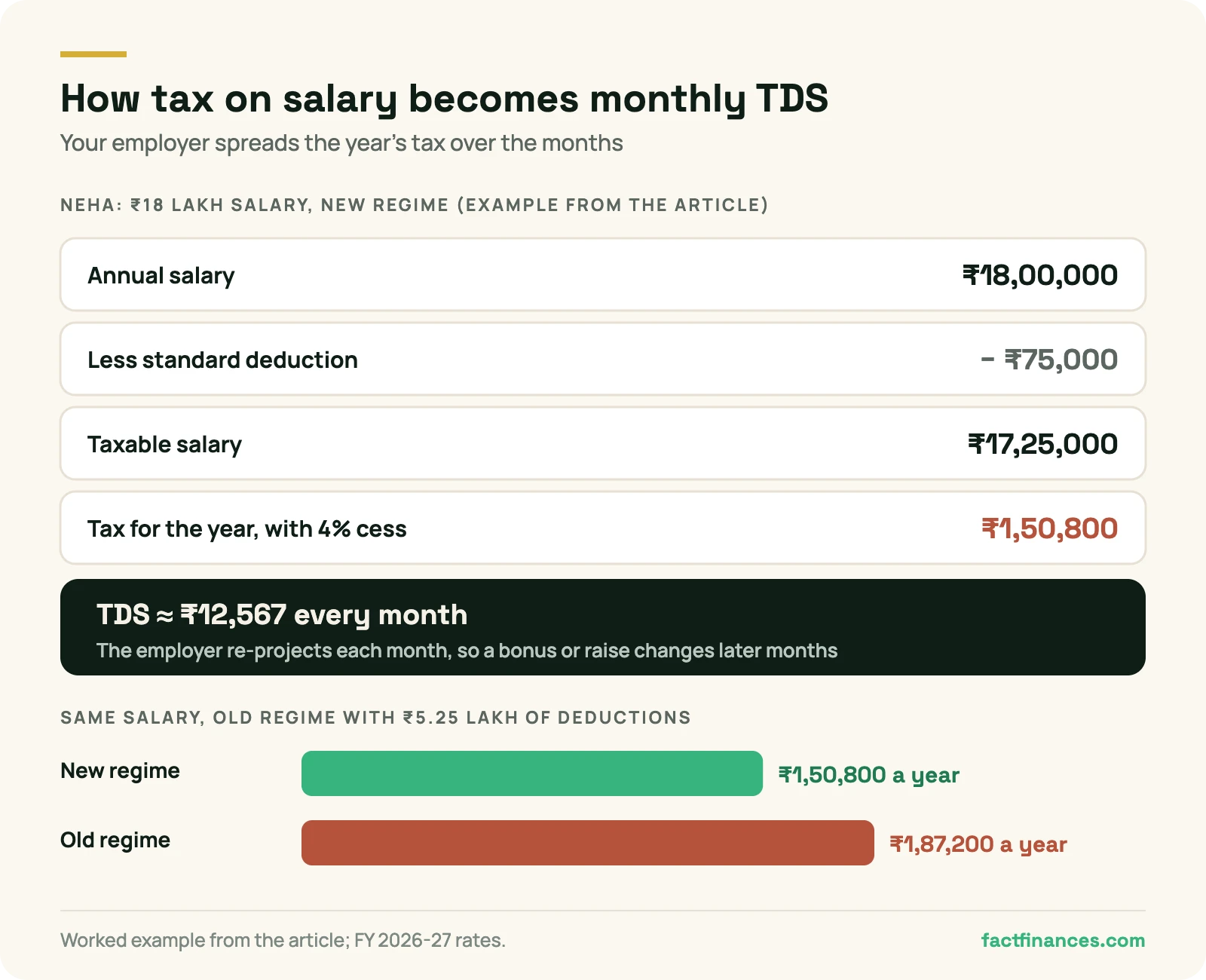
Neha earns ₹18 lakh a year and chooses the new regime. Taxable salary is ₹17.25 lakh after the standard deduction. The tax, with cess, is ₹1,50,800, so her employer deducts about ₹12,567 a month. If she had chosen the old regime and claimed ₹5.25 lakh of deductions, her tax would be ₹1,87,200, about ₹15,600 a month.
Choosing a Regime
Telling your employer which regime you want
At the start of the year, your employer asks which regime to use for TDS. If you say nothing, it uses the new regime, which is the default. Employers usually accept this choice once for the year.
The choice you give your employer is not final. If your income is only salary, interest and rent, you can pick either regime in your return, as long as you file by the due date (31 July for most salaried people). If you told your employer “new” and the old regime turns out cheaper, you claim the old regime in the return and get the difference as a refund. The reverse works too.
Our guide to choosing between the old and new regime explains the break-even point for your salary.
Form 124
Form 124: proofs for the old regime
If you choose the old regime, your employer needs evidence before it reduces your TDS. Form 124 is the declaration; the proofs go with it.
| Claim | What to give your employer |
|---|---|
| HRA | Rent receipts or agreement; landlord’s PAN if rent is above ₹1 lakh a year; whether the landlord is a relative (new from FY 2026-27) |
| Home loan interest | Lender’s name, address and PAN; interest certificate |
| Section 123 (old 80C) | Receipts or statements for PPF, ELSS, life premium, tuition fees, home loan principal |
| Health insurance (old 80D) | Premium receipts; preventive check-up bills |
| LTA | Travel tickets for the journey claimed |
Most employers ask for proofs between December and February. Miss the deadline and your TDS will be higher, but you can still claim the deductions in your return.
Details: HRA exemption, section 123 deductions, section 80D.
Form 130
Form 130: your salary certificate
Form 130 (formerly Form 16) is issued by your employer after the year ends, usually by mid-June. Part A shows the TDS deducted and deposited each quarter; Part B shows how your salary was taxed: gross pay, exemptions, deductions, regime and tax.
Before you file, check three things against Form 168 (formerly Form 26AS) and your Annual Information Statement:
- The TDS in Form 130 matches what your employer actually deposited against your PAN.
- Your PAN, name and employer’s TAN are correct.
- If you changed jobs, both employers’ salary and TDS appear.
For FY 2025-26 income, you received a Form 16 under the old Act; the new number applies from this year’s income.
What Is Exempt
Parts of salary that are tax-free in both regimes
| Item | Exemption |
|---|---|
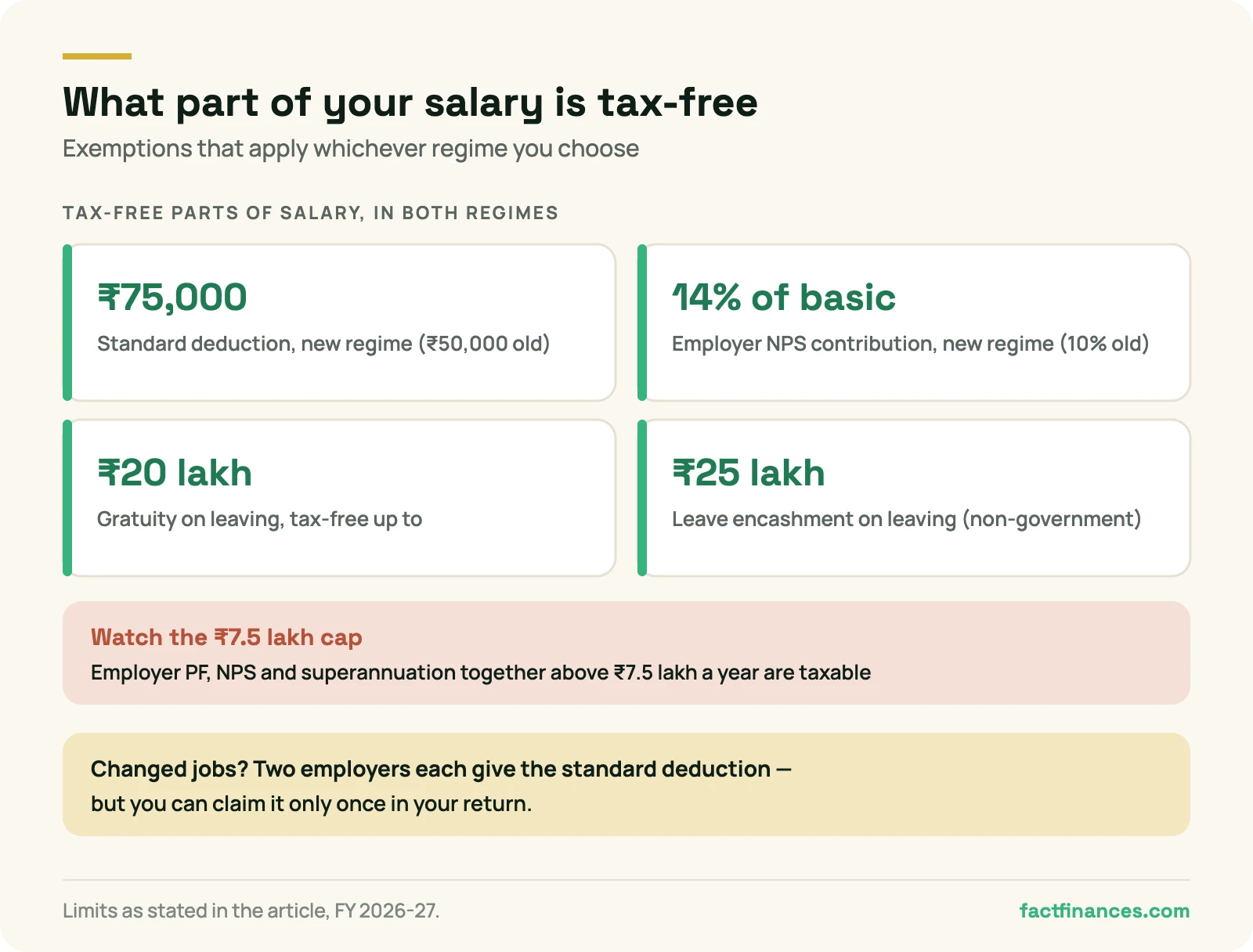
| Standard deduction | ₹75,000 (new) or ₹50,000 (old) |
| Employer NPS contribution | Up to 14% of basic + DA (new) or 10% (old) |
| Gratuity on leaving | Up to ₹20 lakh |
| Leave encashment on retirement or resignation (non-government) | Up to ₹25 lakh |
| Employer PF, NPS and superannuation together | Taxable above ₹7.5 lakh a year |
In the old regime, HRA, LTA, children’s education and hostel allowances, meal vouchers and gifts are also exempt within limits. Several of these limits rose sharply from April 2026; see what the new Act changed.
Special Situations
Changing jobs, other income, and arrears
You changed jobs during the year
Each employer deducts TDS as if its salary were your only income, and each gives you the ₹75,000 standard deduction and the lower slabs. Together they often deduct too little. Give your new employer the previous salary and TDS so it can correct the rest of the year; otherwise expect to pay the balance with your return.
You have interest, rent or capital gains
Your employer only knows your salary. You can declare other income to your employer so TDS covers it; if you do not, pay advance tax or pay the balance before filing. Interest on fixed deposits is the item most often missed. Read our guide to tax on FD and savings interest.
You received salary arrears
Arrears for earlier years can push you into a higher slab this year. Relief is available by spreading the arrears back to the years they relate to; it needs a separate form filed on the portal before you claim it in the return.
Common Mistakes
Mistakes people make with tax on salary
1. Treating TDS as the final tax
TDS covers salary only. Interest, rent and capital gains must still be reported, and tax on them paid.
2. Not checking Form 168 before filing
If your employer deducted TDS but did not deposit it correctly, your credit will be missing. Sort it out with HR before filing.
3. Two employers, two standard deductions
Each employer allows the full standard deduction and rebate. The return allows them only once.
4. Assuming you are stuck with the employer’s regime
You can switch in your return if you file on time.
5. Missing the proof deadline and giving up
Deductions not given in TDS can still be claimed in the return, with proofs kept ready.
Talk It Through
Want your salary tax checked before you file?
Send us your Form 130 (or Form 16), payslips and deduction proofs. We will match your TDS with Form 168 and the AIS, choose the cheaper regime, and help you file your ITR. Ranchi, Deoghar and across India online.
Chat on WhatsApp Send a message · Old vs new regime calculator
Key takeaways
→ Your employer projects your annual tax, spreads it over the months, and deducts it as TDS.
→ Tell your employer your regime at the start of the year; if you do not, the new regime applies. You can still switch in your return if you file on time.
→ Form 124 (old 12BB) carries your proofs; Form 130 (old Form 16) is the year-end certificate; Form 168 (old 26AS) shows what was deposited.
→ Changed jobs? Two employers usually under-deduct. Declare the earlier salary to the new one.
→ Interest, rent and capital gains are not covered by salary TDS; report them in your return.
Questions
Frequently asked questions
What is Form 130?
The salary TDS certificate your employer gives you after the year ends. It replaced Form 16 under the Income-tax Act, 2025 and shows your salary, exemptions, deductions, regime and the tax deducted.
What is Form 124?
The declaration you give your employer for HRA, home loan interest, LTA and deductions like section 123 and 80D. It replaced Form 12BB and now also asks whether your landlord is a relative.
What happens if I do not choose a regime with my employer?
Your employer deducts TDS under the new regime, which is the default. You can still choose the old regime in your return if you file by the due date.
Can I change my regime after telling my employer?
Employers usually accept the choice once for the year, but it does not bind you. You can pick either regime in your return, if your income is not from a business.
Why was so much tax deducted in February and March?
Usually because proofs were submitted late, a bonus was paid, or proofs were rejected. The employer recalculates the year’s tax and recovers the balance in the remaining months.
I changed jobs. Why do I owe tax?
Each employer gave you the full standard deduction and lower slabs as if its salary was all you earned. Combined, your income is in a higher slab, and the return collects the difference.
Keep Learning
Next steps: Old vs new regime calculator · HRA calculator · Tax on FD and savings interest
The bigger picture: The complete guide to income tax in India · Income tax slabs FY 2026-27
About the author
Ujjwal Tiwary
ARN-144500 · NISM Series V-A certified since 2018 · Ranchi & Deoghar, Jharkhand
Ujjwal Tiwary is an AMFI-registered mutual fund distributor (ARN-144500) based in Ranchi and Deoghar, Jharkhand, and has held the NISM Series V-A certification since 2018. He works with families on mutual funds, insurance and income tax returns, and writes or personally reviews every article on FactFinances. He is not a SEBI-registered investment adviser; nothing on this site is personalised advice.
Disclaimer: FactFinances provides educational content only. This article is general information and is not tax, legal or financial advice. It is based on the Income-tax Act, 1961 (which still governs returns for FY 2025-26 and earlier) and the Income-tax Act, 2025 (in force from 1 April 2026), as understood at the time of writing. Tax law, due dates and their interpretation can change, and your tax depends on your full facts; check the current position on the Income Tax Department portal or consult a chartered accountant before acting. FactFinances offers ITR filing assistance; reading this article places you under no obligation to use it.