

This article is part of our complete guide to income tax in India. To work out the tax on a sale, use the capital gains tax calculator.
The Short Answer
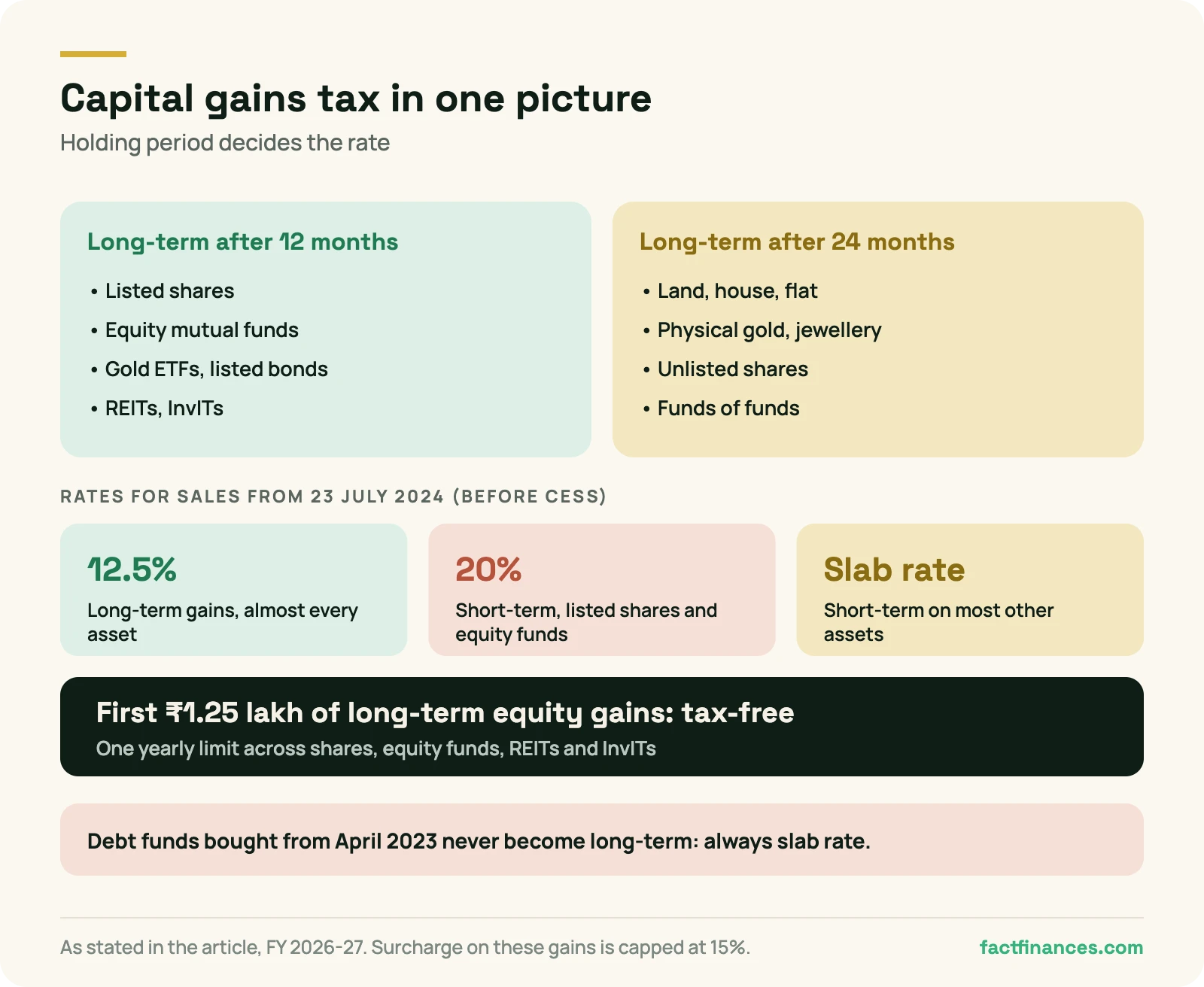
Capital gains tax in India now rests on three numbers. Long-term gains on almost every asset are taxed at 12.5%. Short-term gains on listed shares and equity funds are taxed at 20%; on most other assets, at your slab rate. And the first ₹1.25 lakh of long-term gains on listed shares and equity funds each year is tax-free.
What changes from asset to asset is how long you must hold for a gain to count as long-term: more than 12 months for listed shares, equity funds, gold ETFs and listed bonds; more than 24 months for property, physical gold, unlisted shares and funds of funds. Debt funds bought after March 2023 never become long-term.
These rules apply to sales from 23 July 2024 and continue unchanged for FY 2026-27 under the Income-tax Act, 2025. They are the same in the old and new regimes, and the ₹12 lakh rebate does not cover gains taxed at 20% or 12.5%.
The Rates
Capital gains tax rates for every asset
| Asset | Long-term after | Short-term gain | Long-term gain |
|---|---|---|---|
| Listed shares, equity mutual funds (STT paid) | 12 months | 20% | 12.5% above ₹1.25 lakh a year |
| REIT and InvIT units | 12 months | 20% | 12.5% above ₹1.25 lakh (shared limit) |
| Gold ETFs, listed bonds and debentures | 12 months | Slab rate | 12.5% |
| Gold and international funds of funds | 24 months | Slab rate | 12.5% |
| Land, house, flat | 24 months | Slab rate | 12.5%, or 20% with indexation if bought before 23 July 2024 |
| Physical gold, jewellery, unlisted shares | 24 months | Slab rate | 12.5% |
| Debt mutual funds bought on or after 1 April 2023 | Never | Slab rate | Slab rate |
| Debt mutual funds bought before 1 April 2023 | 24 months | Slab rate | 12.5% |
| Sovereign Gold Bonds held to maturity by original subscriber | — | — | Exempt |
All rates are before 4% cess. Surcharge on capital gains taxed at special rates is capped at 15%, even when your other income attracts more.
How It Is Worked Out
Working out the gain
The gain is the sale value minus expenses on the sale (brokerage, the property broker’s commission) minus the cost of acquisition, and for property, the cost of improvements. Holding period runs from the date of purchase to the date of sale; “more than 12 months” means even one day short keeps the gain short-term.
Example: shares
Ravi bought shares for ₹5 lakh in June 2023 and sells them for ₹7.5 lakh in November 2026. He held them for more than 12 months, so the ₹2.5 lakh gain is long-term. The first ₹1.25 lakh is exempt; the remaining ₹1.25 lakh is taxed at 12.5%, or ₹16,250 with cess.
Shares bought before 1 February 2018
Gains up to 31 January 2018 are protected (“grandfathered”). Your cost is the higher of what you paid and the market value on 31 January 2018 (capped at the sale price). Brokers show this value in their capital gains statements.
Equity and Mutual Funds
Shares and mutual funds
- The ₹1.25 lakh exemption is a single annual limit across all listed shares, equity funds and REIT/InvIT units, not per sale.
- Equity funds are those with at least 65% in Indian equity; hybrid funds below that line follow other rules.
- Each SIP instalment is a separate purchase with its own 12-month clock. Selling units bought in the last year creates short-term gains even if the SIP began years ago.
- Debt funds bought from April 2023 are taxed at your slab rate however long you hold them.
- Share buybacks are taxed as capital gains from 1 April 2026, on the gain over your cost, instead of as dividend on the full amount.
For more detail, see how mutual funds are taxed and how equity income is taxed, including intraday and F&O, which are business income rather than capital gains.
Property
Selling a house, flat or land
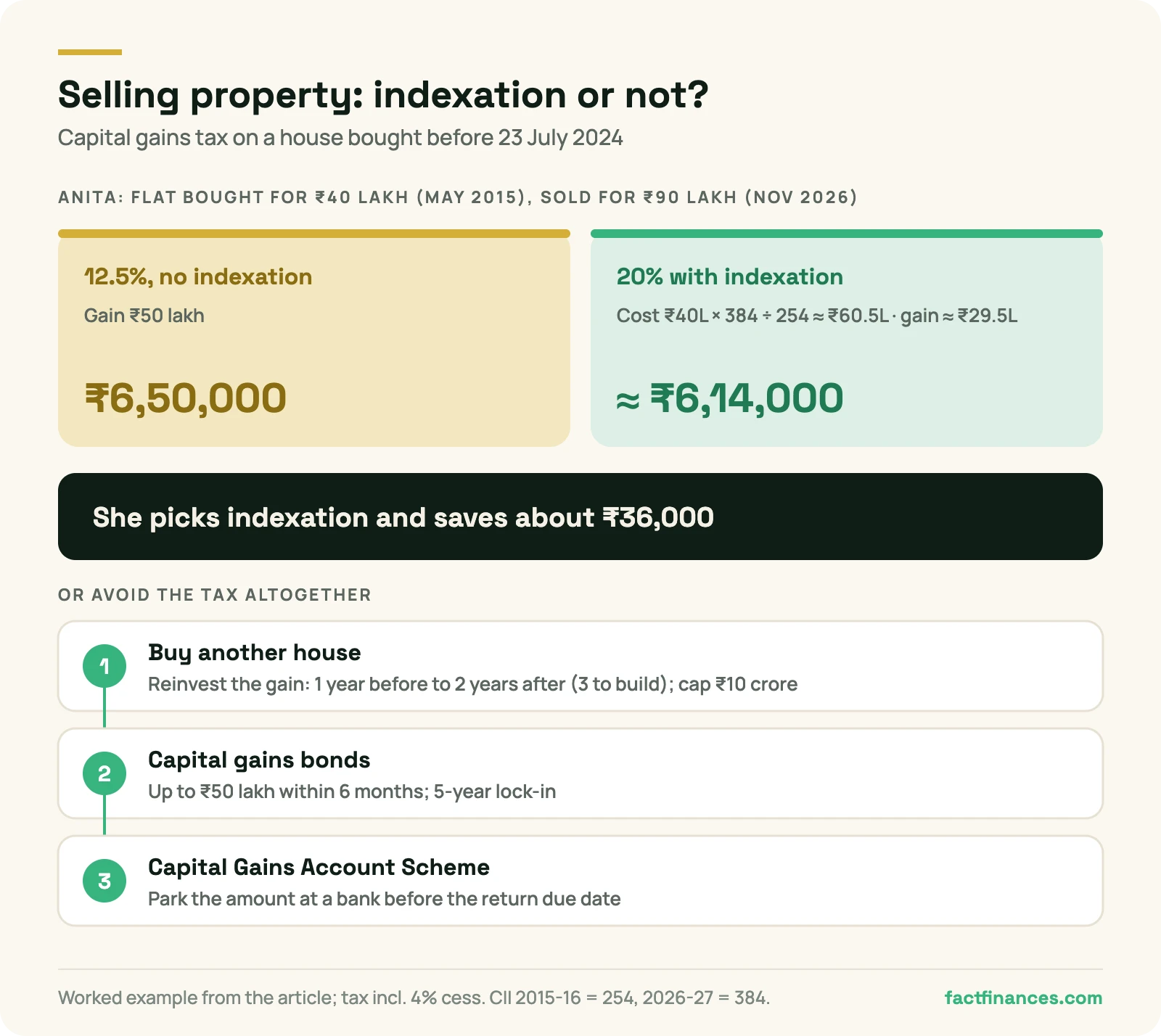
A property held more than 24 months gives a long-term gain taxed at 12.5% without indexation. If you are a resident individual or HUF and bought the property before 23 July 2024, you can instead choose 20% with indexation, which raises your cost by inflation using the Cost Inflation Index. You pay whichever is lower.
Example
Anita bought a flat for ₹40 lakh in May 2015 and sells it for ₹90 lakh in November 2026. Without indexation, the ₹50 lakh gain at 12.5% means ₹6,50,000 of tax with cess. With indexation, her cost becomes ₹40 lakh × 384 ÷ 254 = about ₹60.5 lakh, the gain about ₹29.5 lakh, and the tax at 20% about ₹6,14,000. She chooses indexation and saves about ₹36,000.
Indexation helps most for property held a long time with modest price growth; for fast-rising property, 12.5% is often lower. The calculator compares both.
Ways to avoid the tax
- Buy another house (section 54 of the old Act): reinvest the gain in one residential house, bought within one year before or two years after the sale, or built within three years. The exemption is capped at ₹10 crore.
- Selling something other than a house (old section 54F): invest the whole sale proceeds in a residential house for a full exemption, proportionately less for less.
- Capital gains bonds (old section 54EC): invest up to ₹50 lakh of the gain in specified bonds within six months of the sale; they lock in for five years.
- Not ready to buy before filing? Park the amount in the Capital Gains Account Scheme at a bank before the return due date.
The buyer deducts 1% TDS on property worth ₹50 lakh or more. It is a credit against your tax, not the tax itself.
Gold
Gold: physical, ETF, fund and bonds
| Form | Long-term after | Long-term rate |
|---|---|---|
| Gold ETF (listed) | 12 months | 12.5% |
| Gold mutual fund (fund of funds) | 24 months | 12.5% |
| Physical gold and jewellery | 24 months | 12.5% |
| Sovereign Gold Bond, original subscriber, held to maturity | — | Exempt |
| Sovereign Gold Bond bought on the exchange, or sold early | 12 months (listed) | 12.5% |
From FY 2026-27, the tax-free redemption of Sovereign Gold Bonds applies only to those who bought at the original issue and hold to maturity. Bonds bought later on the stock exchange are taxed on redemption.
Losses
Setting off and carrying forward losses
- A short-term capital loss can be set off against any capital gain, short or long.
- A long-term capital loss can be set off only against long-term gains.
- Capital losses cannot be set off against salary or other income.
- Unused losses carry forward for eight years, but only if your return for the loss year is filed by the due date.
Booking a loss before 31 March on a holding you no longer want can reduce this year’s tax, and booking up to ₹1.25 lakh of long-term equity gains each year uses an exemption that otherwise lapses. See how tax harvesting works.
Paying and Reporting
Paying the tax and reporting the sale
Capital gains tax is due in the year you sell. If your total tax after TDS is ₹10,000 or more, pay advance tax in the next instalment after the sale; interest is not charged for the instalments that fell before the gain arose. Report every sale in your return, even if the gain is exempt: ITR-2 for most individuals with capital gains, ITR-3 if you also have business income. Your Annual Information Statement already shows sales of shares, funds and property, so leaving them out triggers notices.
Common Mistakes
Mistakes people make with capital gains
1. Missing the holding period by days
Long-term means more than 12 or 24 months. A sale one day early can turn a 12.5% gain into 20% or slab rate.
2. Assuming the ₹12 lakh rebate covers gains
It does not cover gains taxed at 20% or 12.5%, even if your total income is below ₹12 lakh.
3. Forgetting SIP instalments have their own dates
Redeeming a SIP fund sells the oldest units first, but recent units may still be short-term.
4. Not reporting exempt gains
Gains within ₹1.25 lakh, or exempt by reinvestment, still have to be shown in the return.
5. Filing late with losses
A late return forfeits the right to carry forward capital losses.
Talk It Through
Sold shares, funds or property this year?
Send us your broker or fund capital gains statements, or the property sale and purchase deeds. We will work out the gains, check exemptions and indexation, set off losses, and help you file your ITR. Ranchi, Deoghar and across India online.
Chat on WhatsApp Send a message · Capital gains tax calculator
Key takeaways
→ Long-term gains: 12.5% on almost everything. Short-term: 20% on listed equity, slab rate on most else.
→ Listed shares and equity funds become long-term after 12 months; property, physical gold and unlisted shares after 24 months.
→ The first ₹1.25 lakh of long-term equity gains each year is tax-free.
→ Property bought before 23 July 2024: choose 12.5% without indexation or 20% with it, whichever is lower.
→ Debt funds bought after March 2023 are always taxed at slab rate.
→ Report every sale, and file on time to carry forward losses.
Questions
Frequently asked questions
What is the capital gains tax rate in India for FY 2026-27?
Long-term gains are taxed at 12.5% on most assets. Short-term gains on listed shares and equity funds are taxed at 20%; on other assets, at your slab rate. The first ₹1.25 lakh of long-term gains on listed equity each year is exempt.
When does a gain become long-term?
For listed shares, equity funds, gold ETFs and listed bonds, after more than 12 months. For property, physical gold, unlisted shares and funds of funds, after more than 24 months. Debt funds bought from April 2023 never become long-term.
Is indexation still available?
Only for land and buildings bought before 23 July 2024, by resident individuals and HUFs, who can choose 20% with indexation instead of 12.5% without. The Cost Inflation Index is 384 for FY 2026-27.
Does the ₹12 lakh rebate apply to capital gains?
No, not to gains taxed at the special rates of 20% or 12.5%. Short-term gains taxed at slab rate, such as on debt funds, are covered.
How can I save tax on the sale of a house?
By reinvesting the gain in another residential house within the time limits, by investing up to ₹50 lakh in specified capital gains bonds within six months, or by depositing the amount in the Capital Gains Account Scheme before filing your return if you have not bought yet.
Are SIP mutual fund gains long-term?
Each instalment is judged separately. Units held more than 12 months (equity funds) give long-term gains; recent instalments give short-term gains.
Keep Learning
Next steps: Capital gains tax calculator · How mutual funds are taxed · How equity income is taxed
The bigger picture: The complete guide to income tax in India · Income tax slabs FY 2026-27
About the author
Ujjwal Tiwary
ARN-144500 · NISM Series V-A certified since 2018 · Ranchi & Deoghar, Jharkhand
Ujjwal Tiwary is an AMFI-registered mutual fund distributor (ARN-144500) based in Ranchi and Deoghar, Jharkhand, and has held the NISM Series V-A certification since 2018. He works with families on mutual funds, insurance and income tax returns, and writes or personally reviews every article on FactFinances. He is not a SEBI-registered investment adviser; nothing on this site is personalised advice.
Disclaimer: FactFinances provides educational content only. This article is general information and is not tax, legal or financial advice. It is based on the Income-tax Act, 1961 (which still governs returns for FY 2025-26 and earlier) and the Income-tax Act, 2025 (in force from 1 April 2026), as understood at the time of writing. Tax law, due dates and their interpretation can change, and your tax depends on your full facts; check the current position on the Income Tax Department portal or consult a chartered accountant before acting. FactFinances offers ITR filing assistance; reading this article places you under no obligation to use it.