

Part of our complete guide to mutual funds in India — an SWP turns a lump sum into a monthly income — and how long it lasts depends almost entirely on how much you take out. This is educational content, not investment advice.
A Systematic Withdrawal Plan (SWP) is the mirror image of a SIP. Instead of putting a fixed amount into a fund every month, you take a fixed amount out, and the rest stays invested. An SWP in mutual funds is how many retirees turn a retirement corpus into a monthly “salary”, and it is usually taxed far more lightly than fixed-deposit interest. It is also not a guaranteed income: draw too much, or hit a bad market early, and the corpus can run dry. This guide shows how an SWP works, how each withdrawal is taxed, and how much is reasonable to draw.
Try your own figures: our SWP calculator shows how long a corpus lasts for any monthly withdrawal and assumed return. Run it at two or three different returns, not just the one you hope for.
The Basics
How an SWP works
You invest a lump sum in a mutual fund scheme and instruct the fund house to redeem a fixed amount on a fixed date — monthly, quarterly or yearly — and credit it to your bank account. Each time, the fund sells just enough units at that day’s NAV to pay you.
- When the NAV is high, fewer units are sold; when it is low, more units are sold to pay the same amount. This is the reverse of rupee-cost averaging, and it is why falls early in an SWP hurt most.
- The balance keeps earning. If the fund’s return is higher than your withdrawal rate, the corpus can grow even while it pays you.
- You stay in control. You can raise, lower, pause or stop the SWP, or redeem a lump sum on top, at any time. There is no lock-in and no penalty beyond any exit load.
- Nothing is guaranteed. Unlike an FD, a pension or an annuity, neither the corpus value nor how long it lasts is promised.
The types you will be offered
| Type | What it pays | Suits |
|---|---|---|
| Fixed amount | The same rupee amount each time | Regular household income — the usual choice |
| Appreciation only | Only the gain since the last payout; nothing if there is none | Those who do not want to touch capital and can live with irregular income |
| Fixed number of units | A set number of units, so the amount varies with NAV | Rarely used |
The Tax Advantage
How SWP withdrawals are taxed
This is the part most people get wrong. An SWP payout is not “income” like interest. Each withdrawal is a sale of units, and each unit sold is partly your own money coming back and partly gain. Only the gain portion is taxed. Units are sold on a first-in, first-out basis.
| Fund type (by holding) | Units held | Tax on the gain portion |
|---|---|---|
| Equity-oriented (65% or more in Indian shares, including most aggressive hybrid, balanced advantage and arbitrage funds) | More than 12 months | 12.5% on total equity gains above ₹1.25 lakh a year |
| Equity-oriented | 12 months or less | 20% |
| Debt-oriented funds bought on or after 1 April 2023 | Any period | At your slab rate |
In numbers: SWP against fixed-deposit interest
Mr Verma, 61, retired in Ranchi, put ₹50 lakh in an equity-oriented hybrid fund a year ago. Assume it has grown 9% a year, so it is now worth about ₹54.5 lakh, and he starts an SWP of ₹30,000 a month. Compare that with keeping ₹50 lakh in a 7% fixed deposit.
| SWP of ₹30,000 a month | ₹50 lakh FD at 7% | |
|---|---|---|
| Cash received in the year | ₹3,60,000 | ₹3,50,000 |
| Part that counts for tax | Gain portion only: ≈ ₹45,000 | All ₹3,50,000 |
| Tax at the 20% slab | Nil (within the ₹1.25 lakh exemption) | ≈ ₹72,800 |
| Tax at the 30% slab | Nil | ≈ ₹1,09,200 |
| Value at the end of the year | ≈ ₹55.7 lakh, if the 9% assumption holds | ₹50 lakh, guaranteed |
The tax saving is real, but notice the last row: the FD’s capital is certain and the fund’s is not. The low tax is the reward for carrying market risk — it is not a free lunch. Full rules are in mutual fund taxation in India, and you can test a figure in our capital gains tax calculator.
SWP or the IDCW (dividend) option?
The IDCW option also pays out cash, but the amount and timing are decided by the fund house, and every rupee paid is added to your income and taxed at your slab. An SWP from the growth option gives you a fixed amount on a fixed date and taxes only the gain portion. For regular income, SWP from the growth option is almost always the better route.
How Much
How much can you withdraw?
The single most important number in an SWP is the withdrawal rate — the yearly withdrawal as a percentage of the starting corpus. Here is ₹50 lakh over 25 years at four withdrawal rates and two assumed returns, with the monthly amount kept constant.
| Withdrawal rate | Monthly amount | Left after 25 years at 7% return | Left after 25 years at 9% return |
|---|---|---|---|
| 4% a year | ≈ ₹16,700 | ≈ ₹1.41 crore | ≈ ₹2.55 crore |
| 6% a year | ₹25,000 | ≈ ₹75.6 lakh | ≈ ₹1.67 crore |
| 8% a year | ≈ ₹33,300 | ≈ ₹10.4 lakh | ≈ ₹78.6 lakh |
| 10% a year | ≈ ₹41,700 | Runs out in about 17 years | Runs out in about 23 years |
Now add inflation
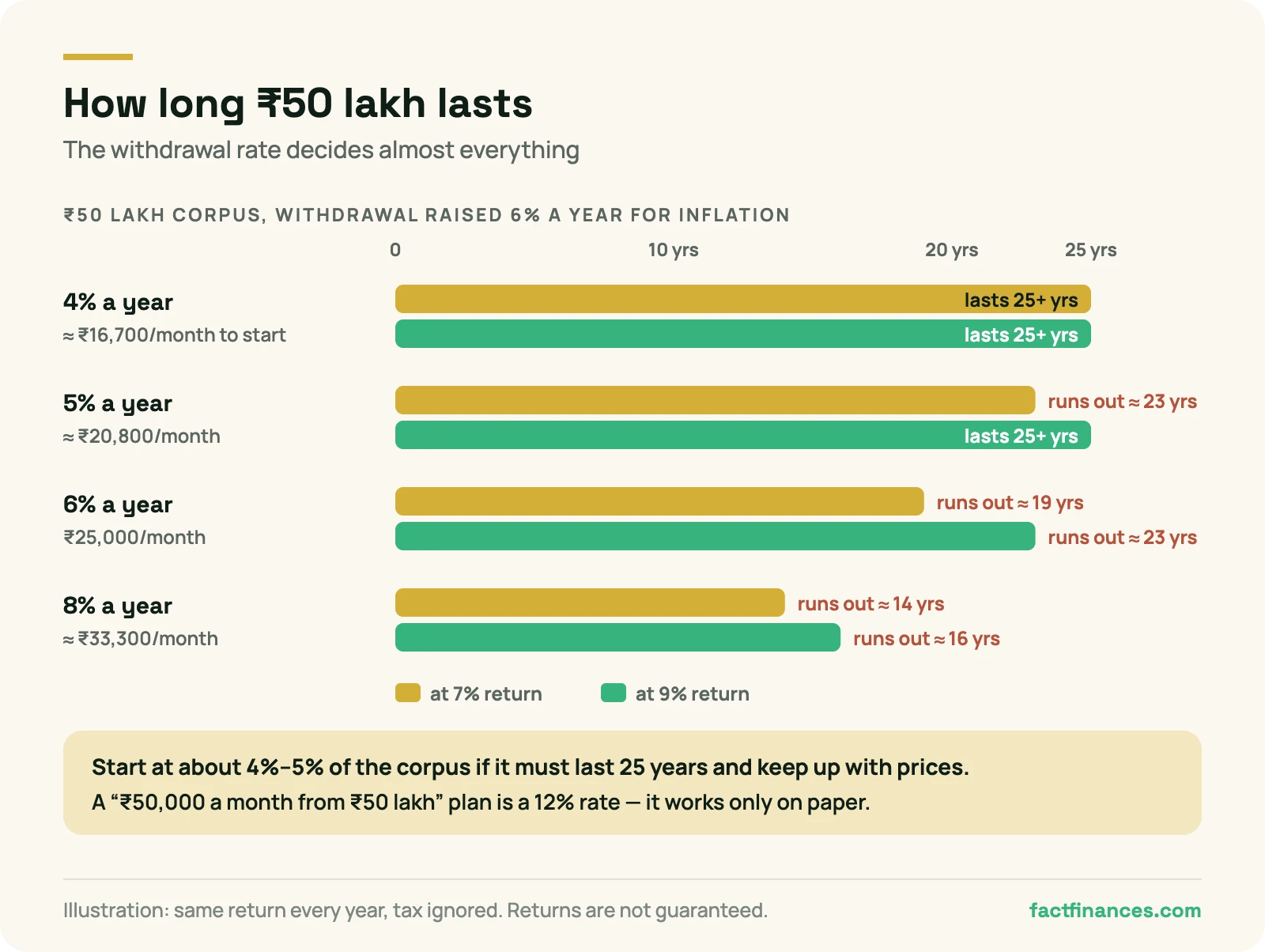
A fixed ₹25,000 buys much less after 15 years. If the withdrawal is raised by 6% every year to keep pace with prices, the picture changes sharply:
| Starting withdrawal rate | First-year monthly amount | At 7% return | At 9% return |
|---|---|---|---|
| 4% a year | ≈ ₹16,700 | ≈ ₹37 lakh left after 25 years | ≈ ₹1.31 crore left |
| 5% a year | ≈ ₹20,800 | Runs out in about 23 years | ≈ ₹55.6 lakh left |
| 6% a year | ₹25,000 | Runs out in about 19 years | Runs out in about 23 years |
| 8% a year | ≈ ₹33,300 | Runs out in about 14 years | Runs out in about 16 years |
The practical reading: if the income has to last 25 years or more and keep up with prices, a starting rate of around 4% to 5% of the corpus is a sensible range, and anything near 8% is drawing down capital quickly. The advertisements that show “₹50,000 a month from ₹50 lakh” (a 12% rate) only work on paper, with an optimistic return repeated every year.
The Hidden Risk
Why the order of returns matters
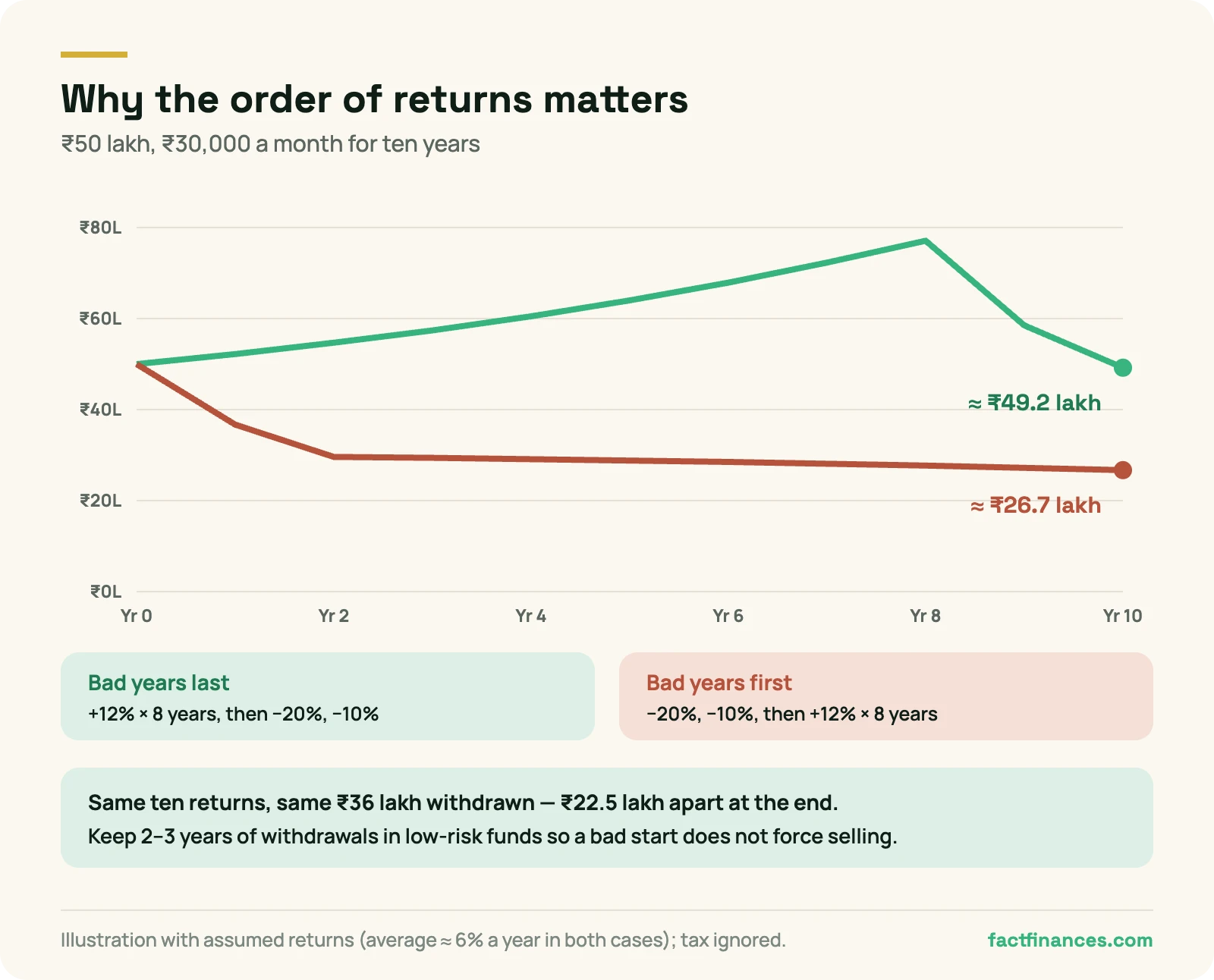
Two people each start with ₹50 lakh and withdraw ₹30,000 a month for ten years. Both get exactly the same ten yearly returns — eight years of +12%, one of −20% and one of −10% — but in a different order.
| Bad years come first | Bad years come last | |
|---|---|---|
| Yearly returns | −20%, −10%, then +12% for eight years | +12% for eight years, then −20%, −10% |
| Average yearly return over ten years | ≈ 6% | ≈ 6% |
| Total withdrawn | ₹36 lakh | ₹36 lakh |
| Corpus left after ten years | ≈ ₹26.7 lakh | ≈ ₹49.2 lakh |
This is called sequence risk. When the market falls early, more units have to be sold at low prices to pay the same income, and those units are not there to recover later. It is the reason an SWP should not be run from a pure equity fund with no cushion.
Setting It Up
Which funds, and how to arrange the money
- Keep two to three years of withdrawals in low-risk funds. A liquid or short-duration debt fund pays the SWP, so a bad year in shares does not force sales at the bottom.
- Put the rest in a fund with growth in it — typically a conservative-to-moderate hybrid or balanced advantage category — sized to your age and other income. Our guide to asset allocation explains how to set the split.
- Refill the low-risk bucket in good years, not on a fixed date. This is the part that takes judgement.
- Mind the exit load. Many equity and hybrid funds charge about 1% on units redeemed within 12 months. Either invest a year before the SWP starts, or pay the first year’s income from the liquid fund. See expense ratio and exit load.
- Waiting 12 months also matters for tax: gains on equity-oriented units sold within a year are taxed at 20% rather than 12.5%.
- Choose the growth option, and pick an SWP date a few days after your big monthly bills fall due.
The steps
- Decide the monthly amount from your budget, then check it is within about 4% to 6% a year of the corpus.
- Invest the corpus — all at once, or staggered over some months if markets worry you (see SIP vs lumpsum).
- Submit the SWP request to the fund house, online or through your distributor: scheme, amount, date, frequency and start month.
- Check that the bank account on the folio is the one you want the money in.
- Review once a year: corpus value, withdrawal rate, whether to raise the amount, and whether the low-risk bucket needs refilling.
The Alternatives
SWP alongside pensions, SCSS and annuities
An SWP is one tool, not the whole retirement plan. The guaranteed options do a job it cannot.
| SWP from mutual funds | Senior Citizens’ Savings Scheme | Annuity from an insurer | |
|---|---|---|---|
| Income | You choose; can be raised | Fixed quarterly interest, 8.2% a year at present | Fixed for life once bought |
| Guaranteed? | No | Yes, government-backed | Yes, by the insurer |
| Capital | Yours, fluctuates, passes to heirs | Returned after 5 years | Usually given up, unless a return-of-purchase-price option is chosen |
| Limit | None | ₹30 lakh per person | None |
| Tax | Gain portion only | Interest fully taxable | Pension fully taxable |
| Keeps up with inflation? | Can, if returns allow | No | No, in most plans |
A common arrangement is to cover essential bills from guaranteed sources — pension, SCSS, an annuity — and use an SWP for the rest and for rising costs. More on the guaranteed side in small savings schemes and annuity and pension plans; to size the corpus itself, use the retirement calculator.
Mistakes
Mistakes that empty a corpus early
- Fixing the withdrawal at 10%–12% of the corpus because a brochure showed it working.
- Running the SWP from a small-cap or pure equity fund with no low-risk cushion.
- Starting the SWP in the first year and paying exit load and 20% tax on every withdrawal.
- Never raising the amount for inflation — or raising it every year without checking the corpus.
- Treating the payout as “interest” and being shocked when the value falls in a bad year.
- Choosing the IDCW option for income instead of an SWP from the growth option.
- Putting the entire retirement corpus into one SWP, with nothing guaranteed underneath.
Our Approach
How we set up SWPs for the families we work with
We are an AMFI-registered mutual fund distributor. Setting up an SWP takes five minutes; keeping it alive for twenty-five years is the real work. In practice:
- We start from the household budget, and from what pension, rent and SCSS already cover, so the SWP carries only what it needs to.
- We test the withdrawal rate at cautious returns and with inflation, and say so plainly if the amount asked for is too high for the corpus.
- We arrange the buckets — low-risk money for the next two to three years, growth money for later — and time the first withdrawal around exit load and the 12-month tax line.
- We review every year and guide the decisions that matter: when to refill the low-risk bucket, when to raise the income, and when to hold back after a bad year. Nobody can promise to call the market’s tops and bottoms; the aim is to avoid forced selling.
- We help the family with nomination and, when the time comes, with transferring the units.
We earn a commission from the Regular plan of the funds you hold through us; direct vs regular plans explains the cost and what it pays for. The free FactFinances app shows your running SWPs and what the corpus is worth today.
FAQ
Frequently asked questions
What is an SWP in mutual funds?
A Systematic Withdrawal Plan is an instruction to redeem a fixed amount from a mutual fund scheme at regular intervals, usually monthly, and credit it to your bank account. The rest of the investment stays in the fund.
Is SWP income taxable?
Only the gain portion of each withdrawal is taxed, not the whole amount. For equity-oriented funds held more than 12 months, gains above ₹1.25 lakh a year are taxed at 12.5%; within 12 months, at 20%. Gains on debt funds bought on or after 1 April 2023 are taxed at your slab rate.
How much can I withdraw from ₹50 lakh through an SWP?
There is no fixed limit, but the rate decides how long the money lasts. Around 4% to 5% a year (about ₹17,000 to ₹21,000 a month) leaves room to raise the income with inflation over 25 years in our illustrations; 8% or more draws the corpus down quickly.
Is SWP better than a fixed deposit for monthly income?
An SWP is usually taxed more lightly and can keep up with inflation, but neither the corpus nor the income is guaranteed. An FD gives a certain income and safe capital, with interest fully taxable. Many retirees use both.
Can an SWP run out of money?
Yes. If withdrawals are higher than the fund’s returns for long enough, or the market falls sharply in the early years, the corpus can be exhausted. A modest withdrawal rate and a low-risk cushion for the next two to three years reduce that risk.
Which type of mutual fund is best for an SWP?
There is no single best fund. A common arrangement keeps two to three years of withdrawals in liquid or short-duration debt funds and the rest in a hybrid category with some equity. Running an SWP from a pure equity fund alone exposes the income to large falls.
Is there an exit load on SWP withdrawals?
Yes, if the units being sold are within the scheme’s exit-load period — often 1% within 12 months for equity and hybrid funds. Starting the SWP after 12 months, or paying the first year from a liquid fund, avoids it.
Keep learning: Try the SWP calculator, read how mutual fund gains are taxed, set your asset allocation, compare annuity and pension plans, or return to the main mutual funds guide.
Free · Printable · 10 minutes
Your 5-point money check-up
A 10-minute printable that shows where your family’s money is protected and where it isn’t. Plus one useful money article a month. No spam.
General information only, not personalised advice. Ujjwal Tiwary, AMFI-registered Mutual Fund Distributor, ARN-144500.
About the author
Ujjwal Tiwary
ARN-144500 · NISM Series V-A certified since 2018 · Ranchi & Deoghar, Jharkhand
Ujjwal Tiwary is an AMFI-registered mutual fund distributor (ARN-144500) based in Ranchi and Deoghar, Jharkhand, and has held the NISM Series V-A certification since 2018. He works with families on mutual funds, insurance and income tax returns, and writes or personally reviews every article on FactFinances. He is not a SEBI-registered investment adviser; nothing on this site is personalised advice.
FactFinances is an educational platform. We are an AMFI-registered mutual fund distributor (ARN-144500). We do not provide investment advice or recommend specific securities. All figures are illustrations at assumed rates and are not guarantees or forecasts of returns. Mutual fund investments are subject to market risks; read all scheme-related documents carefully.