

Part of our complete guide to mutual funds in India — every scheme comes in two plans, and choosing between them is a decision about cost and help. This is educational content, not investment advice.
Every mutual fund scheme in India comes in two versions: a Direct plan and a Regular plan. Same fund manager, same portfolio, same stocks — the only difference is what you pay each year. We should say this upfront: we are an AMFI-registered mutual fund distributor, and Regular plans are how distributors like us are paid. That is exactly why this page gives you the full picture — the real cost of a Regular plan, in rupees, and what that money is supposed to buy — so you can decide for yourself.
The Basics
Same fund, two price tags
SEBI required every scheme to offer a Direct plan from 1 January 2013, so that investors who do not want a distributor’s help do not have to pay for it. A Regular plan’s expense ratio includes the commission the fund house pays your distributor; a Direct plan’s does not.
| Direct plan | Regular plan | |
|---|---|---|
| Portfolio and fund manager | Same | Same |
| How you invest | Yourself — fund house website or app, MFCentral, or a platform offering Direct plans | Through a mutual fund distributor (or a bank or broker acting as one) |
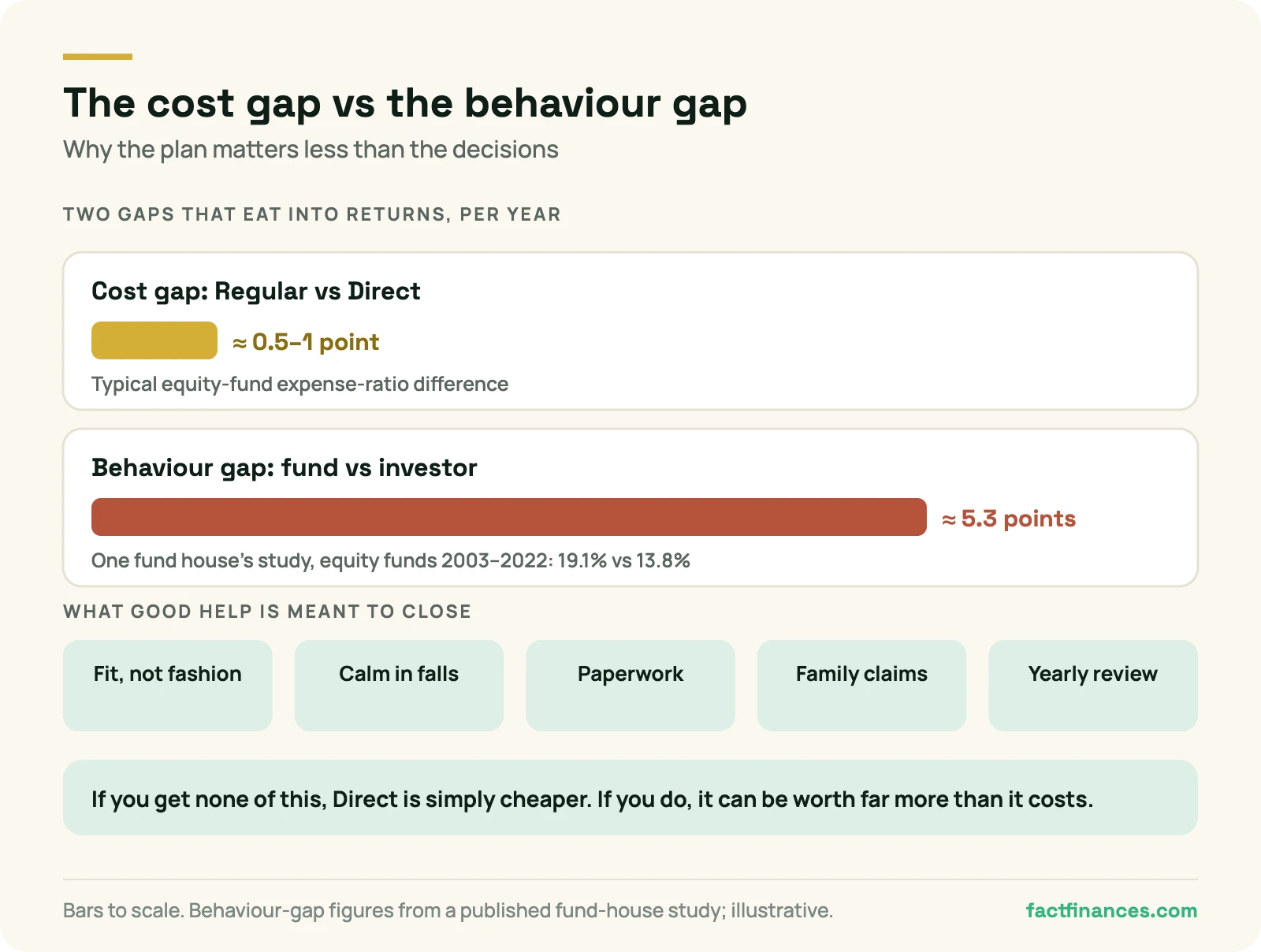
| Expense ratio | Lower | Higher — typically by about 0.5 to 1 percentage point in equity funds |
| NAV | Slightly higher, and the gap widens every year | Slightly lower |
| Who helps you choose, review and handle paperwork | You | Your distributor |
What changed in 2026
- From 1 April 2026, the old total expense ratio was split: a base expense ratio covers the fund house’s fees, including distributor commission, while taxes and levies such as GST and STT are shown separately.
- From 1 November 2026, Direct plans are the default option on fund houses’ own websites and apps, and anyone choosing a Regular plan there must be told it costs more. Existing Regular holdings and SIPs are not converted automatically.
- Every half-yearly Consolidated Account Statement already shows, in rupees, the commission paid on each Regular-plan holding.
The Cost
What a Regular plan costs, in rupees
A difference of under 1% a year sounds small. Compounded over decades, it is not. Assume a fund earns 12% a year before costs, a Direct plan charges 0.6% and the Regular plan 1.4% — a gap of 0.8 percentage point:
| Investment | You put in | Direct plan (assumed 11.4% net) | Regular plan (assumed 10.6% net) | Difference |
|---|---|---|---|---|
| ₹10,000 a month for 20 years | ₹24 lakh | ≈ ₹92.2 lakh | ≈ ₹82.8 lakh | ≈ ₹9.3 lakh |
| ₹5 lakh once, held 15 years | ₹5 lakh | ≈ ₹25.2 lakh | ≈ ₹22.7 lakh | ≈ ₹2.6 lakh |
That is the honest cost of a Regular plan over a long horizon. If you get nothing for it, it is money lost. The real question is whether the help you get is worth more than that — and the answer depends far less on the plan than on the decisions you make.
A Real Case
Two investors, one fund: why the plan was not the deciding factor
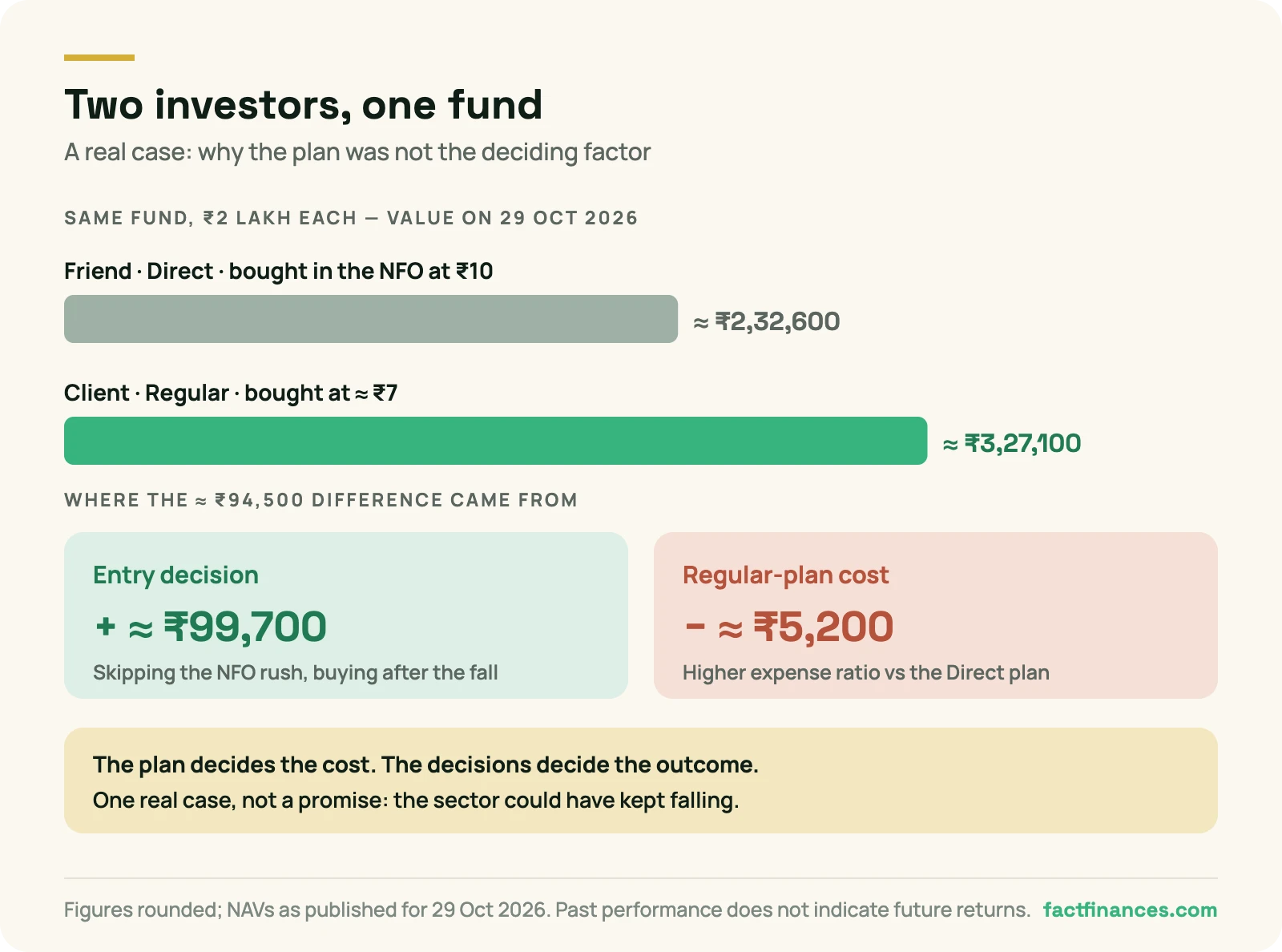
Here is a real case from our own practice, with names left out and figures rounded. In June 2024 a defence-sector index fund was launched through an NFO at ₹10 a unit, at a time when the theme was in every headline. A friend of ours invested ₹2 lakh in the NFO himself, through the Direct plan. Over the following months the sector fell sharply, and the fund’s NAV dropped to around ₹7. At that point we invested ₹2 lakh for a client — through the Regular plan.
| Friend: Direct plan, in the NFO | Client: Regular plan, months later | |
|---|---|---|
| Amount invested | ₹2,00,000 | ₹2,00,000 |
| Price paid per unit | ₹10 (NFO) | ≈ ₹7 |
| Units bought | 20,000 | ≈ 28,571 |
| NAV on 29 Oct 2026 | ₹11.63 (Direct) | ₹11.45 (Regular) |
| Value on 29 Oct 2026 | ≈ ₹2,32,600 | ≈ ₹3,27,100 |
| Gain | ≈ ₹32,600 (+16%) | ≈ ₹1,27,100 (+64%) |
Now split the ≈ ₹94,500 difference into its two causes. The Regular plan’s higher cost cost the client about ₹5,200 — had the same units been bought in the Direct plan at ₹7, they would be worth about ₹3,32,300. The entry decision — not rushing into the NFO, and investing after the theme had cooled — accounts for the rest, about ₹99,700.
What this case shows, and what it does not:
- It shows that the plan is rarely the biggest variable. A 0.7-point annual cost difference was dwarfed by one decision about when and how to enter.
- It shows why NFO excitement is a poor reason to invest. A ₹10 NFO is not “cheap”; the price says nothing about value.
- It does not prove that waiting for a fall always works. The sector could have kept falling. One case — even a real one — is not evidence that a distributor will always time things well, and we would not claim it is.
- It does not mean Direct plans are worse. Had the friend received the same guidance and bought the Direct plan at ₹7, he would have done slightly better than our client. The plan only decides the cost; the decisions decide the outcome.
The Value
What the commission pays for
Studies of Indian investors consistently find that people earn less than the funds they own, because they buy after rallies, sell in falls and stop SIPs at the bottom. One fund house’s study of equity funds over 2003–2022 put fund returns at about 19.1% a year, against about 13.8% for what investors actually earned. That gap is several times larger than any expense-ratio difference. A good distributor earns the commission by helping you close it:
- Choosing what fits. Matching category, plan and option to your goal, horizon and tax position — and saying no to the NFO or theme of the month when it does not fit.
- Timing the big decisions. Whether to rush into an NFO, when to put a lump sum to work or stagger it through an STP, and when to rebalance or redeem for a goal. Nobody can call market tops and bottoms reliably, but a second, unemotional view at these moments is often where the largest rupee differences come from — as the case above shows.
- Staying invested when it is hardest. A steady voice when markets fall is where most of the value lies.
- The paperwork. KYC, nominations, bank mandates, consolidating folios, redemptions done right.
- Your family, later. Someone who knows every folio can help your family claim the units if something happens to you.
- A yearly review. Checking each folio’s XIRR against the right benchmark and rebalancing when the mix drifts.
Choosing
Which plan fits you?
| If this describes you… | Usually a better fit |
|---|---|
| You choose funds, rebalance, track XIRR and handle KYC and nominations yourself — and you stay calm in falls | Direct |
| You want to pay for guidance separately and in full view | Direct, with a SEBI-registered investment adviser charging a fee |
| You want someone to help you choose, review every year and keep you on course in bad markets | Regular, through a distributor you trust |
| You have family members who may need help with claims and paperwork | Regular, or Direct with a plan for who will handle it |
| You are paying for a Regular plan but cannot remember the last review or call | Ask for that service — or reconsider |
Thinking of switching an existing Regular holding to Direct?
Switching is a redemption from one plan and a fresh purchase in the other. It can trigger capital gains tax and an exit load, and it resets the holding period. Existing SIPs do not switch on their own — you would stop the Regular SIP and register a new one. Work out the tax first; our guide to mutual fund taxation explains how.
Whichever you choose, choose it knowingly. If you would like the kind of help described above, that is what we do — and you will always be able to see what it costs on your CAS.
FAQ
Frequently asked questions
What is the difference between direct and regular mutual funds?
They are two plans of the same scheme, with the same portfolio and fund manager. A Regular plan has a higher expense ratio because it includes the commission paid to your distributor; a Direct plan has no commission and a lower expense ratio, so its NAV is slightly higher.
How much more does a regular plan cost?
Typically about 0.5 to 1 percentage point a year in equity funds. Over 20 years on a ₹10,000 monthly SIP, a 0.8-point gap can mean roughly ₹9 lakh less at an assumed 12% gross return — which is why the help you get for it should be real.
Is a direct plan always better?
It is always cheaper. Whether it is better depends on your decisions: investors often lose far more to poor timing and panic selling than to expense ratios. If you make good decisions on your own, Direct is better; if guidance helps you make them, a Regular plan can be worth its cost.
What changed for direct plans in November 2026?
From 1 November 2026, fund houses’ own websites and apps show the Direct plan as the default, and investors choosing a Regular plan there must be told it costs more. Existing Regular holdings and SIPs are not converted automatically.
Should I switch from regular to direct?
Switching is treated as a sale and a fresh purchase, so it can trigger capital gains tax and exit loads. Weigh that cost, and the value of the service you would lose, before switching. For new money, the choice is simpler.
How do I know which plan I hold?
Your Consolidated Account Statement (CAS) names the plan — Direct or Regular — for every folio, and the half-yearly CAS shows the commission paid on Regular holdings in rupees.
Keep learning: Learn to read your CAS, measure your real return with XIRR, avoid common mutual fund mistakes, or return to the main mutual funds guide.
Free · Printable · 10 minutes
Your 5-point money check-up
A 10-minute printable that shows where your family’s money is protected and where it isn’t. Plus one useful money article a month. No spam.
General information only, not personalised advice. Ujjwal Tiwary, AMFI-registered Mutual Fund Distributor, ARN-144500.
About the author
Ujjwal Tiwary
ARN-144500 · NISM Series V-A certified since 2018 · Ranchi & Deoghar, Jharkhand
Ujjwal Tiwary is an AMFI-registered mutual fund distributor (ARN-144500) based in Ranchi and Deoghar, Jharkhand, and has held the NISM Series V-A certification since 2018. He works with families on mutual funds, insurance and income tax returns, and writes or personally reviews every article on FactFinances. He is not a SEBI-registered investment adviser; nothing on this site is personalised advice.
FactFinances is an educational platform. We are an AMFI-registered mutual fund distributor (ARN-144500). We do not provide investment advice or recommend specific securities. All figures are illustrations at assumed rates and are not guarantees or forecasts of returns. Mutual fund investments are subject to market risks; read all scheme-related documents carefully.