

Part of our complete guide to mutual funds in India — your returns can be measured three ways, and only one of them is right for a SIP. This is educational content, not investment advice.
Open a mutual fund app, a factsheet and your CAS side by side and you may see three different “returns” for what feels like the same money: an absolute return, a CAGR and an XIRR. They are not three opinions. They answer three different questions — and using the wrong one is how a perfectly good SIP gets mistaken for a bad investment, or a short lucky streak for a great one.
The one-line answer: use absolute return for anything under a year, CAGR for a single lump sum held longer than a year, and XIRR whenever money went in or came out on more than one date — every SIP, top-up or withdrawal. Our free FactFinances app shows XIRR for every folio from your CAS.
The Basics
Three numbers, three different questions
| Measure | The question it answers | Use it for | Watch out for |
|---|---|---|---|
| Absolute return | How much did my money grow in total? | Holdings under one year | Ignores time completely |
| CAGR | At what steady yearly rate did one sum grow? | One lump sum held over a year; fund factsheets | Assumes a single entry and a smooth ride |
| XIRR | What yearly rate did I earn on all my money, given when each rupee went in or came out? | SIPs, top-ups, withdrawals, whole portfolios | Wild numbers over short periods |
Absolute Return
Absolute return: the total, with no clock
Absolute return is the simplest: the gain divided by what you put in. ₹1,00,000 that becomes ₹1,40,000 has an absolute return of 40%.
The problem is that it has no clock. That same 40% over four years works out to about 8.8% a year; over ten years, 90% sounds impressive but is only about 6.6% a year — roughly what a bank deposit has paid. That is why SEBI requires mutual funds to show returns for periods under one year in absolute terms, and to annualise only beyond a year. Under a year, absolute return is the honest number; beyond a year, it flatters.
CAGR
CAGR: one sum, one start, one finish
CAGR — compound annual growth rate — asks: at what constant yearly rate would the starting amount have grown into the ending amount? The formula is (ending value ÷ starting value)1 ÷ years − 1. ₹1,00,000 to ₹1,40,000 over four years gives 1.40.25 − 1 ≈ 8.8%.
This is the number on every fund factsheet: the 1-, 3-, 5- and 10-year returns of a scheme are point-to-point CAGRs of its NAV. It is the right tool for a single lump sum. But it hides two things.
What CAGR hides: the ride
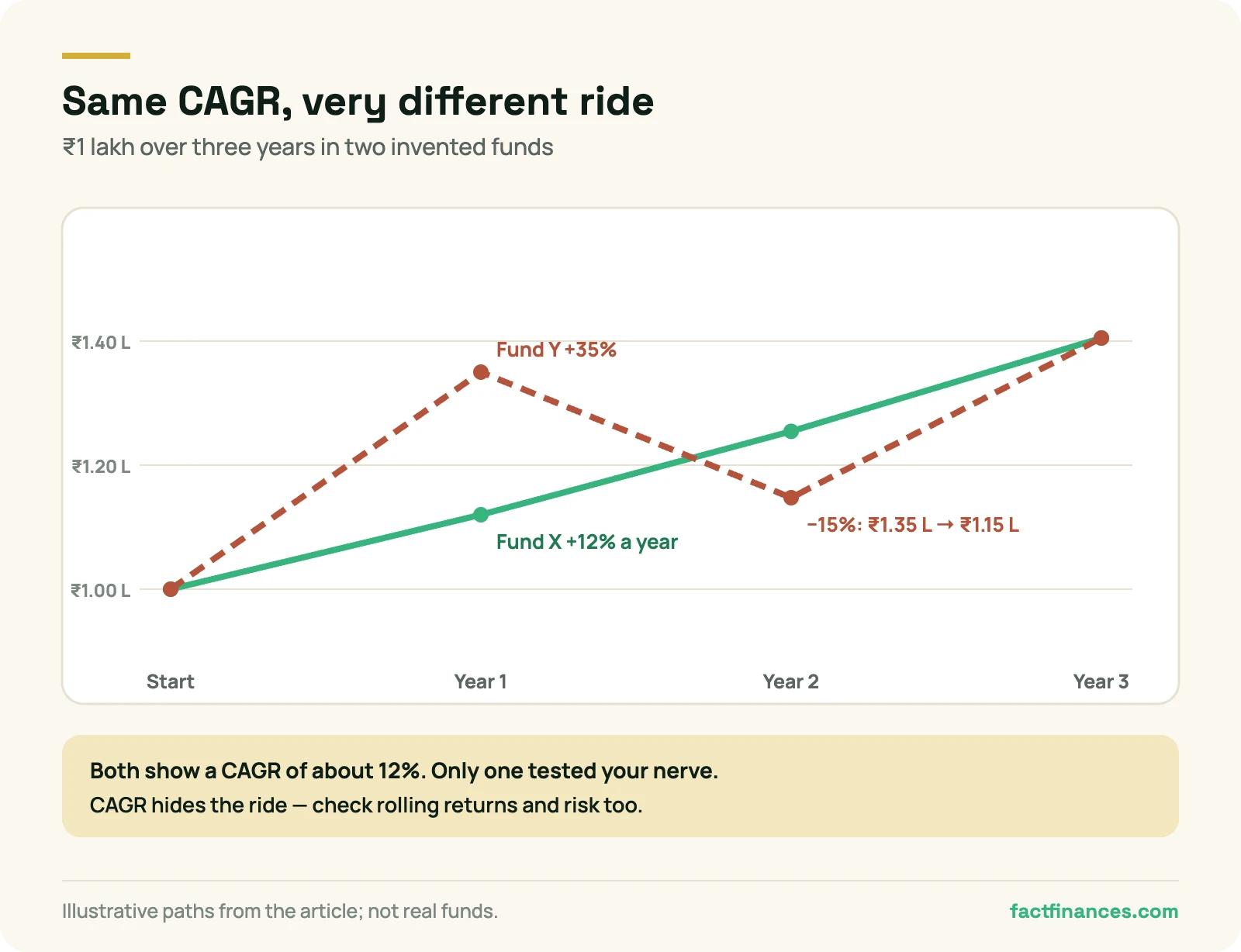
Two funds can show the same CAGR with very different journeys. Below, both turn ₹1 lakh into about ₹1.40 lakh in three years — a CAGR of about 12% each.
| Year 1 | Year 2 | Year 3 | After 3 years | CAGR | |
|---|---|---|---|---|---|
| Fund X | +12% | +12% | +12% | ≈ ₹1.40 lakh | ≈ 12% |
| Fund Y | +35% | −15% | +22.4% | ≈ ₹1.40 lakh | ≈ 12% |
An investor in Fund Y watched ₹1.35 lakh fall to ₹1.15 lakh in year two. Many would have sold — and never seen year three. CAGR cannot tell you that, which is why our guide to evaluating fund performance uses rolling returns and risk ratios alongside it.
What CAGR also hides: your own timing
CAGR assumes one entry date. A SIP has dozens. Apply a CAGR formula to a SIP and you pretend every rupee was invested on the first day — which badly understates your return, as the next example shows.
XIRR
XIRR: the return on your actual cash flows
XIRR — extended internal rate of return — treats every rupee separately. Each instalment, top-up and withdrawal is a cash flow with its own date, and XIRR finds the single yearly rate that makes all of them add up to today’s value. It is the right measure for anything with more than one date, and it is what most statements and apps use for SIPs.
A worked example: Vikas’s SIP
Vikas, a pharmacist in Deoghar, starts a ₹5,000 monthly SIP in January 2024. In March 2025 he adds his ₹50,000 bonus. In August 2025 he withdraws ₹20,000 for his daughter’s school admission. By November 2026 the folio is worth ₹2,35,000.
| Date | What happened | Cash flow |
|---|---|---|
| 5 Jan 2024 – 5 Oct 2026 | 34 monthly SIP instalments of ₹5,000 | −₹1,70,000 |
| 15 Mar 2025 | Bonus invested | −₹50,000 |
| 10 Aug 2025 | Withdrawal for school admission | +₹20,000 |
| 12 Nov 2026 | Current value (as if redeemed today) | +₹2,35,000 |
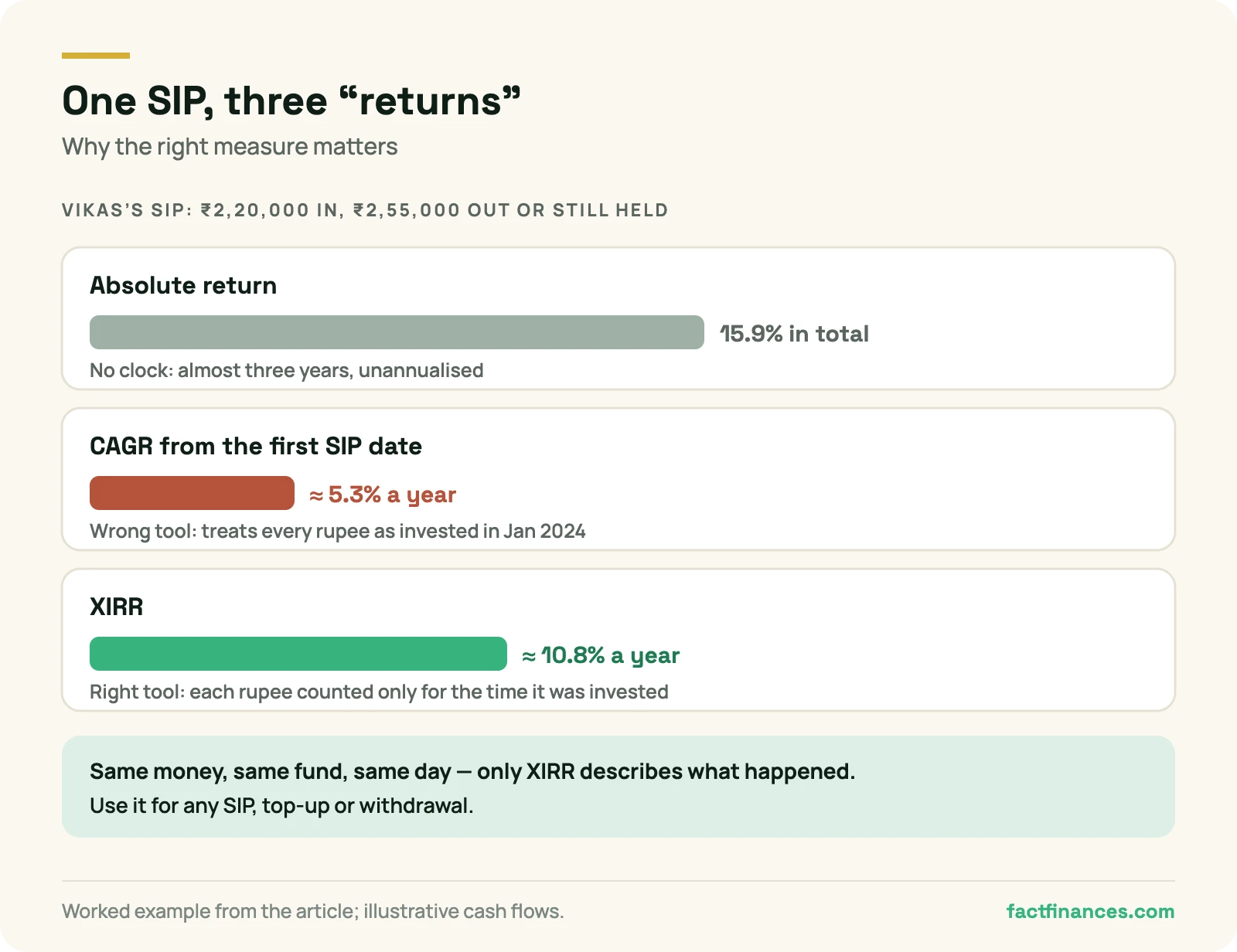
He has put in ₹2,20,000 and got back or still holds ₹2,55,000 — a gain of ₹35,000. Now the three measures:
| Measure | Result | Why |
|---|---|---|
| Absolute return | 15.9% | ₹35,000 ÷ ₹2,20,000 — but over almost three years? |
| CAGR from the first SIP date | ≈ 5.3% a year | Wrongly treats all ₹2,20,000 as invested in January 2024 |
| XIRR | ≈ 10.8% a year | Gives each rupee credit only for the time it was actually invested |
The CAGR shortcut makes Vikas’s SIP look worse than a fixed deposit. The XIRR shows it has actually earned about double that rate. Same money, same fund, same day — and only one of the three numbers describes what really happened.
How to calculate XIRR yourself
- Column A: the date of every transaction. Column B: the amount — negative for money you invested, positive for withdrawals and dividends paid out.
- Add a final row: today’s date and the current value as a positive number.
- In Excel or Google Sheets, type
=XIRR(B2:B40, A2:A40)and format the result as a percentage. - The transaction dates are in your detailed CAS. Our app does all of this automatically for every folio.
Pitfalls
Five mistakes people make with returns
- Comparing your SIP’s XIRR with the fund’s factsheet CAGR. The factsheet measures one lump sum from a fixed date; your SIP bought at many prices. They will differ, and neither is wrong.
- Annualising a few months. A SIP three months old can show an XIRR of 60% or −40%. Over short periods, look at absolute return and wait.
- Forgetting withdrawals and IDCW payouts. Money that came back to you must go into the calculation, or your return will look lower than it is.
- Comparing pre-tax with post-tax. A fund’s XIRR is before tax; so is an FD rate. Compare like with like, then think about tax on each.
- Judging on one period. Any return is a snapshot from one start date to one end date. Look at several periods before drawing conclusions.
So what is a “good” XIRR?
There is no single number. A fair test is to compare your XIRR with what the fund’s benchmark index would have earned on the same cash flows, and with what a safe alternative such as an FD would have paid after tax over the same dates. Equity returns vary widely from year to year, so judge over five years or more, not one. This folio-by-folio comparison — your XIRR against the right yardstick — is exactly what a yearly review with your distributor should cover.
FAQ
Frequently asked questions
What is XIRR in mutual funds?
XIRR (extended internal rate of return) is the annualised return on all your cash flows — every SIP instalment, top-up and withdrawal — taking into account the date of each. It is the right measure for SIPs and for any investment with more than one transaction.
What is the difference between XIRR and CAGR?
CAGR measures the steady yearly growth of one sum from one start date to one end date, so it suits a single lump sum. XIRR handles many cash flows on different dates, so it suits SIPs and portfolios. For a single lump sum with no other transactions, the two give the same answer.
Why does my new SIP show a very high or very low XIRR?
XIRR annualises your return. Over a few months, a small gain or loss is stretched into a yearly rate, which exaggerates it. For holdings under a year, look at the absolute return instead.
How do I calculate XIRR in Excel or Google Sheets?
List each transaction date in one column and the amount in the next — negative for money invested, positive for money received — and add today’s date with the current value as a positive amount. Then use =XIRR(amounts, dates).
What is a good XIRR for a SIP?
It depends on the fund category and the period. A fair test is to compare your XIRR with what the fund’s benchmark index would have earned on the same cash flows, and with a safe alternative after tax. Judge equity funds over five years or more.
Does XIRR include expenses and tax?
It includes the expense ratio, because NAVs are published after expenses, and any exit load if you have redeemed. It does not include income tax on your gains, which depends on your holding period and tax position.
Keep learning: See how a SIP works, learn to read your CAS, judge a fund properly with rolling returns and benchmarks, or return to the main mutual funds guide.
Free · Printable · 10 minutes
Your 5-point money check-up
A 10-minute printable that shows where your family’s money is protected and where it isn’t. Plus one useful money article a month. No spam.
General information only, not personalised advice. Ujjwal Tiwary, AMFI-registered Mutual Fund Distributor, ARN-144500.
About the author
Ujjwal Tiwary
ARN-144500 · NISM Series V-A certified since 2018 · Ranchi & Deoghar, Jharkhand
Ujjwal Tiwary is an AMFI-registered mutual fund distributor (ARN-144500) based in Ranchi and Deoghar, Jharkhand, and has held the NISM Series V-A certification since 2018. He works with families on mutual funds, insurance and income tax returns, and writes or personally reviews every article on FactFinances. He is not a SEBI-registered investment adviser; nothing on this site is personalised advice.
FactFinances is an educational platform. We are an AMFI-registered mutual fund distributor (ARN-144500). We do not provide investment advice or recommend specific securities. All figures are illustrations at assumed rates and are not guarantees or forecasts of returns. Mutual fund investments are subject to market risks; read all scheme-related documents carefully.