

Part of our complete guide to mutual funds in India — every fund charges for running your money, and since April 2026 you can see exactly what that charge is made of.
A mutual fund never sends you a bill. Its running costs are taken out of the fund’s assets a little every day, so the NAV you see — and every return figure a fund publishes — is already after those costs. That makes costs easy to ignore, and they matter: over 20 years, a one-percentage-point difference in annual cost can take lakhs of rupees out of a ₹10,000 monthly SIP. This guide explains the four cost words you will meet — expense ratio, TER, BER and exit load — under the SEBI rules in force from 1 April 2026, with the figures in rupees.
See costs in your own numbers: run your SIP through our SIP calculator twice — once at the return you expect, and once one percentage point lower. The gap between the two answers is roughly what a 1% yearly cost does to your money.
The Basics
What an expense ratio is, and how you pay it
The expense ratio is the yearly cost of running a fund, shown as a percentage of the money it manages. It pays for the fund manager and research team, the trustee, custodian and registrar, audit and legal work, investor communication — and, in a Regular plan, the commission paid to your distributor.
You never pay it separately. The fund divides the yearly rate by 365 and deducts that sliver from the fund’s assets every day before the NAV is calculated. On ₹1 lakh in a fund with a 1% expense ratio, that is about ₹1,000 a year — roughly ₹2.74 a day, taken quietly and continuously.
- It is charged whether the fund rises or falls. In a bad year you still pay it.
- Published returns are already after it. When a factsheet shows a 12% return, the expense ratio has already been deducted. Do not subtract it a second time.
- Direct and Regular plans of the same fund have different expense ratios. The only difference is the distributor’s commission, which is why their NAVs drift apart over time.
The 2026 Change
TER and BER: what the new numbers mean
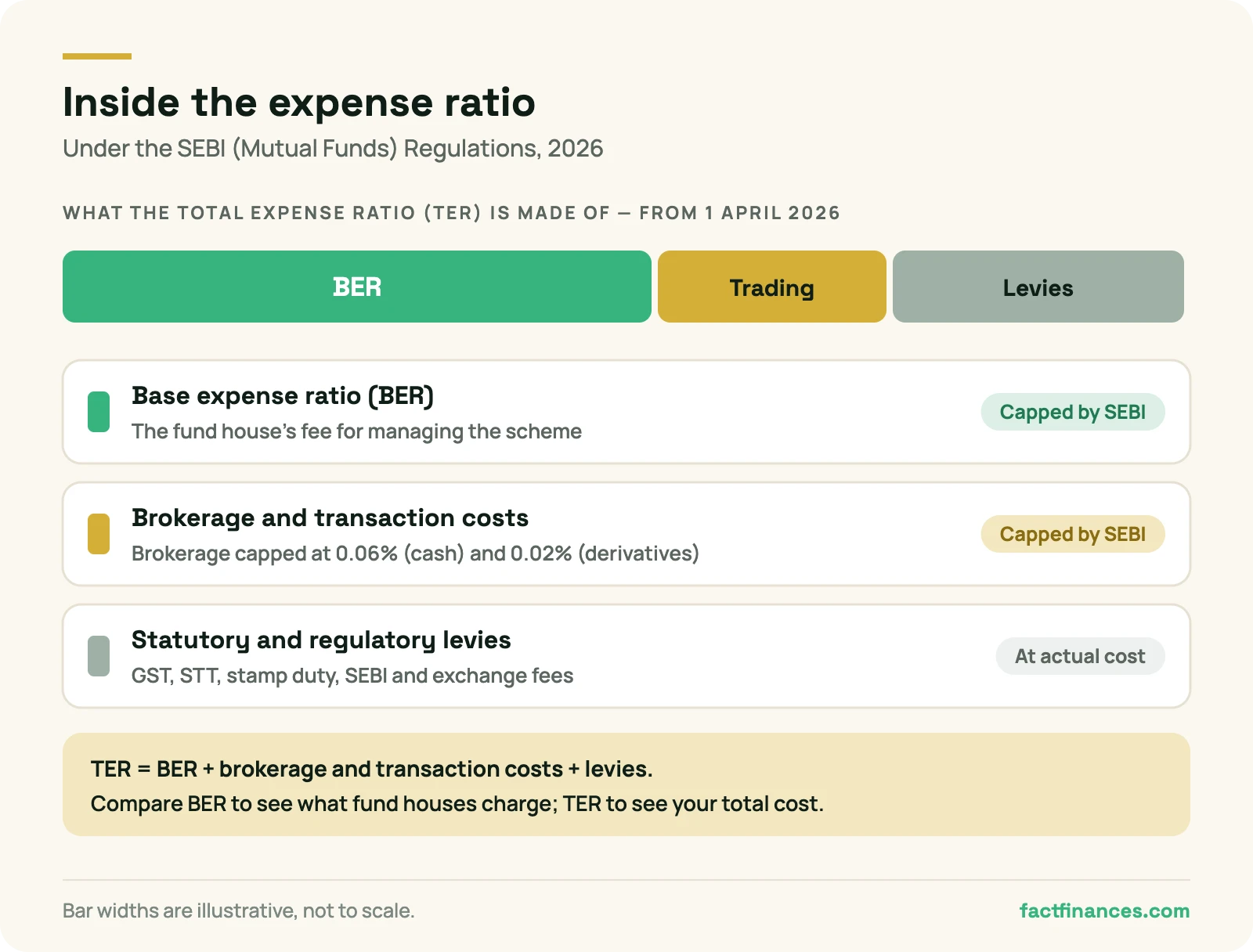
Until 31 March 2026, a fund showed one number — the total expense ratio (TER) — and SEBI’s limit applied to that single number, which also had to absorb taxes such as GST. Under the SEBI (Mutual Funds) Regulations, 2026, in force from 1 April 2026, the cost is shown in parts:
| Part | What it covers | Is there a SEBI limit? |
|---|---|---|
| Base expense ratio (BER) | The fund house’s fee for managing the scheme — management, administration, registrar and custody costs, marketing, and distributor commission in Regular plans | Yes — slabs by fund size (table below) |
| Brokerage and transaction costs | What the fund pays brokers when it buys and sells shares or bonds | Yes — brokerage capped at 0.06% of trade value in the cash market and 0.02% in derivatives (down from 0.12% and 0.05%) |
| Statutory and regulatory levies | GST, securities transaction tax (STT), stamp duty, SEBI and exchange fees | No cap — charged at actual cost |
| Total expense ratio (TER) | The sum of all of the above | — |
Why your fund’s TER may look higher after April 2026
Some investors noticed their fund’s TER rise after 1 April 2026 and assumed they were being charged more. Usually they were not. Trading costs and the taxes on them were always paid out of the fund; they simply were not all shown inside the TER figure. Now they are, so the TER can look higher and can also move a little from day to day, because levies are charged at actual cost. To compare what fund houses charge for their work, look at the BER. To know what the fund costs you in total, look at the TER.
The Limits
How much a fund is allowed to charge
SEBI caps the base expense ratio according to the fund’s size: the bigger the fund, the lower the cap on each additional slab of assets. The limits were cut by about 0.10 to 0.15 percentage point in most slabs when the BER replaced the old cap.
| Daily net assets of the scheme | Equity-oriented scheme | Other schemes (debt and others) |
|---|---|---|
| First ₹500 crore | 2.10% | 1.85% |
| Next ₹250 crore (₹500–750 crore) | 1.90% | 1.65% |
| Next ₹1,250 crore (₹750–2,000 crore) | 1.60% | 1.40% |
| Next ₹3,000 crore (₹2,000–5,000 crore) | 1.50% | 1.25% |
| Next ₹5,000 crore (₹5,000–10,000 crore) | 1.40% | 1.15% |
| ₹10,000–15,000 crore | 1.35% | 1.10% |
| ₹15,000–20,000 crore | 1.30% | 1.05% |
| ₹20,000–25,000 crore | 1.25% | 1.00% |
| ₹25,000–30,000 crore | 1.20% | 0.95% |
| ₹30,000–35,000 crore | 1.15% | 0.90% |
| ₹35,000–40,000 crore | 1.10% | 0.85% |
| ₹40,000–45,000 crore | 1.05% | 0.80% |
| ₹45,000–50,000 crore | 1.00% | 0.75% |
| Above ₹50,000 crore | 0.95% | 0.70% |
Two things follow. A fund cannot charge more than its cap, but it can and often does charge less. And a Direct plan must always cost less than the Regular plan of the same scheme, because it carries no distribution commission.
In Numbers
What different expense ratios do to the same SIP
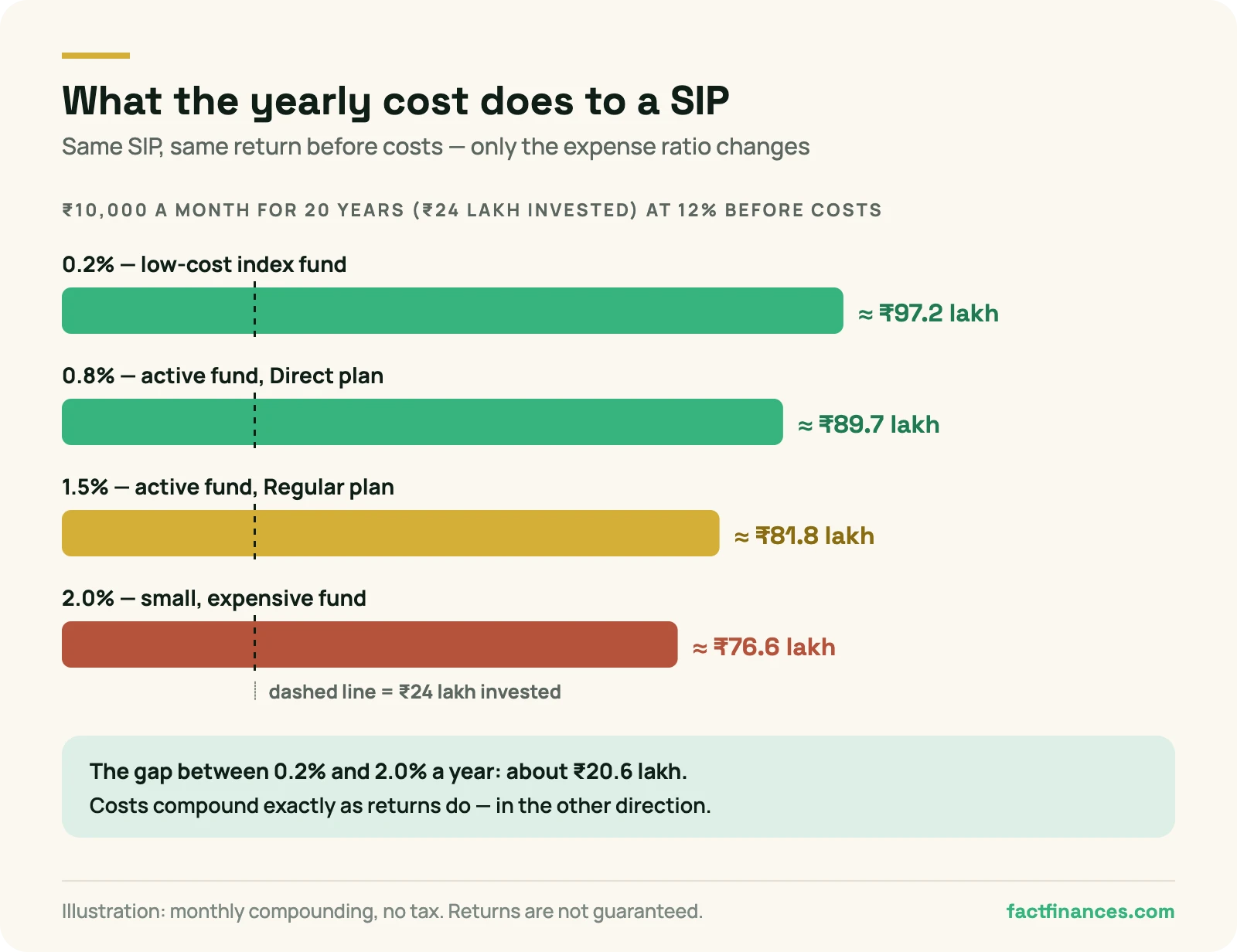
Neha works in a bank in Ranchi and invests ₹10,000 a month for 20 years — ₹24 lakh in all. Suppose the underlying investments earn 12% a year before costs. Here is what she ends up with at four different yearly costs:
| Yearly cost (TER) | Typical of | Value after 20 years | Lost to costs vs 0.2% |
|---|---|---|---|
| 0.2% | A low-cost index fund | ≈ ₹97.2 lakh | — |
| 0.8% | An actively managed fund, Direct plan | ≈ ₹89.7 lakh | ≈ ₹7.5 lakh |
| 1.5% | An actively managed fund, Regular plan | ≈ ₹81.8 lakh | ≈ ₹15.4 lakh |
| 2.0% | A small, expensive fund | ≈ ₹76.6 lakh | ≈ ₹20.6 lakh |
The same pattern holds for a lump sum: ₹10 lakh held for 10 years grows to about ₹30.5 lakh at a 0.2% cost and about ₹27.1 lakh at 1.5%, on the same 12% assumption. Costs compound exactly as returns do — just in the other direction.
So should you simply pick the cheapest fund?
Not on its own. The table assumes every fund earns the same before costs, and real funds do not. A sensible order of questions is:
- Is this the right kind of fund for my goal? A cheap fund in the wrong category is still the wrong fund.
- Compare costs within the same category. An equity fund will cost more than a liquid fund; that comparison tells you nothing.
- For index funds and ETFs, cost and tracking difference are almost everything. They hold the same index, so the cheaper, closely tracking one usually wins.
- For active funds, look at long-term returns after costs against the benchmark — measured properly, with XIRR or CAGR, not absolute return. A higher-cost fund has to earn its fee.
- Direct or Regular is a separate decision. It is about whether you want a distributor’s help, and what that help is worth to you. We set out both sides, in rupees, in direct vs regular mutual funds.
Exit Load
Exit load: the charge for leaving early
An exit load is a percentage deducted from your redemption amount if you sell — or switch out — within a set period after buying. Its purpose is to discourage short-term trading that hurts long-term investors, and the amount deducted goes back into the scheme, not to the fund house.
- Maximum 3%. Under the 2026 regulations SEBI cut the ceiling from 5% to 3%. In practice most schemes charge 1% or less.
- The extra 0.05% is gone. Schemes with an exit load used to be allowed an additional 0.05% in expenses; that allowance was removed from 1 April 2026.
- Same for both plans. Direct and Regular plans of a scheme have the same exit load.
- No entry load. Entry loads were abolished in 2009; nothing is deducted when you invest, apart from a 0.005% stamp duty on purchases.
| Type of fund | Common exit load (check your scheme) |
|---|---|
| Equity funds (large, mid, small, flexi cap and others) | Often 1% if redeemed within 12 months; some charge less, some nil |
| ELSS (tax-saving) funds | Nil — units are locked in for 3 years anyway |
| Index funds and ETFs | Often nil or small, for a short period |
| Liquid funds | Graded: 0.0070% if redeemed on day 1, falling to 0.0045% on day 6, nil from day 7 |
| Overnight funds and most other debt funds | Usually nil |
| Hybrid funds | Varies — some allow a part of your units (often 10%) to be redeemed free in the first year |
How exit load works with a SIP
Each SIP instalment has its own exit-load clock, and redemptions use the oldest units first (“first in, first out”). That means the same redemption can cost very different amounts depending on when you make it.
Pooja, a teacher in Deoghar, has a ₹10,000 monthly SIP in an equity fund with a 1% exit load within 12 months. The SIP started on 5 January 2026. On 15 March 2027 she needs ₹40,000. Assume each of her early instalments is now worth about ₹11,000:
| Units sold (oldest first) | Value | Held more than 12 months? | Exit load |
|---|---|---|---|
| January, February and March 2026 instalments | ≈ ₹33,000 | Yes | Nil |
| Part of the April 2026 instalment | ≈ ₹7,000 | No — bought 5 April 2026 | 1% ≈ ₹70 |
| Total | ₹40,000 | ≈ ₹70 |
The exit load also reduces your sale value for tax purposes, so your capital gain is worked out on the amount after the load. Selling equity fund units within 12 months can attract both the exit load and short-term capital gains tax — see mutual fund taxation in India for the current rates.
Switches count as redemptions
Moving money from one scheme to another — or from a Regular plan to the Direct plan of the same scheme — is a sale followed by a purchase. Exit load and capital gains tax apply to the units switched out, and the new units start a fresh exit-load clock. Some fund houses waive the load on certain switches within the same scheme, so check before you switch.
Finding The Numbers
Where to check a fund’s costs
- The monthly factsheet shows the TER of both plans and the exit load. Our guide to reading a mutual fund factsheet shows where to look.
- The fund house’s website must publish the TER of every scheme, for both plans, every day — now broken into BER, brokerage, transaction costs and levies.
- The AMFI website carries the same daily TER data for all fund houses in one place.
- Your Consolidated Account Statement shows, for Regular-plan holdings, the commission paid in rupees over the half-year. Here is how to read it.
- Notice of increases. SEBI rules require a fund house to tell investors by email or SMS, and on its website, at least three working days before it raises a scheme’s base expense charge.
Our Approach
How we handle costs for the families we work with
We are an AMFI-registered mutual fund distributor, and our income comes from the commission inside Regular plans — the same commission you can see on your CAS. We think you should know exactly what you pay and what you get for it. In practice that means:
- We show the cost. For any fund we discuss, we show its TER and what the same money would cost in the Direct plan.
- We plan redemptions around exit loads and tax. Choosing which units to sell and when — for example waiting a few weeks for older SIP units to cross 12 months, or spreading long-term gains across financial years — often saves more than a year’s expense ratio.
- We review every year. If a fund’s costs rise or its returns after costs fall behind its benchmark for long enough, we tell you.
- We help you decide the big moves. When to invest a lump sum, whether to stagger it through an STP, when to rebalance and when to redeem for a goal — guidance on decisions that usually matter more than cost, though nobody can promise to call the market’s tops and bottoms.
You can see all of your holdings — and their real returns — in one place with the free FactFinances app, which reads the Detailed CAS from MFCentral or from NSDL/CDSL.
Frequently asked questions
What is the expense ratio of a mutual fund?
It is the yearly cost of running the fund, shown as a percentage of its assets. It is deducted from the fund a little every day, so the NAV and all published returns are already after it. On ₹1 lakh, a 1% expense ratio costs about ₹1,000 a year.
What is the difference between TER and BER?
From 1 April 2026, the base expense ratio (BER) is the fund house’s fee for managing the scheme, and it is what SEBI caps. The total expense ratio (TER) adds brokerage, transaction costs and statutory levies such as GST, STT and stamp duty. BER tells you what the fund house charges; TER tells you the total cost.
Why did my fund’s expense ratio go up after April 2026?
Usually because more of the existing costs are now shown inside the TER — trading costs and the taxes on them were paid from the fund before, but not all of them were in the TER figure. The BER caps themselves were cut. Compare the BER to see whether the fund house’s own fee changed.
What is a good expense ratio for a mutual fund?
It depends on the type of fund. Index funds and ETFs often charge well under 0.5%; actively managed equity funds charge more, and Regular plans more than Direct plans. Compare a fund with others in the same category, and judge active funds on their long-term returns after costs, not on cost alone.
What is the maximum exit load a mutual fund can charge?
3% under the SEBI (Mutual Funds) Regulations, 2026, down from 5% earlier. Most equity funds charge around 1% if you redeem within 12 months, and many debt funds charge nothing. The exact load is in the scheme’s factsheet.
Does exit load apply to each SIP instalment?
Yes. Every instalment has its own exit-load period from the date it was invested, and redemptions use the oldest units first. Redeeming after your older instalments cross the exit-load period can reduce the load to nil.
Is exit load charged when I switch from a Regular to a Direct plan?
Usually yes, because a switch is treated as a redemption and a fresh purchase. Exit load and capital gains tax can apply to the units switched out, unless the fund house waives the load for that switch.
Keep learning: Compare direct and regular plans, learn to read a factsheet and your CAS, measure returns with XIRR, or return to the main mutual funds guide.
Free · Printable · 10 minutes
Your 5-point money check-up
A 10-minute printable that shows where your family’s money is protected and where it isn’t. Plus one useful money article a month. No spam.
General information only, not personalised advice. Ujjwal Tiwary, AMFI-registered Mutual Fund Distributor, ARN-144500.
About the author
Ujjwal Tiwary
ARN-144500 · NISM Series V-A certified since 2018 · Ranchi & Deoghar, Jharkhand
Ujjwal Tiwary is an AMFI-registered mutual fund distributor (ARN-144500) based in Ranchi and Deoghar, Jharkhand, and has held the NISM Series V-A certification since 2018. He works with families on mutual funds, insurance and income tax returns, and writes or personally reviews every article on FactFinances. He is not a SEBI-registered investment adviser; nothing on this site is personalised advice.
FactFinances is an educational platform. We are an AMFI-registered mutual fund distributor (ARN-144500). We do not provide investment advice or recommend specific securities. All figures are illustrations at assumed rates and are not guarantees or forecasts of returns. Mutual fund investments are subject to market risks; read all scheme-related documents carefully.