

Part of our complete guide to mutual funds in India — two pieces of paperwork decide whether your SIPs keep running and whether your family can claim your funds easily. This is educational content, not investment advice.
Two pieces of mutual fund paperwork are easy to forget and expensive to get wrong. Your KYC status decides whether your SIPs keep running and whether you can invest in a new fund. Your nomination decides how easily your family can claim the money if something happens to you. Both can be checked in a few minutes. This guide explains what each KYC status means, how to fix the common problems, and what the nomination rules have looked like since 1 September 2026.
Start with your statement: your Consolidated Account Statement lists every folio you hold, across all fund houses. Use it as the checklist for both jobs below — KYC is checked once for your PAN, but nomination is recorded folio by folio.
Part One · KYC
What your mutual fund KYC status means
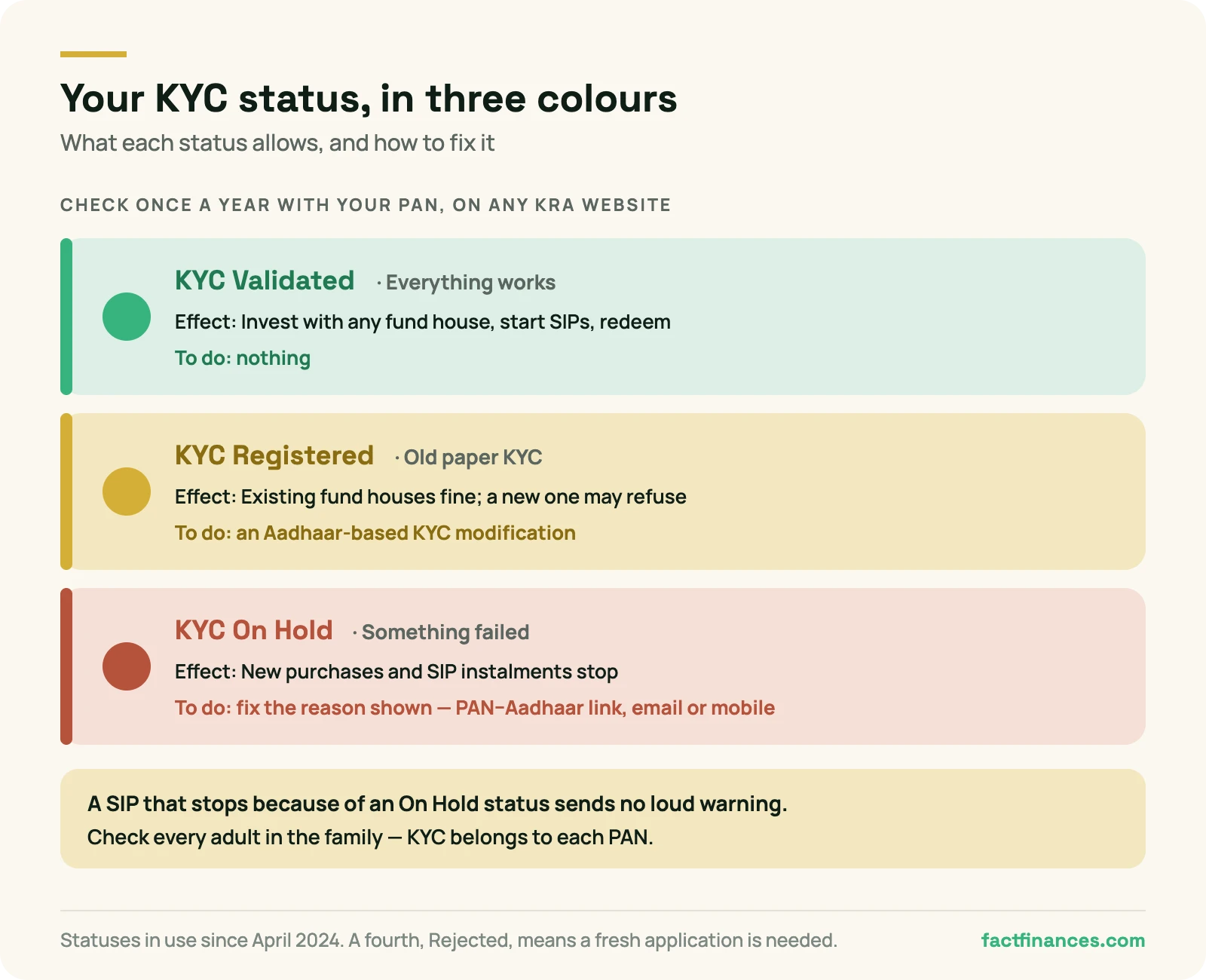
KYC — “know your customer” — is done once and stored with a KYC Registration Agency (KRA). Every fund house reads the same record using your PAN, so you do not repeat KYC for each fund. Since April 2024, that record carries one of three statuses, and each one allows different things.
| Status | What it means | What you can do |
|---|---|---|
| KYC Validated | Your PAN, Aadhaar-based address and contact details have been verified with the official source | Everything: invest in any fund house, start SIPs, redeem |
| KYC Registered | KYC was done earlier with documents that could not be verified online (often old paper KYC, or an address proof other than Aadhaar) | Keep transacting with fund houses where you already invest; a new fund house may ask you to re-do KYC first |
| KYC On Hold | Something is missing or failed verification — commonly PAN not linked to Aadhaar, or email or mobile number not verified | No new purchases or SIP instalments until it is fixed; the reason is shown with the status |
How to check your KYC status in two minutes
- Open any KRA website — CVL KRA, CAMS KRA, KFin KRA or NDML KRA. They share records, so any one will do.
- Choose “KYC Inquiry”, enter your PAN and the captcha.
- Read the status and the reason. If it is On Hold, the page names the missing item, such as an unverified email or a PAN–Aadhaar link.
- Check every adult in the family, including retired parents. KYC belongs to the PAN, so each person has their own status.
How to fix each status
| Problem shown | What to do |
|---|---|
| On Hold — email or mobile not verified | Validate them through any fund house or RTA website, or through your distributor. An OTP to each usually clears it within a few days. |
| On Hold — PAN not linked to Aadhaar | Link them on the income-tax e-filing portal first (a late fee applies). Once the link shows, ask for the KYC to be revalidated. |
| On Hold — document deficiency | Submit a fresh KYC or a KYC modification with the missing document through a fund house, RTA or distributor. |
| Registered — want to move to Validated | Do a KYC modification using Aadhaar (online, with an OTP to the Aadhaar-linked mobile). This is what most people with old paper KYC need. |
An example from Deoghar
Rakesh, 52, did his KYC on paper in 2016. His SIPs in two fund houses kept running, but when he tried to start a SIP with a third fund house, it was rejected. His status was Registered. An Aadhaar-based KYC modification moved him to Validated within a week. His mother’s small folio was a different story: her status was On Hold because her PAN had never been linked to Aadhaar, and her monthly SIP had quietly stopped going through. Linking the two and revalidating fixed it, but she had missed four instalments by then.
Nothing was lost in either case, but nobody noticed for months. A quick status check once a year — or whenever a SIP instalment fails — avoids that.
Part Two · Nomination
Why nomination matters more than most people think
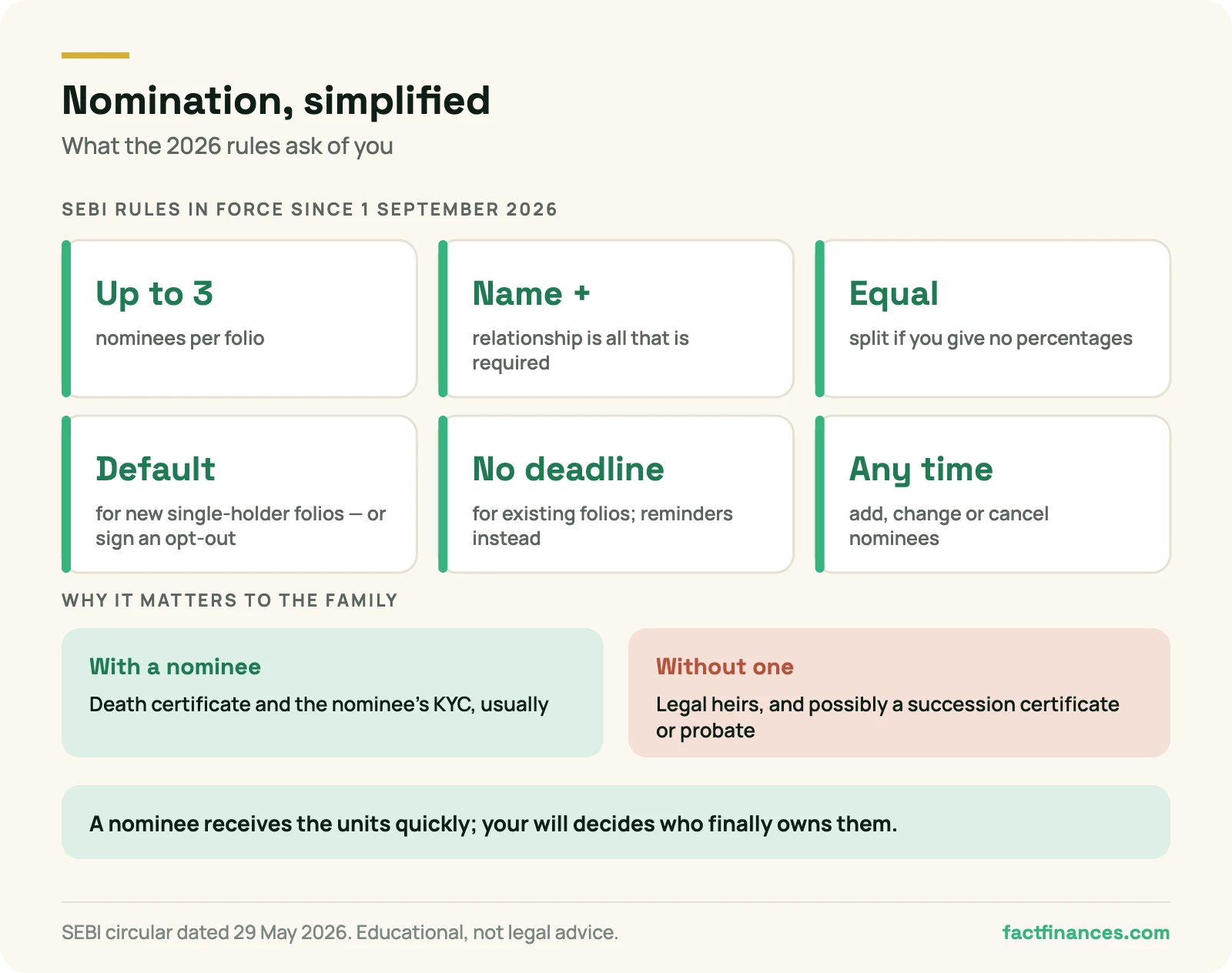
A nominee is the person the fund house will transfer your units to if you die. With a nominee registered, your family usually needs little more than a death certificate and the nominee’s KYC. Without one, the fund house must deal with the legal heirs, and that can mean documents such as a succession certificate or probate — which can take months and cost money.
One point is often misunderstood: a nominee receives the units so that the transfer is quick, but who finally owns the money is decided by your will or by succession law. If you want a particular person to inherit, a will is still the right document; the nomination simply makes sure the money is not stuck in the meantime.
The nomination rules since 1 September 2026
SEBI changed the nomination rules in January 2025 and then simplified them again by a circular dated 29 May 2026, in force from 1 September 2026. Much of what you will read online about “up to 10 nominees” is now out of date. The current position:
| Rule | What it says now |
|---|---|
| How many nominees | Up to three per folio or demat account |
| New single-holder folios | Nomination is the default; you must name a nominee or sign an opt-out declaration |
| Joint folios | Nomination is optional; adding or changing one needs the consent of all joint holders |
| Details required | Only the nominee’s name and relationship (plus date of birth for a minor). Mobile, email, ID, share and guardian details are optional |
| Shares between nominees | If you do not specify percentages, the units are divided equally |
| Witnesses | Not needed for a signed form; two witnesses only if you sign with a thumb impression |
| Existing folios without a nominee | No deadline and no freeze; you will get reminders by email, SMS and on login until you add one or opt out |
| Changes | Add, change or cancel nominees as often as you like |
How to add or change a nominee
- Online: through the fund house’s website or app, the RTA (CAMS or KFintech) website, or MF Central, which handles service requests for folios across fund houses. Authentication is by OTP.
- On paper: the nomination form from the fund house or your distributor, signed by you (and all joint holders, for a joint folio).
- Through your distributor: we can submit the request for every folio at once and check that each one has been updated.
- Check it took effect: the confirmation comes from the fund house; your next CAS should show the nominee against the folio.
Choosing well
- Name a nominee on every folio, including old ones you have forgotten about — those are the ones families find hardest to claim.
- If you name more than one person, decide the percentages deliberately rather than leaving it to the equal-split default.
- For a minor nominee, consider naming a guardian even though it is optional; it saves a step later.
- Keep it consistent with your will, your bank accounts and your insurance policies, so the family is not dealing with contradictions.
- Tell the nominee. A nomination nobody knows about helps less than it should.
Our Approach
How we check this for the families we work with
As an AMFI-registered mutual fund distributor, we treat KYC and nomination as part of the yearly review, not as one-time paperwork:
- We check the KYC status of every family member before starting a SIP, and again whenever an instalment fails.
- We go folio by folio through the CAS to find any holding without a nominee, including folios bought elsewhere.
- We handle the requests — KYC modification, contact validation, nomination updates — and confirm they have gone through.
- When a family loses someone, we help with the transmission paperwork so the units reach the nominee or heirs without avoidable delay.
The free FactFinances app reads your CAS and shows every folio in one place, which makes the folio-by-folio check easier. For how to start investing once your KYC is in order, see how to invest in mutual funds.
FAQ
Frequently asked questions
How do I check my mutual fund KYC status?
Open any KYC Registration Agency website — CVL KRA, CAMS KRA, KFin KRA or NDML KRA — choose KYC Inquiry and enter your PAN. The status shows as Validated, Registered or On Hold, with the reason if there is a problem.
What is the difference between KYC Validated and KYC Registered?
Validated means your details have been verified with the official source, so you can invest with any fund house. Registered means your KYC was accepted earlier with documents that could not be verified online; you can keep transacting where you already invest, but a new fund house may ask you to re-do KYC.
Why is my mutual fund KYC on hold?
Most often because your PAN is not linked to Aadhaar or your email or mobile number has not been verified. While KYC is on hold, new purchases and SIP instalments do not go through. Fix the reason shown on the KRA website and the status updates in a few working days.
Will my SIP stop if my KYC is on hold?
Yes. SIP instalments are new purchases, so they are not processed while the status is On Hold. Your existing units stay invested.
How many nominees can I have in a mutual fund?
Up to three per folio, under SEBI’s nomination rules in force from 1 September 2026. If you do not specify percentages, the units are divided equally among them.
Is nomination mandatory for mutual funds?
For single-holder folios opened on or after 1 September 2026, you must either name a nominee or sign an opt-out declaration. For existing folios there is no deadline and no freeze, though you will receive reminders. Nomination is optional for joint folios.
Does the nominee become the owner of my mutual funds?
The nominee receives the units so the fund house can transfer them quickly. Who finally owns them is decided by your will or by succession law, so a will remains the document for deciding who inherits.
Keep learning: Read how to read your CAS, see how to invest in mutual funds, compare direct and regular plans, or return to the main mutual funds guide.
Free · Printable · 10 minutes
Your 5-point money check-up
A 10-minute printable that shows where your family’s money is protected and where it isn’t. Plus one useful money article a month. No spam.
General information only, not personalised advice. Ujjwal Tiwary, AMFI-registered Mutual Fund Distributor, ARN-144500.
About the author
Ujjwal Tiwary
ARN-144500 · NISM Series V-A certified since 2018 · Ranchi & Deoghar, Jharkhand
Ujjwal Tiwary is an AMFI-registered mutual fund distributor (ARN-144500) based in Ranchi and Deoghar, Jharkhand, and has held the NISM Series V-A certification since 2018. He works with families on mutual funds, insurance and income tax returns, and writes or personally reviews every article on FactFinances. He is not a SEBI-registered investment adviser; nothing on this site is personalised advice.
FactFinances is an educational platform. We are an AMFI-registered mutual fund distributor (ARN-144500). We do not provide investment advice or recommend specific securities. All figures are illustrations at assumed rates and are not guarantees or forecasts of returns. Mutual fund investments are subject to market risks; read all scheme-related documents carefully.