

Part of our complete guide to mutual funds in India — for money you will need soon, the right parking spot depends on when you need it and your tax slab, not on the headline rate. This is educational content, not investment advice.
Money you will need within a year or two — an emergency fund, a house down payment, next year’s fees, the proceeds of a sale — should not sit in equity funds, and should not lie idle either. The usual choices are a bank FD, a liquid fund and an arbitrage fund. Their headline returns are often within a percentage point of each other, so the real differences are elsewhere: how quickly you can get the money back, what can go wrong, and how much tax you pay. This guide compares all three, with a worked example after tax.
The short version: in a low tax slab, an FD or liquid fund usually leaves you with the most. In the 30% slab, an arbitrage fund often leaves more after tax — especially if you hold it a little over a year. Liquid funds win on access; FDs win on certainty.
Start Here
First, two questions
Before comparing products, answer two questions about the money itself:
- When will you need it? Within days, within a few months, or on a known date about a year away?
- How sure must the amount be? If you need exactly ₹4,80,000 on 10 March, certainty matters more than an extra half a percent. If the money is a buffer for “just in case”, access matters more.
| When you need it | Usually suits |
|---|---|
| Any day, without notice | Savings account or sweep-in FD, plus a liquid fund for the rest |
| In a few weeks to a few months | Liquid fund |
| In about a year, date not fixed | Liquid fund or arbitrage fund, depending on your slab |
| On a known date, exact amount needed | FD maturing on that date |
Side By Side
The three options compared
| Bank FD | Liquid fund | Arbitrage fund | |
|---|---|---|---|
| What earns the return | Fixed interest set at the start | Very short-term debt (maturities up to 91 days) | The gap between share prices in the cash and futures markets |
| Is the return known? | Yes | No, but it moves very little | No; it depends on market spreads |
| Getting money back | Break the FD; a penalty on interest is common | Next business day; up to ₹50,000 instantly | Usually one to two business days |
| Early-exit cost | Interest penalty | Tiny graded load for the first 6 days | Often a small exit load in the first few weeks — check the scheme |
| How it is taxed | Interest at your slab, every year | Gains at your slab, only when you redeem | As equity: 20% within 12 months; 12.5% after, with ₹1.25 lakh exempt |
| Protection | DICGC insurance up to ₹5 lakh per bank | Market-linked; no guarantee | Market-linked; no guarantee |
Option One
Liquid funds: the most flexible parking spot
A liquid fund lends money for very short periods — up to 91 days — to the government, banks and large companies. Because the loans are so short, the NAV rises almost every day in small steps. It is not guaranteed, but large falls are rare.
- Access: a normal redemption is paid the next business day. Many fund houses also offer instant redemption of up to ₹50,000 or 90% of your holding, whichever is lower, per day per scheme — useful in an emergency, including on holidays.
- Exit load: a graded load applies only in the first six days — from 0.0070% on day one to 0.0045% on day six, or about ₹45–70 on ₹10 lakh. From day seven it is nil.
- Tax: gains are added to your income and taxed at your slab, but only when you redeem. Unlike FD interest, nothing is taxed while the money sits, and there is no TDS for resident investors.
- What to check: fund size, the quality of what it holds, and the expense ratio — in a category where returns are close, costs matter. See how expense ratios work.
Option Two
Arbitrage funds: debt-like returns with equity taxation
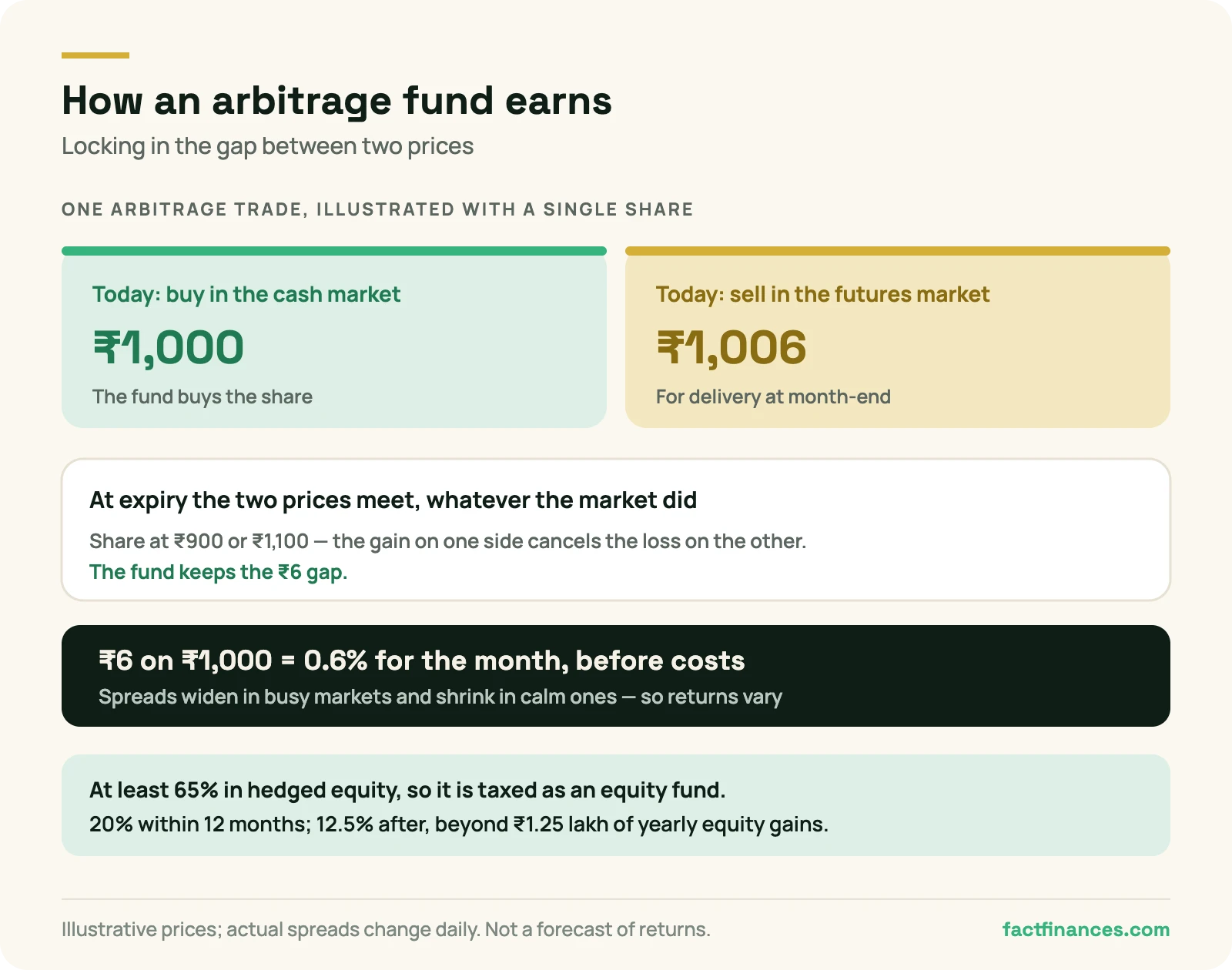
An arbitrage fund buys shares in the cash market and sells the same shares in the futures market at a slightly higher price, locking in the gap. When the futures contract expires, the two prices meet and the fund keeps the difference. The rest is held in short-term debt.
Because at least 65% of the fund is in (hedged) equity, it is taxed as an equity fund. That is the whole attraction: gains held more than 12 months are taxed at 12.5%, and only beyond the ₹1.25 lakh a year of equity gains that are exempt; within 12 months they are taxed at 20%.
- Returns vary with markets. When markets are calm and few people trade futures, the spreads shrink and returns can fall below a liquid fund’s. An occasional flat or slightly negative week is normal.
- Access is slower — usually one to two business days — and there is no instant redemption.
- Exit loads are common for redemptions within the first few weeks; check the scheme before you invest money you may need soon.
- The ₹1.25 lakh exemption is shared with all your other equity gains in the year, including any tax harvesting you do.
Option Three
FDs: certainty, at a cost in tax
An FD tells you on day one exactly what you will have at maturity, and bank deposits are insured by DICGC up to ₹5 lakh per depositor per bank. That certainty is worth a lot when the money is needed for a fixed payment on a fixed date.
- Tax every year: interest is taxed at your slab as it accrues, even on a cumulative FD where you receive nothing until maturity.
- TDS: the bank deducts 10% if your interest from it is more than ₹50,000 in a year (₹1 lakh for senior citizens). TDS is an advance, not the final tax — see tax on FD interest.
- Breaking early usually costs a reduction in the interest rate, so match the FD’s term to your date.
Worked Example
What you keep after tax: ₹5 lakh for one year
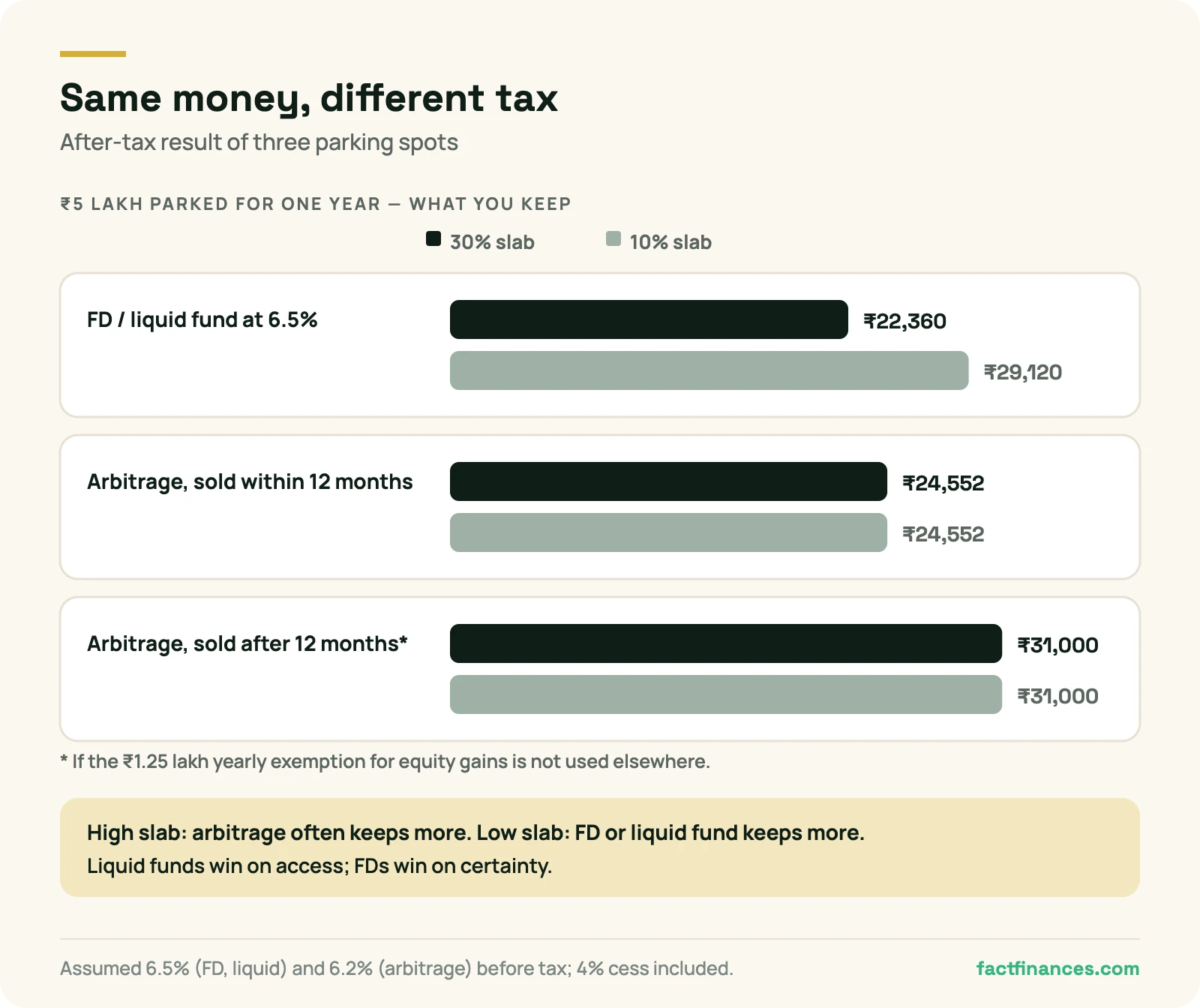
Assume ₹5,00,000 is parked for one year, and that the FD and the liquid fund both earn 6.5% and the arbitrage fund earns 6.2% before tax. These are round assumptions for illustration — actual rates change, and fund returns are not guaranteed.
| Pre-tax gain | Kept in the 30% slab | Kept in the 10% slab | |
|---|---|---|---|
| FD at 6.5% | ₹32,500 | ₹22,360 | ₹29,120 |
| Liquid fund at 6.5% | ₹32,500 | ₹22,360 | ₹29,120 |
| Arbitrage fund at 6.2%, sold within 12 months | ₹31,000 | ₹24,552 | ₹24,552 |
| Arbitrage fund, sold just after 12 months, exemption unused | ₹31,000 | ₹31,000 | ₹31,000 |
Three things stand out. In the 30% slab, the arbitrage fund keeps about ₹2,200 more even within a year, and about ₹8,600 more if held just past 12 months with the exemption unused. In the 10% slab, the FD and liquid fund keep about ₹4,600 more than an arbitrage fund sold within the year. And if your income is low enough that tax on interest is nil, the FD or liquid fund wins outright. The full rules are in how mutual funds are taxed.
Choosing
Which one when
- Emergency fund: a few weeks’ expenses in the savings account, the rest in a liquid fund for next-day access, with instant redemption as a backstop.
- A fixed payment on a fixed date: an FD that matures just before the date, so the amount is certain.
- A year or more, in the 30% slab: an arbitrage fund deserves a look — if you can live with slower access and slightly variable returns.
- A large sum waiting to go into equity: park it in a liquid fund and move it in steps — see SIP vs lump sum.
- Regular income from a lump sum: a liquid or arbitrage fund can feed a systematic withdrawal plan.
For money with a longer horizon, the trade-offs are different — see mutual funds vs fixed deposits.
How We Help
How we help with short-term money
As an AMFI-registered mutual fund distributor, we are paid by fund houses and we tell you what we earn. For short-term money, we:
- Match the parking spot to the date and how certain the amount must be.
- Work out what you keep after tax at your actual slab, including any equity gains already used against the ₹1.25 lakh exemption.
- Set up instant redemption and bank details before you need them, so an emergency is not the first test.
- Plan the move into longer-term investments when the money is no longer short-term.
FAQ
Frequently asked questions
Which is better for short-term money: a liquid fund, an arbitrage fund or an FD?
It depends on your tax slab and when you need the money. In low slabs an FD or liquid fund usually keeps the most after tax; in the 30% slab an arbitrage fund often keeps more, especially if held a little over a year. FDs give certainty; liquid funds give the fastest access.
How is a liquid fund taxed?
Gains on liquid fund units bought from 1 April 2023 are added to your income and taxed at your slab rate, whatever the holding period. Tax is due only when you redeem, and there is no TDS for resident investors.
How is an arbitrage fund taxed?
As an equity fund, because at least 65% is in hedged equity. Gains are taxed at 20% if held up to 12 months, and at 12.5% after that, on gains above the ₹1.25 lakh a year exempt for all equity gains together.
How quickly can I get money from a liquid fund?
A normal redemption is paid the next business day. Many fund houses also allow instant redemption of up to ₹50,000 or 90% of your holding, whichever is lower, per day per scheme.
Is there an exit load on liquid funds?
Only in the first six days, on a graded scale from 0.0070% to 0.0045% of the amount redeemed. From the seventh day there is no exit load.
Can an arbitrage fund lose money?
Over short periods its NAV can be flat or dip slightly when spreads narrow, and returns vary with market conditions. It is market-linked and not guaranteed, though large falls are uncommon because positions are hedged.
Keep learning: Compare mutual funds and fixed deposits for longer goals, see the types of mutual funds, read about tax on FD interest, or return to the main mutual funds guide.
Free · Printable · 10 minutes
Your 5-point money check-up
A 10-minute printable that shows where your family’s money is protected and where it isn’t. Plus one useful money article a month. No spam.
General information only, not personalised advice. Ujjwal Tiwary, AMFI-registered Mutual Fund Distributor, ARN-144500.
About the author
Ujjwal Tiwary
ARN-144500 · NISM Series V-A certified since 2018 · Ranchi & Deoghar, Jharkhand
Ujjwal Tiwary is an AMFI-registered mutual fund distributor (ARN-144500) based in Ranchi and Deoghar, Jharkhand, and has held the NISM Series V-A certification since 2018. He works with families on mutual funds, insurance and income tax returns, and writes or personally reviews every article on FactFinances. He is not a SEBI-registered investment adviser; nothing on this site is personalised advice.
FactFinances is an educational platform. We are an AMFI-registered mutual fund distributor (ARN-144500). We do not provide investment advice or recommend specific securities. All figures are illustrations at assumed rates and are not guarantees or forecasts of returns. Mutual fund investments are subject to market risks; read all scheme-related documents carefully.