

Part of our complete guide to mutual funds in India — a new fund offer is a new product, not a discount — the ₹10 price tells you nothing about value. This is educational content, not investment advice.
Every few weeks a new fund offer (NFO) is advertised: a fresh scheme, units at ₹10, open for a short window, often built around a theme that has just had a good run. The pitch is easy to like — get in at the start, at a low price. This guide explains what an NFO actually is, why the ₹10 price is not a bargain, what changed in the rules in 2025 and 2026, and a checklist to run before you put money into one.
The short version: an NFO is worth a look only when it gives you something your portfolio cannot already get from a fund with a track record. The launch price, the advertising and the deadline are not reasons to invest.
The Basics
What an NFO is
An NFO is the first time a new mutual fund scheme is offered to investors. During the offer period the fund house collects money and issues units, usually at ₹10 each. The offer stays open for a limited time — at most 15 days for most schemes. After the units are allotted, an open-ended scheme must reopen for regular purchases and redemptions within five business days, at the daily NAV like any other fund.
So the “limited window” is mostly a marketing device. If the fund is open-ended, you can buy it next month at the prevailing NAV, after you have seen how it is being run. Closed-ended NFOs, such as fixed maturity plans, are different: you can only enter during the offer, and the units are locked until maturity.
The ₹10 Myth
Why a ₹10 NAV is not cheap
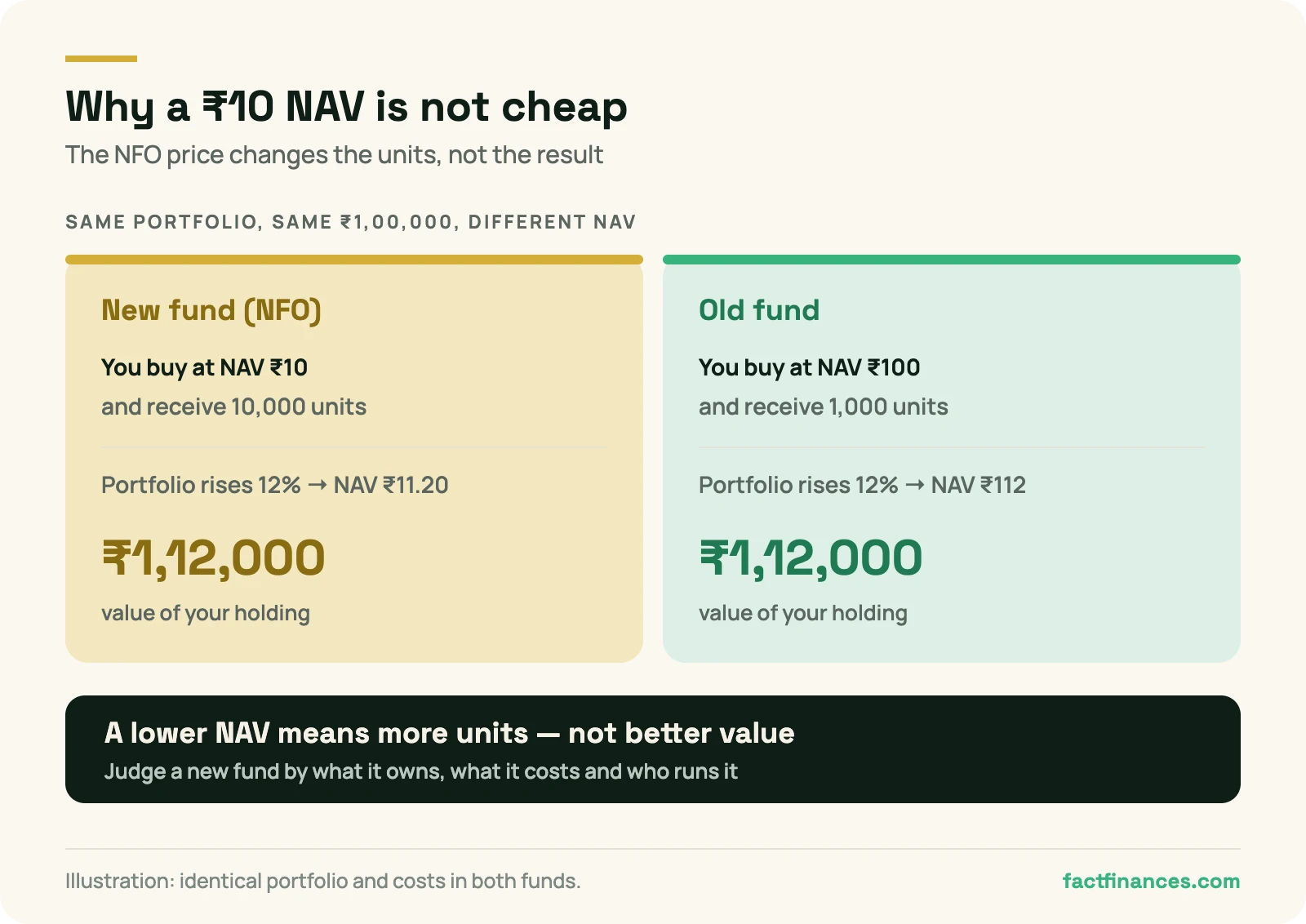
A share price can be high or low relative to a company’s earnings. A fund’s NAV is different: it is simply the value of the fund’s holdings divided by the number of units. A low NAV means more units, not better value. Take two funds that hold exactly the same portfolio, one with a NAV of ₹10 and one with a NAV of ₹100, and put ₹1 lakh in each:
| New fund (NAV ₹10) | Old fund (NAV ₹100) | |
|---|---|---|
| Amount invested | ₹1,00,000 | ₹1,00,000 |
| Units received | 10,000 | 1,000 |
| Portfolio rises 12% | NAV ₹11.20 | NAV ₹112 |
| Value | ₹1,12,000 | ₹1,12,000 |
What matters is what the fund owns, what it costs and how well it is run — the same questions you would ask of any fund. The guide to how mutual funds work explains NAV in more detail.
A Real Case
What happened to one ₹10 NFO
In June 2024 a defence-sector index fund was launched through an NFO at ₹10 a unit, after defence stocks had risen sharply. A friend of ours put ₹2 lakh into the NFO. Some months later, after the theme had cooled and the NAV had fallen to about ₹7, we invested ₹2 lakh for a client in the same fund.
| Invested in the NFO | Invested later | |
|---|---|---|
| Entry NAV | ₹10 | about ₹7 |
| Amount | ₹2,00,000 | ₹2,00,000 |
| Value on 29 Oct 2026 | about ₹2,32,600 | about ₹3,27,100 |
| Gain | about 16% | about 64% |
The same fund, the same theme, a gap of nearly ₹1 lakh — almost all of it from the entry decision. One case does not prove that waiting always works; a theme can keep rising after its NFO. But it shows two things clearly: the ₹10 launch price was no protection, and NFOs tend to arrive when a theme is already popular. The full breakdown is in Direct vs Regular plans.
The Rules
What the rules now require of fund houses
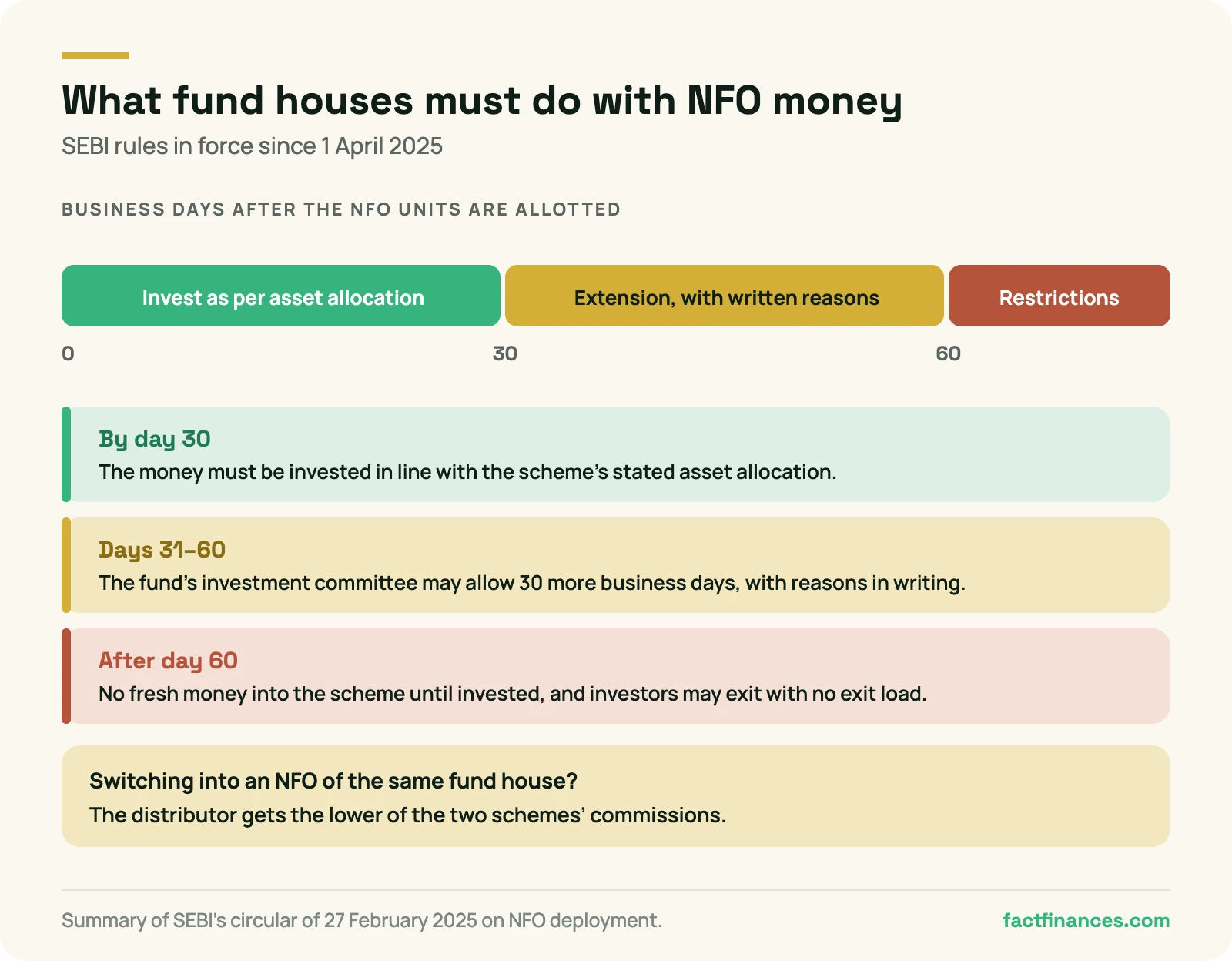
SEBI tightened NFO rules after a wave of launches. From 1 April 2025:
- Money must be invested within 30 business days of allotment, as per the scheme’s stated asset allocation. The fund’s investment committee can extend this by another 30 business days, with written reasons.
- If it is still not invested after 60 business days, the scheme cannot take fresh money until it is, and investors who want to leave can exit without an exit load.
- Switching into an NFO earns the distributor less. When you switch from an existing scheme into an NFO of the same fund house, the distributor is paid the lower of the two schemes’ commissions — so there is no extra reward for moving you.
And since SEBI’s February 2026 recategorisation circular, a new sectoral or thematic fund cannot overlap by more than 50% with the fund house’s other equity schemes (large-cap schemes excepted). That stops a “new theme” from being an old fund in new clothes — but a genuinely different fund can still be a poor fit for you.
Checklist
Six checks before you invest in an NFO
- Does it fill a gap? List what you already own. If you hold a flexi-cap and a mid-cap fund, a new “opportunities” fund may add little. See the types of mutual funds to place it.
- Is there an existing fund that does the same job? For an index NFO, look for older funds on the same index — their tracking difference is already known (see index funds and ETFs). For an active NFO, look at the fund house’s existing funds in the same category.
- Read the Scheme Information Document. Check the benchmark, the asset allocation range, the exit load and any lock-in. A theme with wide allocation ranges can drift into anything.
- Check the costs. A new fund starts small, and the expense limits allow small funds the highest rates. Compare the stated expense ratio with similar funds — the expense ratio guide shows how.
- Look at the manager, not the brochure. The NFO has no record, but its fund manager usually does. Review their other schemes over a full market cycle using the methods in evaluating fund performance.
- Size it as a satellite. A sector or theme is concentrated risk. If you invest, keep it to a small slice of your equity money so that a bad run for the theme cannot derail your goals.
Worked Example
The cost of switching into an NFO
Mr Sinha in Ranchi (a fictional example) holds an equity fund bought nine months ago: ₹3 lakh invested, now worth ₹3.3 lakh. He gets a call about an NFO “at only ₹10” and considers switching the whole amount. A switch is a redemption followed by a new purchase, so before the new fund earns a rupee:
| Cost of the switch | Amount |
|---|---|
| Exit load at 1% (redeemed within one year) | ₹3,300 |
| Short-term capital gains tax at 20% on the ₹26,700 gain left after the exit load | ₹5,340 plus cess |
| Total, before any return from the NFO | about ₹8,850 |
He would also give up a fund with a nine-month record for one with none. Taxation of switches is covered in how mutual funds are taxed.
When It Makes Sense
When an NFO can be worth it
- A genuinely new exposure that no existing fund offers — a new index, or a category introduced by the 2026 rules, such as life cycle funds.
- A closed-ended product you specifically want, such as a fixed maturity plan whose maturity matches a known expense.
- A category you lack, from a fund house you already know well, where the manager’s record in similar funds is long and consistent.
Even then, for an open-ended fund there is rarely a cost to waiting a few months and watching how the money is invested.
How We Help
How we handle NFOs
As an AMFI-registered mutual fund distributor, we are paid a commission by fund houses, and we tell you what it is. NFOs do not pay us more than existing funds, and we do not pitch them. When a client asks about one, we:
- Compare it with what you already own and with older funds that do the same job.
- Read the offer document with you — allocation, costs, exit load and lock-in.
- Work out the real cost of any switch, including exit loads and tax, before you decide.
- Suggest a size that keeps a theme from dominating your portfolio, if you go ahead.
FAQ
Frequently asked questions
What is an NFO in mutual funds?
A new fund offer is the first offer of units in a new mutual fund scheme, usually at ₹10 a unit for a limited period of up to 15 days. Open-ended schemes reopen for regular buying and selling within five business days of allotment.
Is a ₹10 NAV in an NFO cheap?
No. NAV is the value of the fund’s holdings divided by the number of units. A ₹10 NAV gives you more units than a ₹100 NAV, but the same rupee gain or loss for the same portfolio.
Should I invest in an NFO or an existing fund?
An existing fund has a track record, a known portfolio and known costs. Consider an NFO only when it offers an exposure that no existing fund provides and fits a gap in your portfolio.
How long does a fund house have to invest NFO money?
Since 1 April 2025, within 30 business days of allotment, extendable by 30 more. If the money is still not invested after 60 business days, investors can exit without an exit load.
Can I buy an NFO fund after the offer closes?
Yes, if it is open-ended. It reopens for purchases at the daily NAV within five business days of allotment. Closed-ended schemes such as fixed maturity plans can only be bought during the offer.
Is switching from my existing fund to an NFO a good idea?
A switch is a sale and a purchase. It can trigger an exit load and capital gains tax, and you give up a fund with a record for one without. Work out the cost before deciding.
Keep learning: Compare Direct and Regular plans, learn to read a mutual fund factsheet, see common mutual fund mistakes, or return to the main mutual funds guide.
Free · Printable · 10 minutes
Your 5-point money check-up
A 10-minute printable that shows where your family’s money is protected and where it isn’t. Plus one useful money article a month. No spam.
General information only, not personalised advice. Ujjwal Tiwary, AMFI-registered Mutual Fund Distributor, ARN-144500.
About the author
Ujjwal Tiwary
ARN-144500 · NISM Series V-A certified since 2018 · Ranchi & Deoghar, Jharkhand
Ujjwal Tiwary is an AMFI-registered mutual fund distributor (ARN-144500) based in Ranchi and Deoghar, Jharkhand, and has held the NISM Series V-A certification since 2018. He works with families on mutual funds, insurance and income tax returns, and writes or personally reviews every article on FactFinances. He is not a SEBI-registered investment adviser; nothing on this site is personalised advice.
FactFinances is an educational platform. We are an AMFI-registered mutual fund distributor (ARN-144500). We do not provide investment advice or recommend specific securities. All figures are illustrations at assumed rates and are not guarantees or forecasts of returns. Mutual fund investments are subject to market risks; read all scheme-related documents carefully.