

Part of our complete guide to mutual funds in India — one fund, two or three asset classes, and a built-in way to stop your mix drifting. This is educational content, not investment advice.
Hybrid mutual funds hold more than one asset class — usually equity and debt, sometimes gold or silver too — inside a single scheme. The fund keeps the mix in line, so you do not have to rebalance it yourself. The catch is that “hybrid” covers very different funds: one can be 80% in shares, another 10%. This guide maps the seven categories under SEBI’s 2026 rules, then compares the three most people actually choose between: balanced advantage (now called dynamic asset allocation), aggressive hybrid and multi-asset allocation.
The short version: an aggressive hybrid is an equity fund with a cushion; a balanced advantage fund moves between equity and debt depending on how expensive the market is; a multi-asset fund spreads across at least three asset classes. How each is taxed depends on how much of it is in equity — and that can matter as much as the returns.
The Map
The seven hybrid categories under the 2026 rules
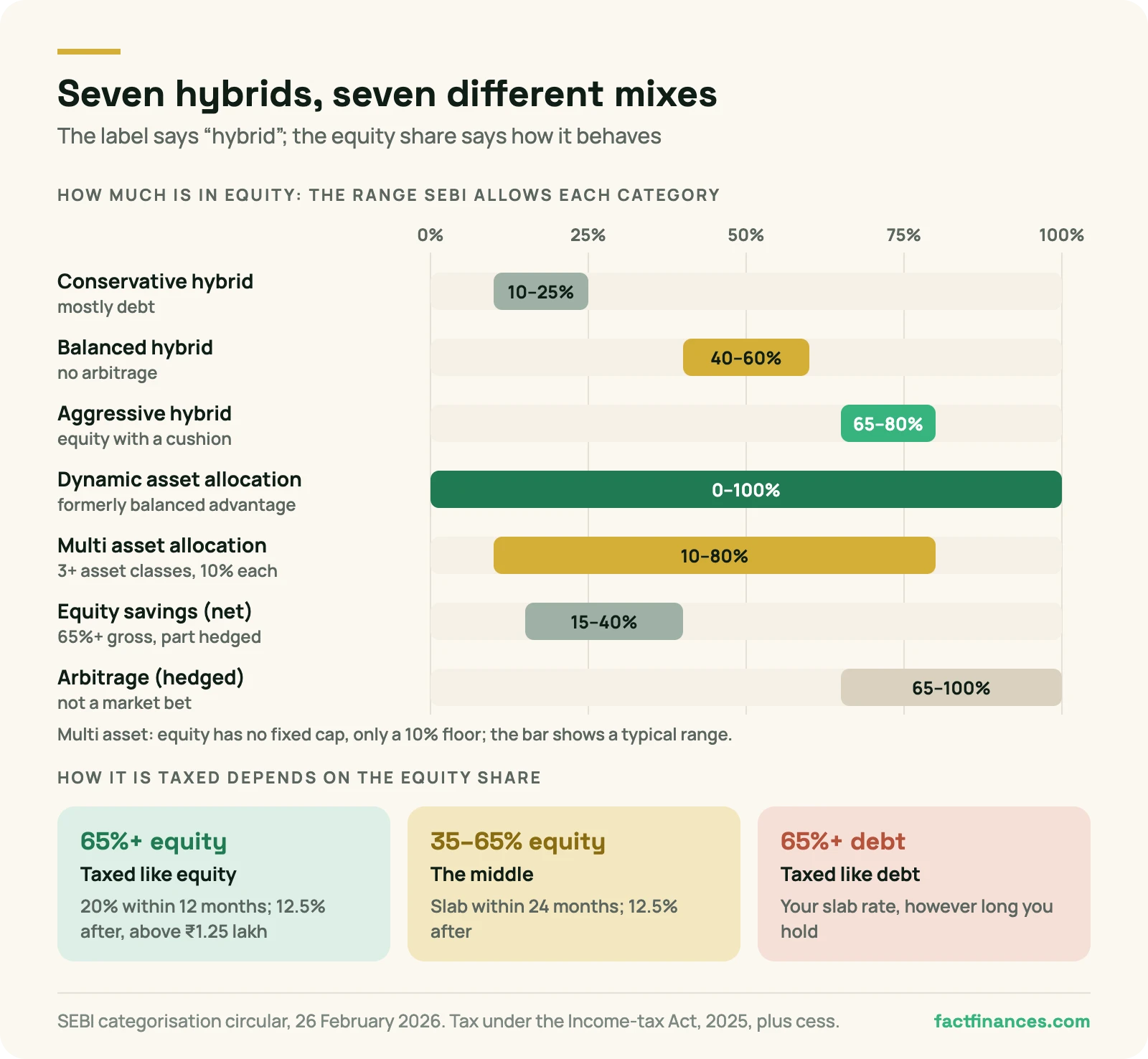
SEBI’s categorisation circular of 26 February 2026 kept the hybrid family but tightened several definitions. Existing schemes were given six months to comply, so names and mandates have now been realigned.
| Category | Equity | Debt | What sets it apart |
|---|---|---|---|
| Conservative hybrid | 10–25% | 75–90% | Mostly debt with a small equity kicker |
| Balanced hybrid | 40–60% | 40–60% | Roughly even split; arbitrage not allowed |
| Aggressive hybrid | 65–80% | 20–35% | Equity-heavy with a debt cushion |
| Dynamic asset allocation | 0–100% | 0–100% | Formerly “balanced advantage”; mix moves with market valuations |
| Multi asset allocation | At least 10% | At least 10% | At least three asset classes, at least 10% in each |
| Arbitrage | At least 65% (hedged) | Rest | Earns from price gaps, not market direction |
| Equity savings | At least 65% gross; 15–40% net | At least 10% | Part equity, part hedged, part debt |
Three changes are worth knowing. The balanced hybrid category now explicitly bars arbitrage, so its equity is genuinely unhedged. Dynamic asset allocation funds are confined to equity and debt. And hybrid funds other than arbitrage funds may now put a small residual portion into InvITs, exchange-traded commodity derivatives and gold or silver ETFs. Arbitrage funds are covered separately in liquid vs arbitrage vs FD; the rest of this guide is about the three growth-oriented hybrids.
Aggressive Hybrid
Aggressive hybrid: an equity fund with a cushion
An aggressive hybrid keeps 65–80% in shares and the rest in bonds. Because equity never falls below 65%, it behaves like a gentler equity fund: it rises a little less in good years and falls a little less in bad ones. The fund manager rebalances back into the band, which means trimming shares after a rally and adding after a fall.
- Suits: goals five or more years away, for someone who wants most of equity’s growth but finds a pure equity fund’s swings hard to sit through.
- Watch: in a sharp fall it can still drop by around three-quarters as much as the market. It is not a low-risk fund.
- Tax: taxed as an equity fund, because equity is at least 65%.
Balanced Advantage
Balanced advantage (dynamic asset allocation): the mix moves for you
A dynamic asset allocation fund can hold anywhere from 0% to 100% in equity. Most use a valuation model — often based on price-to-earnings or price-to-book ratios — to hold more equity when the market is cheap and less when it is expensive. The idea is to soften falls and reduce the temptation to time the market yourself.
There is a detail that explains how most of these funds are taxed. They usually keep gross equity at 65% or more, but hedge part of it with arbitrage positions, so their net (unhedged) equity can be much lower — 30% to 80% depending on the model and the market. The hedged part earns a steady, debt-like return. Always look at net equity in the factsheet, not the headline equity figure.
- Suits: a first equity investment, a lump sum you are nervous about investing at market highs, or a goal three to five years away.
- Watch: funds use very different models, so two “balanced advantage” funds can behave very differently. In a strong rally, a fund sitting at low net equity will lag.
- Tax: most are taxed as equity funds because gross equity stays at 65% or more — check each fund’s stated policy.
Multi Asset
Multi asset allocation: three or more asset classes
A multi asset fund must hold at least three asset classes with at least 10% in each — typically equity, debt and gold or silver. Gold and equity often move differently, so the fund is less likely to have every part falling at once. Some multi asset funds run high equity (with arbitrage to take gross equity above 65%); others hold 35–65% equity.
- Suits: someone who wants equity, debt and gold in one place, without managing three separate funds.
- Watch: the mix varies a lot across funds — one may be 65% equity, another 40%. Check the equity, debt and commodity shares before comparing returns.
- Tax: depends entirely on the equity share. This is where multi asset funds differ most, as the next section shows.
Side by Side
Balanced advantage vs aggressive hybrid vs multi asset
| Aggressive hybrid | Balanced advantage | Multi asset | |
|---|---|---|---|
| Equity | 65–80%, fixed band | 0–100%, moves with valuations | At least 10%; often 35–65%+ |
| Other assets | Debt | Debt and arbitrage | Debt, gold, silver |
| Behaves like | A gentler equity fund | Equity that leans against extremes | A ready-made diversified portfolio |
| Typical horizon | 5+ years | 3–5 years | 3–5+ years |
| Usual tax treatment | Equity | Equity (most) | Depends on equity share |
Worked Example
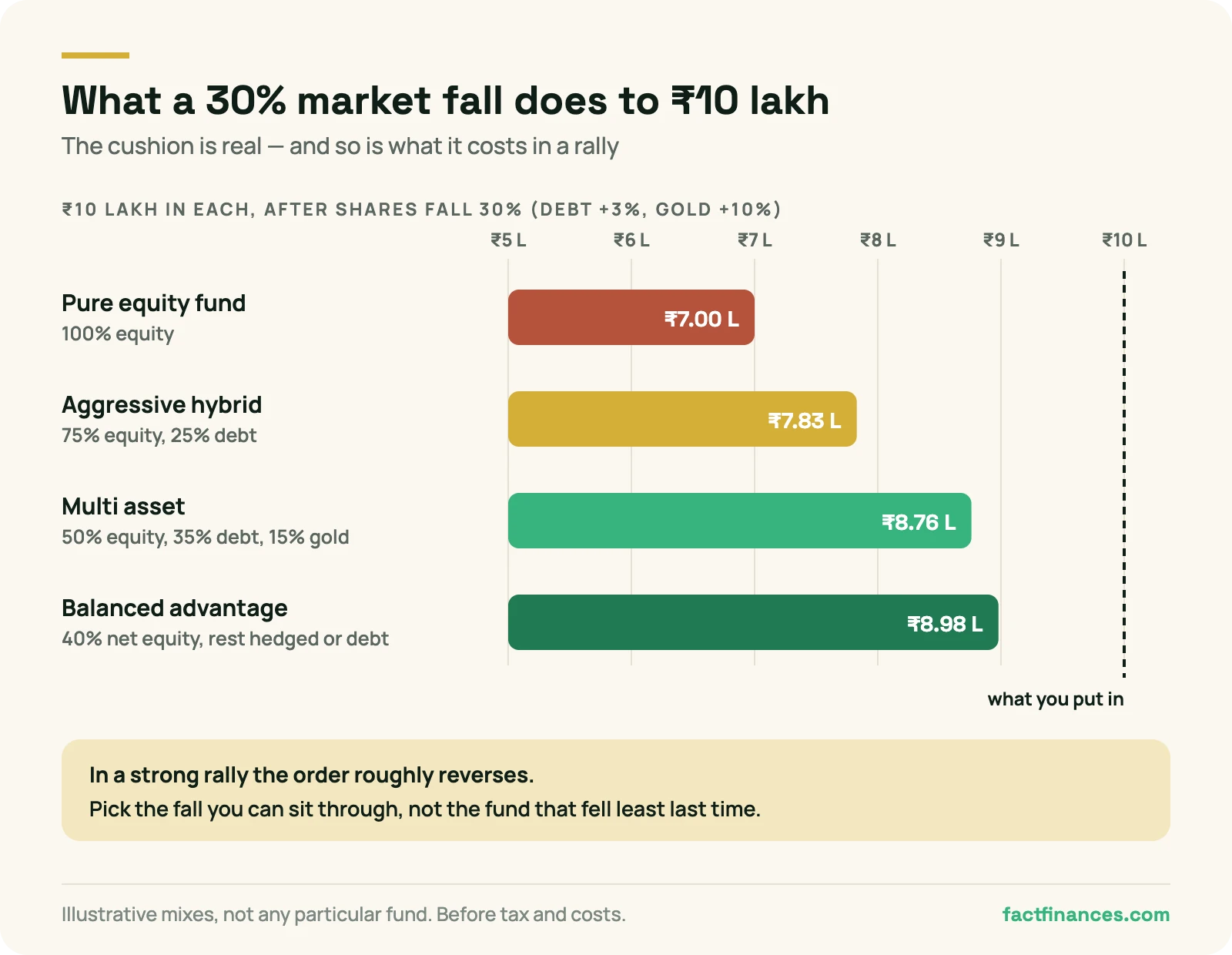
What a 30% market fall does to ₹10 lakh
Suppose you put ₹10 lakh into each type, and over the next year shares fall 30%, while debt and arbitrage positions earn 3% and gold rises 10%. The allocations below are illustrative assumptions, not any particular fund:
| Fund (assumed mix) | Change | Value after the fall |
|---|---|---|
| Pure equity fund (100% equity) | −30.0% | ₹7.00 lakh |
| Aggressive hybrid (75% equity, 25% debt) | −21.8% | ₹7.83 lakh |
| Multi asset (50% equity, 35% debt, 15% gold) | −12.5% | ₹8.76 lakh |
| Balanced advantage (40% net equity, rest hedged or debt) | −10.2% | ₹8.98 lakh |
The cushion is real, but so is the cost: in a strong rising market, the same mixes would rise in roughly the reverse order. A hybrid does not remove risk — it changes how much of the market’s swing you feel. Choose the swing you can sit through, because the investor who stays invested usually does better than the one who picks the “best” fund and sells in a fall.
Tax
How hybrid funds are taxed in 2026-27
Under the Income-tax Act, 2025, a hybrid fund’s tax depends on what it holds:
| Fund holds | Short-term | Long-term |
|---|---|---|
| 65% or more in Indian equity | 20% if sold within 12 months | 12.5% after 12 months, on gains above ₹1.25 lakh a year |
| More than 65% in debt and money market | Your slab rate, however long you hold | Your slab rate |
| Anything in between (e.g. 35–65% equity) | Your slab rate if sold within 24 months | 12.5% after 24 months, no ₹1.25 lakh exemption |
So most aggressive hybrids and balanced advantage funds are taxed like equity; conservative hybrids are taxed like debt; and balanced hybrids, and multi asset funds with 35–65% equity, fall in the middle. Take a ₹1.5 lakh gain after 18 months, for someone in the 30% slab:
- Equity-taxed fund: 12.5% on ₹25,000 (the gain above ₹1.25 lakh) = about ₹3,250 with cess, if no other equity gains have used the exemption that year.
- Fund with 50% equity: still short-term at 18 months, so taxed at the slab — about ₹46,800 with cess.
- The same fund held 25 months: 12.5% on the whole ₹1.5 lakh — about ₹19,500 with cess.
The ₹1.25 lakh exemption is one limit for all your equity gains in a year, not one per fund. Dividends (IDCW) from any hybrid are taxed at your slab rate. For more, see how mutual funds are taxed, and use the capital gains calculator to work out tax lot by lot.
Choosing
How to choose between them
- Start with the goal and the horizon. Under three years, most hybrids carry too much equity; look at short-term options instead.
- Decide how big a fall you can sit through. If a 20% drop would make you sell, an aggressive hybrid is the wrong fund, however good its returns look.
- Look at net equity, not the label. The factsheet shows gross equity, hedged equity and net equity; the last is the one that drives the swings. See how to read a factsheet.
- Check the tax line. For a multi asset or balanced hybrid fund, find out whether it holds 65% or more in equity.
- Compare costs. Hybrids are actively managed, and the expense ratio comes out every year.
- Fit it into the whole portfolio. A hybrid already holds debt, so count it when you work out your asset allocation.
How We Help
How we help with hybrid funds
As an AMFI-registered mutual fund distributor, we are paid by fund houses and we tell you what we earn. Hybrid funds are where the label says least about the fund, so for the families we work with we:
- Read the factsheet with you — net equity, the valuation model, the debt quality — so you know what a fund will actually do in a fall.
- Match the category to the goal, the horizon and the size of fall you can sit through.
- Check how the fund will be taxed before you invest, not after you redeem.
- Review the mix each year, and stay with you through falls — when the cushion matters most and selling costs most.
FAQ
Frequently asked questions
What is a hybrid mutual fund?
A mutual fund that invests in more than one asset class — usually equity and debt, sometimes gold or silver — in a single scheme, and keeps the mix within the limits SEBI sets for its category.
What are the types of hybrid funds in India?
Under SEBI’s 2026 rules: conservative hybrid, balanced hybrid, aggressive hybrid, dynamic asset allocation (balanced advantage), multi asset allocation, arbitrage and equity savings funds.
What is the difference between a balanced advantage fund and an aggressive hybrid fund?
An aggressive hybrid keeps 65–80% in equity at all times. A balanced advantage (dynamic asset allocation) fund can hold 0–100%, moving its equity up and down with market valuations, often using arbitrage so that net equity is lower than gross equity.
Are hybrid funds taxed like equity funds?
Only if they hold 65% or more in Indian equity. Funds with more than 65% in debt are taxed at your slab rate; funds in between are taxed at the slab within 24 months and 12.5% after that.
Is a balanced advantage fund safe?
It is lower-risk than a pure equity fund, not risk-free. It can still lose money in a market fall, and different funds use very different models.
What is a multi asset allocation fund?
A hybrid fund that must invest in at least three asset classes, with at least 10% in each — typically equity, debt and gold or silver.
Keep learning: Compare all fund families in types of mutual funds, set your asset allocation, read a factsheet properly, or return to the main mutual funds guide.
Free · Printable · 10 minutes
Your 5-point money check-up
A 10-minute printable that shows where your family’s money is protected and where it isn’t. Plus one useful money article a month. No spam.
General information only, not personalised advice. Ujjwal Tiwary, AMFI-registered Mutual Fund Distributor, ARN-144500.
About the author
Ujjwal Tiwary
ARN-144500 · NISM Series V-A certified since 2018 · Ranchi & Deoghar, Jharkhand
Ujjwal Tiwary is an AMFI-registered mutual fund distributor (ARN-144500) based in Ranchi and Deoghar, Jharkhand, and has held the NISM Series V-A certification since 2018. He works with families on mutual funds, insurance and income tax returns, and writes or personally reviews every article on FactFinances. He is not a SEBI-registered investment adviser; nothing on this site is personalised advice.
FactFinances is an educational platform. We are an AMFI-registered mutual fund distributor (ARN-144500). We do not provide investment advice or recommend specific securities. All figures are illustrations at assumed rates and are not guarantees or forecasts of returns. Mutual fund investments are subject to market risks; read all scheme-related documents carefully.