

Part of our complete guide to mutual funds in India — redeeming is easy; redeeming at the right time, from the right fund, is where the money is saved. This is educational content, not investment advice.
Selling mutual fund units — redeeming them — takes a few minutes online. What takes thought is everything around it: which NAV you get, when the money reaches your bank, which of your units are actually sold, and how much goes in exit load and tax. Get those right and the same withdrawal can cost noticeably less. This guide walks through the process and the rules, with a worked SIP example.
The short version: place the request before 3 pm on a business day to get that day’s NAV; the money arrives within three working days. Your oldest units are always sold first, so check how many of them are past the exit-load period and the 12-month tax line before you redeem.
The Process
Where and how to place a redemption
You can redeem through any of these, and the money goes only to the bank account registered in your folio:
- The fund house’s website or app, using your folio number or PAN.
- MF Central, or the CAMS or KFintech portals, which cover funds across fund houses.
- Your distributor or investment platform, if you invested through one.
- Your broker, if the units are held in a demat account.
You choose to redeem a rupee amount, a number of units, or all units. For regular withdrawals, a systematic withdrawal plan does the same thing automatically each month. If your bank account has changed, update it in the folio first — see KYC and folio details — because a payout to a closed account is a common cause of delay.
Timing
Which NAV you get, and when the money arrives
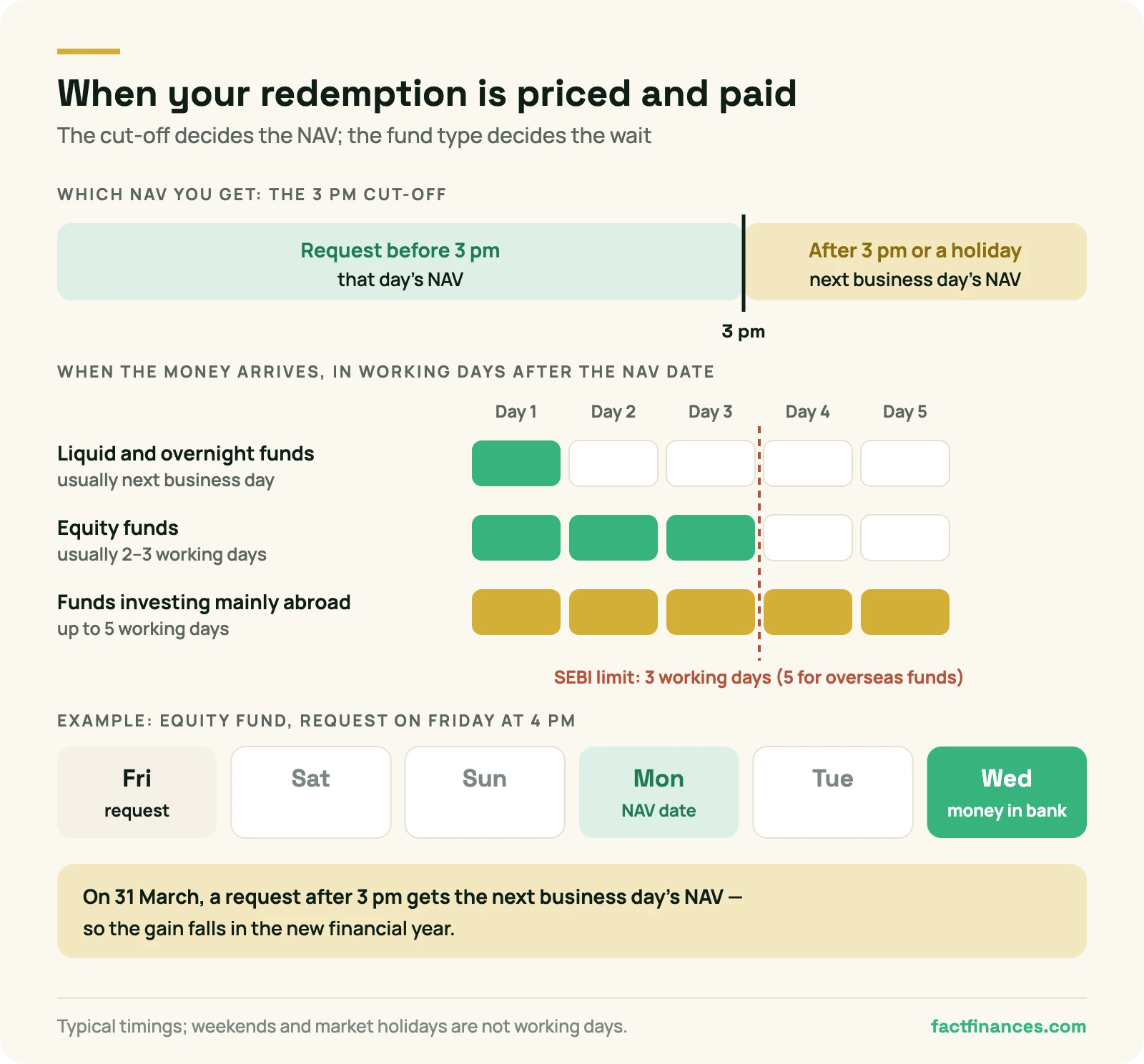
- Cut-off time: a redemption request received before 3 pm on a business day gets that day’s NAV. After 3 pm, or on a holiday, it gets the next business day’s NAV.
- Payout: SEBI requires fund houses to transfer the money within three working days. In practice, liquid and overnight funds usually pay the next business day, and equity funds within two to three working days. Funds investing mainly abroad can take up to five.
- Weekends and holidays do not count, so a Friday-afternoon request in an equity fund may arrive the following Wednesday.
- The tax year follows the NAV date. A request placed after 3 pm on 31 March is processed on the next business day, which falls in the new financial year — useful, or costly, if you are planning tax harvesting.
The Key Rule
Which units are sold: first in, first out
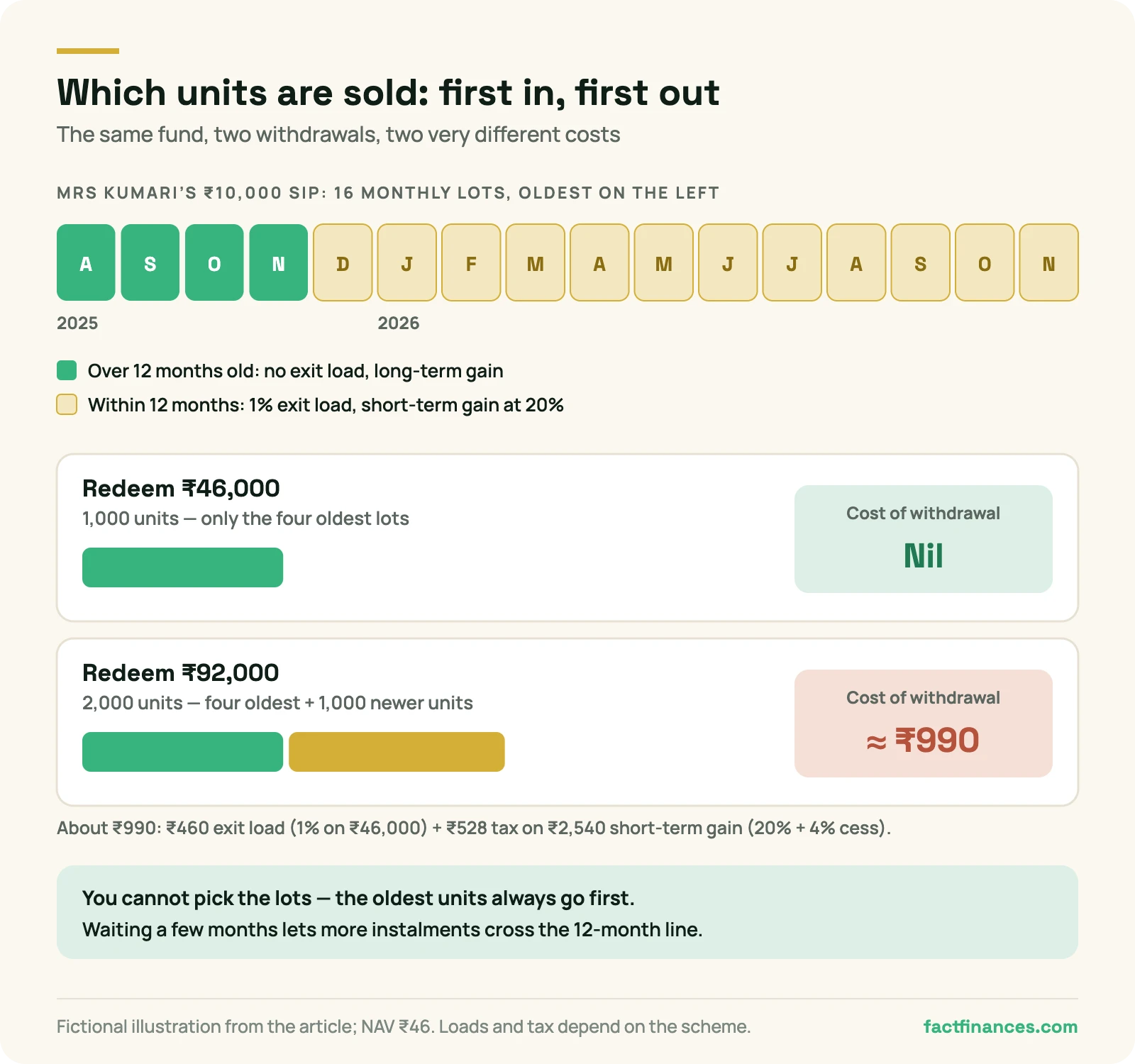
If you have invested in a fund more than once — every SIP instalment counts — you hold many “lots” of units, each with its own purchase date and price. You cannot choose which lot to sell. Units are redeemed on a first-in, first-out (FIFO) basis: the oldest units go first. Both the exit load and the tax are then worked out lot by lot, using each lot’s age and cost.
This matters most for SIP investors. A two-year-old SIP may look “long-term”, but only its earlier instalments are; the last twelve are still within a year. Your CAS or the capital gains statement from CAMS or KFintech shows each lot’s date.
Worked Example
A SIP redemption in Deoghar
Mrs Kumari (a fictional example) has run a ₹10,000 monthly SIP in an equity fund since August 2025 — sixteen instalments by November 2026. She needs money in mid-November 2026. Her first four instalments, from August to November 2025, are now more than 12 months old; the other twelve are not. Assume those four bought 1,000 units for ₹40,000, the next twelve months’ units cost a little more, and the NAV today is ₹46.
| Redeem ₹46,000 (1,000 units) | Redeem ₹92,000 (2,000 units) | |
|---|---|---|
| Units sold | Only the four oldest instalments | The four oldest, plus 1,000 units from the last 12 months |
| Exit load (1% within a year) | Nil | ₹460 on the newer units |
| Gain | ₹6,000, all long-term | ₹6,000 long-term + about ₹2,540 short-term |
| Tax | Nil, within the ₹1.25 lakh long-term exemption | About ₹528 on the short-term part (20% plus cess) |
| Cost of the withdrawal | Nil | About ₹990 |
The extra ₹990 is small here, but it scales with the amount and the gain. If she can take ₹46,000 now and the rest a few months later, as more instalments cross 12 months, she avoids it. If she needs ₹92,000 today, it may be better to take part of it from a fund where her units are all old — or from her short-term parking money. To see the same lot-by-lot picture for your own SIP, use our mutual fund capital gains calculator — it can build your SIP instalments from actual NAVs or read them from your CAS.
Charges
Exit load: the fee for leaving early
Many funds charge an exit load if units are redeemed within a set period — commonly 1% within one year for equity funds, and much shorter or nil for debt funds. It is deducted from the amount paid out: the redemption price is the NAV less the load. Because of FIFO, the load applies only to the units that are still within the period. The exact load is in the scheme’s factsheet and Scheme Information Document; see expense ratio and exit load.
Lock-ins are different: ELSS units cannot be redeemed at all for three years, and each SIP instalment has its own three-year lock-in.
Tax
Tax on redemption
| Fund type | Held up to 12 months | Held more than 12 months |
|---|---|---|
| Equity-oriented (65%+ equity, incl. arbitrage) | 20% | 12.5% on gains above ₹1.25 lakh a year |
| Debt funds (units bought from 1 April 2023) | Your slab rate | Your slab rate |
- A switch is a redemption. Moving money from one scheme to another — even within the same fund house — is taxed as a sale.
- STT of 0.001% is deducted on equity fund redemptions — ₹1 on ₹1 lakh.
- No TDS for residents on capital gains; you pay the tax yourself, through advance tax or with your return.
- Losses can be set off against other capital gains and carried forward, if you file your return on time.
The full rules are in how mutual funds are taxed and capital gains tax in India.
Checklist
Before you redeem
- Which fund? Redeem from the part of your portfolio that is overweight, or from the fund meant for this goal — not simply the one that has done worst or best. See asset allocation.
- How old are the units? Check how many units are past the exit-load period and the 12-month tax line.
- Which tax year? Near 31 March, decide whether the gain should fall in this year or the next.
- Is the bank account current? Check it in the folio before you place the request.
- All at once, or in parts? A large withdrawal split across two financial years can use the ₹1.25 lakh long-term exemption twice.
How We Help
How we help with redemptions
As an AMFI-registered mutual fund distributor, we are paid by fund houses and we tell you what we earn. When clients need money from their funds, we:
- Pull the lot-by-lot picture from your capital gains statement, so you know what each withdrawal will cost before you place it.
- Suggest which fund and how much to redeem, to keep exit loads and tax low and your asset mix intact.
- Place and track the request until the money reaches your bank.
- Note the gains for your return — and we help you file your ITR if you want us to.
FAQ
Frequently asked questions
How do I redeem a mutual fund?
Through the fund house’s website or app, MF Central, the CAMS or KFintech portals, your distributor or platform, or your broker for demat units. Choose an amount, a number of units or all units; the money goes to the bank account registered in the folio.
How long does it take to get money after redeeming a mutual fund?
SEBI requires payment within three working days. Liquid and overnight funds usually pay the next business day; equity funds within two to three working days. Funds investing mainly abroad can take up to five.
Which NAV applies to my redemption?
If the request reaches the fund before the 3 pm cut-off on a business day, that day’s NAV applies. Otherwise, the next business day’s NAV applies.
Which units are sold when I redeem part of my SIP?
The oldest units first — first in, first out. Exit load and capital gains tax are then calculated for each lot according to its own purchase date and cost.
Is there tax on mutual fund redemption?
Yes, on the gain. Equity funds: 20% within 12 months, 12.5% after on gains above ₹1.25 lakh a year. Debt funds bought from April 2023: your slab rate. There is no TDS for residents, and STT of 0.001% applies on equity fund redemptions.
Is switching between funds a redemption?
Yes. A switch is a redemption from one scheme and a purchase in another, so it can attract exit load and capital gains tax on the scheme you leave.
Keep learning: Set up a systematic withdrawal plan for regular income, plan tax harvesting before 31 March, learn how to read your CAS, or return to the main mutual funds guide.
Free · Printable · 10 minutes
Your 5-point money check-up
A 10-minute printable that shows where your family’s money is protected and where it isn’t. Plus one useful money article a month. No spam.
General information only, not personalised advice. Ujjwal Tiwary, AMFI-registered Mutual Fund Distributor, ARN-144500.
About the author
Ujjwal Tiwary
ARN-144500 · NISM Series V-A certified since 2018 · Ranchi & Deoghar, Jharkhand
Ujjwal Tiwary is an AMFI-registered mutual fund distributor (ARN-144500) based in Ranchi and Deoghar, Jharkhand, and has held the NISM Series V-A certification since 2018. He works with families on mutual funds, insurance and income tax returns, and writes or personally reviews every article on FactFinances. He is not a SEBI-registered investment adviser; nothing on this site is personalised advice.
FactFinances is an educational platform. We are an AMFI-registered mutual fund distributor (ARN-144500). We do not provide investment advice or recommend specific securities. All figures are illustrations at assumed rates and are not guarantees or forecasts of returns. Mutual fund investments are subject to market risks; read all scheme-related documents carefully.