

Part of our complete guide to mutual funds in India — an ELSS saves tax only if you file under the old regime — so the first question is your regime, not the fund. This is educational content, not investment advice.
ELSS — the Equity Linked Savings Scheme — has been the default “tax-saving mutual fund” for two decades. In 2026 that label needs a second look. The deduction it offers exists only in the old tax regime, and the new regime is now the default for everyone. For some investors ELSS tax saving funds still put up to ₹46,800 a year back in their pocket; for others they save nothing at all and simply lock up money for three years. This guide shows which group you are in, what the lock-in really means for a SIP, how ELSS compares with PPF and NPS, and what to do with ELSS units you already hold.
Check your regime first: put your salary and deductions into our old vs new tax regime calculator. If the new regime comes out cheaper, an ELSS will not reduce your tax — and the rest of this article tells you what to do instead.
The Basics
What an ELSS is
An ELSS is an equity mutual fund with two special features set by law: every investment is locked in for three years, and the amount invested qualifies for a tax deduction. SEBI’s February 2026 scheme categorisation now calls the category “ELSS – Tax Saver Fund”, and requires the fund to keep at least 80% of its assets in shares.
- It is an equity fund first. Its value rises and falls with the stock market. Nothing about the tax benefit makes it safer.
- The deduction is under section 123 of the Income-tax Act, 2025 — the section that replaced the old section 80C from 1 April 2026. The limit is unchanged at ₹1.5 lakh a year, shared with EPF, PPF, life insurance premiums, children’s tuition fees and home-loan principal.
- The lock-in is three years from the date each lot of units is allotted — the shortest among section 123 investments, but absolute. You cannot redeem or switch during it.
- There is no upper limit on investing, but only ₹1.5 lakh a year (across all section 123 items) earns a deduction.
Our guide to section 123 deductions lists every investment and payment that shares this ₹1.5 lakh limit.
The 2026 Question
Does an ELSS actually save you tax?
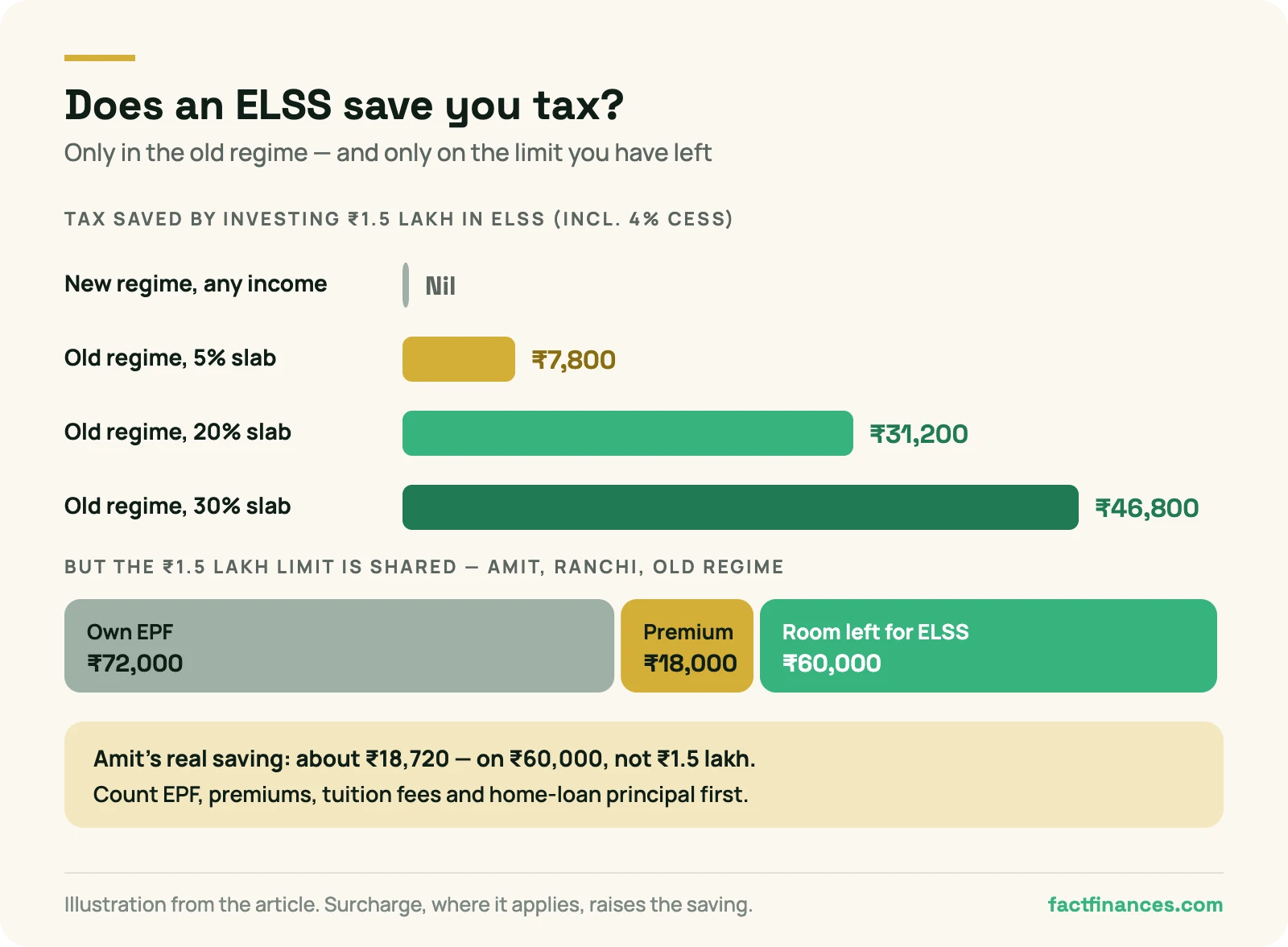
Only if you file under the old tax regime. The new regime — the default since FY 2023-24 — does not allow the section 123 deduction at all. Under the new regime, salaried income up to ₹12.75 lakh already bears no tax, and above that the lower slab rates usually beat the old regime unless your deductions are large.
| Your position | Tax saved by ₹1.5 lakh in ELSS | What it means |
|---|---|---|
| New regime (any income) | Nil | ELSS is just an equity fund with a lock-in |
| Old regime, 5% slab | ₹7,800 | Small saving; weigh it against the lock-in |
| Old regime, 20% slab | ₹31,200 | Worth having if equity suits the goal |
| Old regime, 30% slab | ₹46,800 | The full benefit |
The limit you have left is usually smaller than ₹1.5 lakh
Amit, 36, works for a company in Ranchi and has chosen the old regime because of his home loan and HRA. His own EPF contribution is ₹72,000 a year and his term insurance premium is ₹18,000. That is ₹90,000 of the ₹1.5 lakh limit already used before he invests a rupee.
| Item | Amount |
|---|---|
| Section 123 limit | ₹1,50,000 |
| Less: own EPF contribution | ₹72,000 |
| Less: term insurance premium | ₹18,000 |
| Room left for ELSS | ₹60,000 |
| Tax saved on ₹60,000 at the 30% slab | ≈ ₹18,720 |
So before choosing an amount, add up what your salary slip and existing commitments already cover. Many salaried people with a home loan have little or no room left. The article on old vs new tax regime shows how to compare the two properly.
The Lock-in
How the three-year lock-in really works
The lock-in applies to each purchase separately. A lump sum is simple: invest on 10 January 2027 and those units are free on 10 January 2030. A SIP is different — every instalment starts its own three-year clock.
| SIP instalment | Units can be redeemed from |
|---|---|
| 5 April 2026 | 5 April 2029 |
| 5 May 2026 | 5 May 2029 |
| 5 June 2026 | 5 June 2029 |
| … | … |
| 5 March 2027 (twelfth instalment) | 5 March 2030 |
- No early exit for any reason. Not for a medical emergency, not by paying a penalty. Keep your emergency fund elsewhere.
- No switching either. You cannot move locked units to another scheme, or from the Regular plan to the Direct plan.
- On the investor’s death, the nominee or legal heir can redeem once one year has passed from the date the units were allotted.
- Stopping a SIP is allowed at any time. The instalments already paid simply finish their own three years.
- Three years is the legal minimum, not the right holding period. Equity needs five years or more. Treat the lock-in as the earliest exit, not the plan.
Tax on the Way Out
How ELSS gains are taxed
Because every unit is held for more than 12 months, all ELSS gains are long-term capital gains. They are taxed at 12.5% on the part of your total equity gains that exceeds ₹1.25 lakh in a financial year, in both regimes. There is no exit load.
Example: ₹1.5 lakh invested in an ELSS that grows at an assumed 12% a year is worth about ₹2.11 lakh after three years — a gain of roughly ₹60,700. If that is your only equity gain that year, it is within the ₹1.25 lakh exemption and no tax is due. Larger holdings can be redeemed across financial years to use the exemption more than once; we explain the method in tax harvesting.
Choose the growth option. In the IDCW (dividend) option, payouts are added to your income and taxed at your slab rate, which defeats the purpose for most taxpayers. Full rules are in mutual fund taxation in India.
The Comparison
ELSS vs PPF vs NPS vs tax-saving FD
All four can earn a deduction in the old regime. They are very different products, and the right mix depends on what the money is for.
| ELSS | PPF | NPS (Tier I) | 5-year tax-saving FD | |
|---|---|---|---|---|
| What it is | Equity mutual fund | Government savings scheme | Market-linked pension account | Bank deposit |
| Lock-in | 3 years per investment | 15 years (partial withdrawal from year 7) | Until retirement, with limited partial withdrawals | 5 years |
| Return | Market-linked, not guaranteed | 7.1% a year at present, reset quarterly | Market-linked, depends on your equity/debt mix | Fixed at the bank’s rate |
| Can it fall in value? | Yes, sharply in bad years | No | Yes, less so with more debt | No |
| Deduction (old regime) | Section 123, within ₹1.5 lakh | Section 123, within ₹1.5 lakh | Within ₹1.5 lakh, plus an extra ₹50,000 under section 124 | Section 123, within ₹1.5 lakh |
| Tax on what you get back | 12.5% on gains above ₹1.25 lakh a year | Tax-free | Part tax-free lump sum; pension taxed as income | Interest taxed every year at your slab |
For the savings-scheme side in detail, see small savings schemes and EPF and NPS.
In Numbers
₹1.5 lakh a year for 15 years: PPF and ELSS side by side
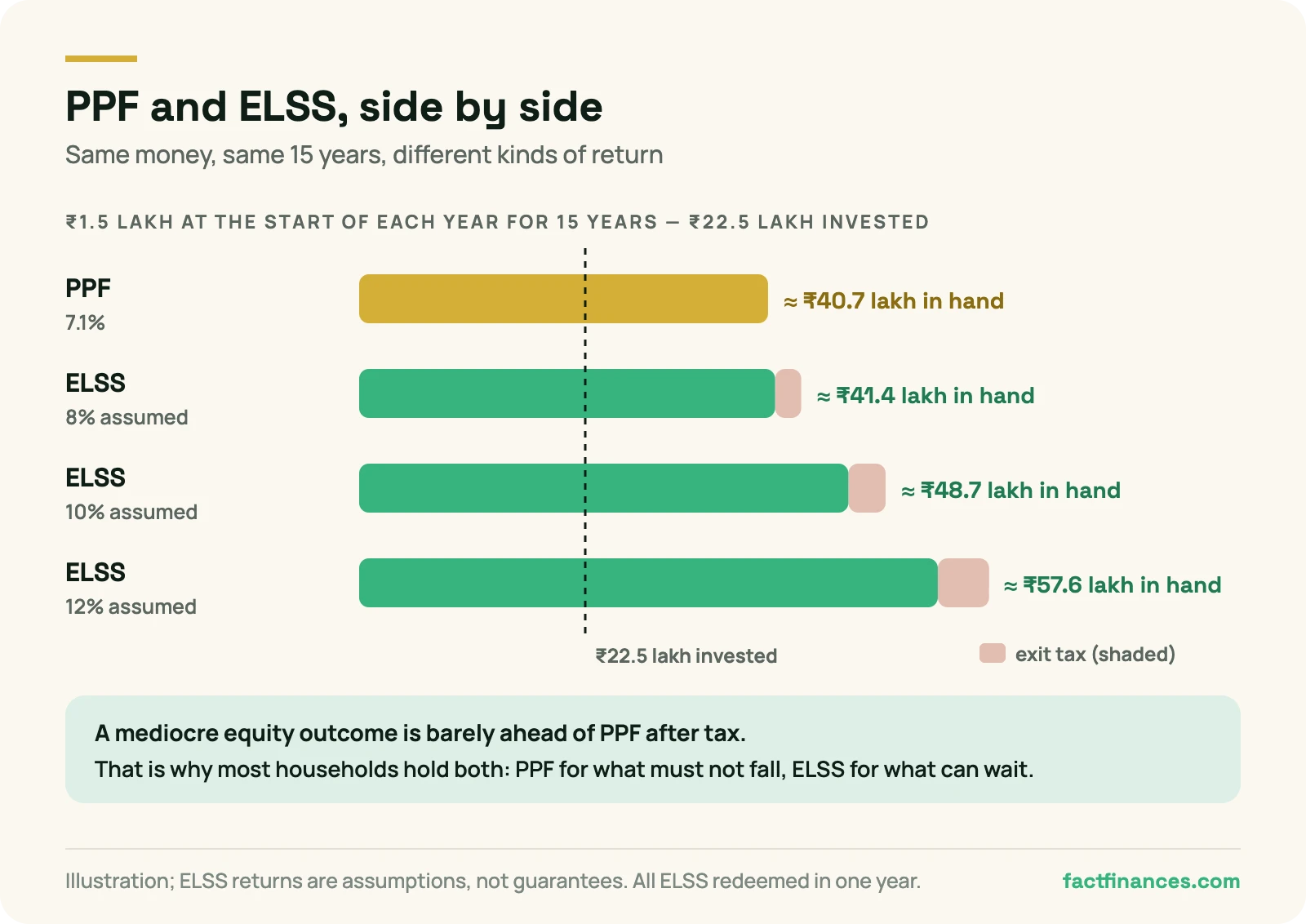
Suppose you invest ₹1.5 lakh at the start of every year for 15 years — ₹22.5 lakh in all. PPF is assumed to stay at 7.1%. For ELSS we show three assumed returns, because nobody knows which one you will get.
| Where | Assumed return | Value after 15 years | Tax on exit | In hand |
|---|---|---|---|---|
| PPF | 7.1% | ≈ ₹40.7 lakh | Nil | ≈ ₹40.7 lakh |
| ELSS | 8% | ≈ ₹44.0 lakh | ≈ ₹2.6 lakh | ≈ ₹41.4 lakh |
| ELSS | 10% | ≈ ₹52.4 lakh | ≈ ₹3.7 lakh | ≈ ₹48.7 lakh |
| ELSS | 12% | ≈ ₹62.6 lakh | ≈ ₹5.1 lakh | ≈ ₹57.6 lakh |
Two things stand out. Over a long period, equity has room to do meaningfully better than a fixed rate — but only if you can sit through the bad years, and the 8% row shows that a mediocre equity outcome is barely ahead of PPF after tax. That is why most households use both: PPF or EPF for the part that must not fall, ELSS for the part that can wait and grow.
New Regime
If you are in the new regime
- Do not buy an ELSS “to save tax”. It will not. If someone suggests one for that reason, ask which regime the calculation assumes.
- If you want an equity fund, pick one without a lock-in. A flexi-cap or index fund gives similar exposure and lets you redeem when you need to.
- Already running an ELSS SIP? You can stop it and redirect the money to an ordinary equity fund. The instalments already paid stay locked until each completes three years.
- Units past their lock-in are now ordinary equity fund units. Keep them if the fund is doing its job; there is no need to sell just because the three years are over.
- One real use remains: some investors value a lock they cannot break. If the three-year bar stops you from selling in a panic, that discipline has a value — just be clear it is a behaviour tool, not a tax one.
Choosing
How to choose and use an ELSS well
- One fund is usually enough; two at most. Adding a new ELSS every January leaves you with eight funds holding much the same shares.
- Judge it as an equity fund. Look at long-term returns against its benchmark and at its costs — see how to evaluate performance and expense ratios. Last year’s topper is rarely next year’s.
- Spread it through the year. A monthly SIP of ₹12,500 uses the full ₹1.5 lakh without the March scramble, and buys at twelve different prices instead of one.
- Match the amount to the room you have. Work out your unused section 123 limit first, as Amit did above.
- Keep the statement. Your employer will ask for proof of investment in January–February; the account statement or your CAS serves.
Common mistakes
- Investing in ELSS under the new regime and expecting a refund.
- Putting in the full ₹1.5 lakh when EPF and insurance have already used most of the limit.
- Buying in the last week of March, in a hurry, whatever the market level.
- Redeeming the day the lock-in ends and reinvesting the same money for a fresh deduction, year after year — the money never gets the long holding period equity needs.
- Choosing the IDCW option for “regular income”.
- Using ELSS for money needed within three to five years.
Our Approach
How we handle tax-saving investments for the families we work with
We are an AMFI-registered mutual fund distributor and we also help clients file their income-tax returns, so we see both sides of this decision. In practice:
- Regime first, product second. We work out your tax under both regimes before discussing any tax-saving investment. If the new regime is cheaper, we say so, even though it means no ELSS.
- We count what is already used. EPF, premiums, tuition fees and home-loan principal come off the ₹1.5 lakh before we suggest an amount.
- We fit it to a goal. ELSS money is equity money, so it is matched to goals five or more years away, alongside the safer part of your savings.
- We plan the exit. After the lock-in we help decide whether to hold or redeem, and how to spread redemptions so the ₹1.25 lakh exemption is used each year.
We earn a commission from the Regular plan of any fund you invest in through us; direct vs regular plans sets out what that costs and what it pays for. You can track every ELSS lot and its real return in the free FactFinances app.
FAQ
Frequently asked questions
Can I claim ELSS in the new tax regime?
No. The deduction for ELSS is under section 123 (earlier section 80C), which is available only in the old tax regime. In the new regime an ELSS is simply an equity fund with a three-year lock-in.
How much tax can I save with ELSS?
Up to ₹46,800 a year at the 30% slab, ₹31,200 at 20% and ₹7,800 at 5%, including cess, if your whole ₹1.5 lakh section 123 limit is unused and you file under the old regime. EPF, PPF, insurance premiums and home-loan principal share the same limit.
What is the lock-in period for an ELSS SIP?
Three years for each instalment, counted from the date its units are allotted. A SIP instalment paid in April 2026 can be redeemed from April 2029, the May 2026 instalment from May 2029, and so on.
Can I withdraw ELSS before three years in an emergency?
No. Units cannot be redeemed or switched during the lock-in for any reason. The only exception is the investor’s death, where the nominee or legal heir can redeem after one year from the date of allotment.
Is ELSS tax-free after three years?
Not entirely. Gains are long-term capital gains, taxed at 12.5% on total equity gains above ₹1.25 lakh in a financial year. Gains within ₹1.25 lakh are not taxed.
Which is better: ELSS or PPF?
They do different jobs. PPF gives a government-backed, tax-free return (7.1% at present) with a 15-year term. ELSS is an equity fund: it can grow faster over long periods but can also fall. Many households use both.
Should I continue my ELSS SIP after moving to the new regime?
There is no tax reason to. You can stop the SIP and invest the same amount in an equity fund without a lock-in. The instalments already paid remain locked until each completes three years, after which you can hold or redeem them like any equity fund.
Keep learning: Compare the old and new tax regimes, see every section 123 deduction, read how mutual funds are taxed and how tax harvesting works, or return to the main mutual funds guide.
Free · Printable · 10 minutes
Your 5-point money check-up
A 10-minute printable that shows where your family’s money is protected and where it isn’t. Plus one useful money article a month. No spam.
General information only, not personalised advice. Ujjwal Tiwary, AMFI-registered Mutual Fund Distributor, ARN-144500.
About the author
Ujjwal Tiwary
ARN-144500 · NISM Series V-A certified since 2018 · Ranchi & Deoghar, Jharkhand
Ujjwal Tiwary is an AMFI-registered mutual fund distributor (ARN-144500) based in Ranchi and Deoghar, Jharkhand, and has held the NISM Series V-A certification since 2018. He works with families on mutual funds, insurance and income tax returns, and writes or personally reviews every article on FactFinances. He is not a SEBI-registered investment adviser; nothing on this site is personalised advice.
FactFinances is an educational platform. We are an AMFI-registered mutual fund distributor (ARN-144500). We do not provide investment advice or recommend specific securities. All figures are illustrations at assumed rates and are not guarantees or forecasts of returns. Mutual fund investments are subject to market risks; read all scheme-related documents carefully.