

This is the hub of our income tax pillar: what changed in 2026, the numbers that matter this year, and where to go next. Every article it links to goes deeper on one decision.
The Short Answer
Income tax in India changed shape on 1 April 2026. The Income-tax Act, 2025 replaced the 1961 Act, the “financial year” and “assessment year” became a single tax year, and almost every section and form got a new number. The tax you pay did not change: the slabs, rebate and deductions for FY 2026-27 are the same as last year.
For most salaried people, income tax in India now comes down to a few simple facts. The new regime is the default, and income up to ₹12 lakh is tax-free under it (₹12.75 lakh of salary, after the standard deduction). The old regime, with HRA, 80C and home loan deductions, wins only if those deductions are large. Returns for FY 2025-26 are still filed under the old Act, and the last date for a belated return is 31 December 2026.
What Changed
The Income-tax Act, 2025 in one table
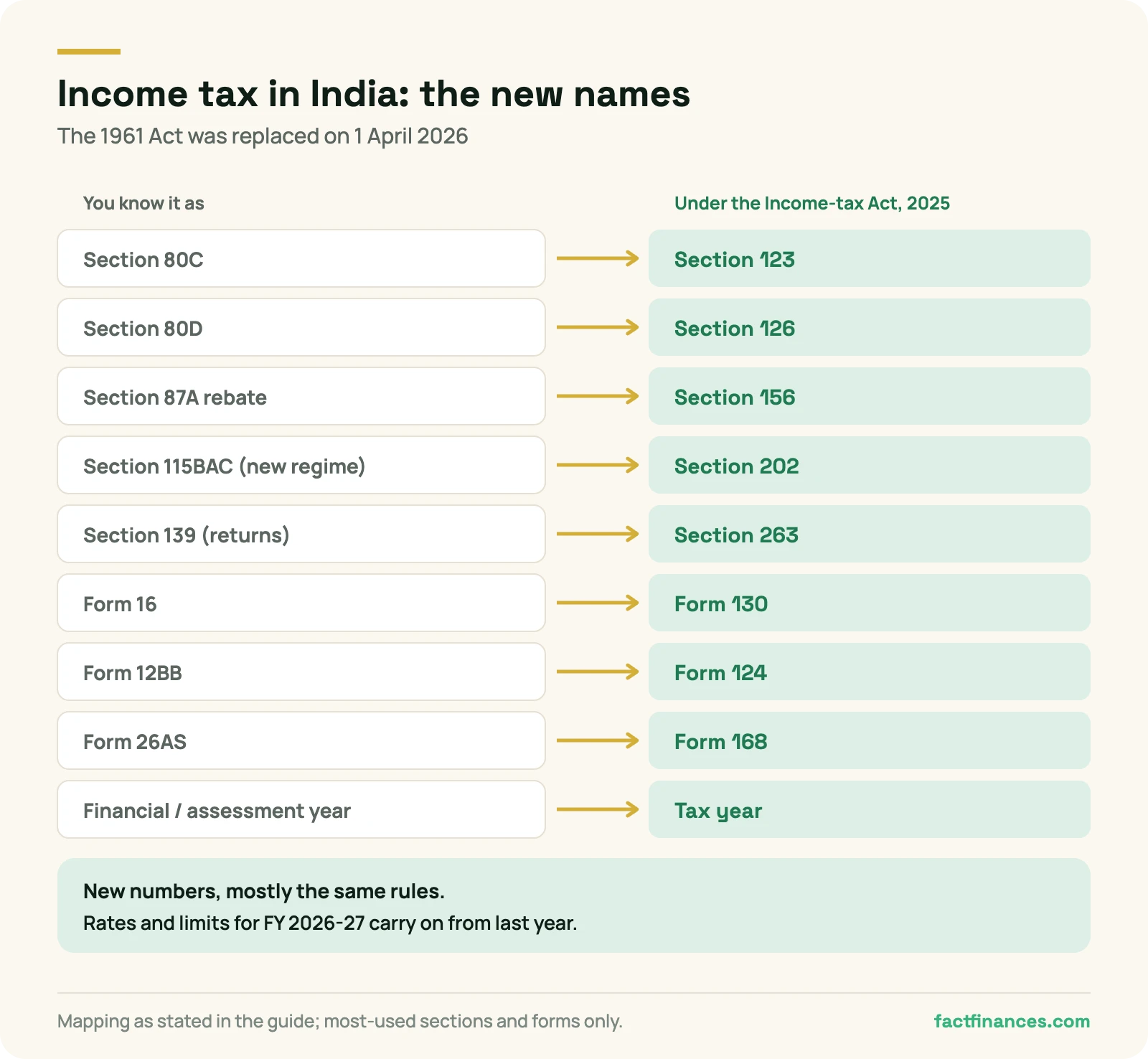
The new Act rewrote the law in simpler language and fewer sections, but kept the substance. What you will notice is the new vocabulary on forms, notices and your Form 16. The familiar names will be with us for years, so here is how they map:
| You know it as | Under the 2025 Act |
|---|---|
| Financial year / assessment year | Tax year (FY 2026-27 is tax year 2026-27) |
| Section 80C (with 80CCC, 80CCE) | Section 123 |
| Section 80D (health insurance) | Section 126 |
| Section 87A rebate | Section 156 |
| Section 115BAC (new regime) | Section 202 |
| Section 139 (filing returns) | Section 263 |
| Section 10 exemptions, e.g. 10(10D) | Schedules, e.g. Schedule II |
| Form 16 / Form 16A | Form 130 / Form 131 |
| Form 12BB (investment proofs) | Form 124 |
| Form 26AS | Form 168 |
Which law applies to you right now? Income earned up to 31 March 2026 (FY 2025-26) is taxed and filed under the 1961 Act, using the familiar ITR forms. Income from 1 April 2026 falls under the 2025 Act; the first returns under it will be filed in 2027.
This Year’s Numbers
Key figures for FY 2026-27
| Item | New regime | Old regime |
|---|---|---|
| Tax-free income (with rebate) | Up to ₹12 lakh | Up to ₹5 lakh |
| Standard deduction (salary, pension) | ₹75,000 | ₹50,000 |
| Top slab | 30% above ₹24 lakh | 30% above ₹10 lakh |
| 80C / s.123 deduction | Not allowed | Up to ₹1.5 lakh |
| 80D / s.126 health insurance | Not allowed | ₹25,000 (₹50,000 if senior) + up to ₹50,000 for parents |
| HRA exemption | Not allowed | Allowed; 50% city rate now in 8 cities |
| Employer NPS contribution | Up to 14% of basic + DA | Up to 10% |
| Highest surcharge | 25% | 37% |
| Health and education cess | 4% | 4% |
Capital gains are taxed the same way in both regimes: listed shares and equity mutual funds at 20% if held up to a year, and 12.5% on long-term gains above ₹1.25 lakh a year. The ₹12 lakh rebate does not cover them.
Not sure which regime suits you? Our old vs new tax regime calculator works out both and tells you how many deductions the old regime would need to win.
How This Guide Is Organised
Income tax in India: find the answer you need
Choosing your tax regime
The single biggest tax decision for a salaried person each year. Start with old vs new tax regime: which should you choose, then run your own figures in the regime calculator.
This year’s rates and the new law
Every slab, the ₹12 lakh rebate and marginal relief just above it are in income tax slabs for FY 2026-27. What the new law changed, and which Act applies to your return, is in the Income-tax Act, 2025 explained.
Filing your return
Missed the July deadline? Belated, revised and updated returns explains what you can still do before 31 December 2026, what it costs, and what changes after that date. Not sure which form to use? See which ITR form to file.
Deductions that still matter
If you stay in the old regime, rent is often the biggest item: see HRA exemption and the new eight-city rule, and work out your figure with the HRA calculator. For EPF, PPF, ELSS, insurance premium, tuition and home loan principal, see section 123 (old 80C): the ₹1.5 lakh list, compared. Health insurance is one of the few deductions open to everyone: see section 80D: the health insurance tax deduction.
Tax on your investments
For rates and holding periods on every asset, see capital gains tax in India and the capital gains tax calculator. To use this year’s ₹1.25 lakh exemption before 31 March, see tax harvesting. How mutual funds are taxed on redemption and on dividends is in mutual fund taxation in India. For shares, F&O and intraday trading, read how equity income is taxed.
Salaried? How tax on salary works covers TDS, Form 124 and Form 130. Living on interest or a pension? Read tax on FD and savings interest for TDS limits, Form 121 and the senior citizen rules. Freelancer, landlord or investor? Advance tax explains the four due dates, and the advance tax calculator works out each instalment. A guide to choosing your ITR form follows before the filing season.
The Tax Calendar
Dates to remember
| Date | What happens |
|---|---|
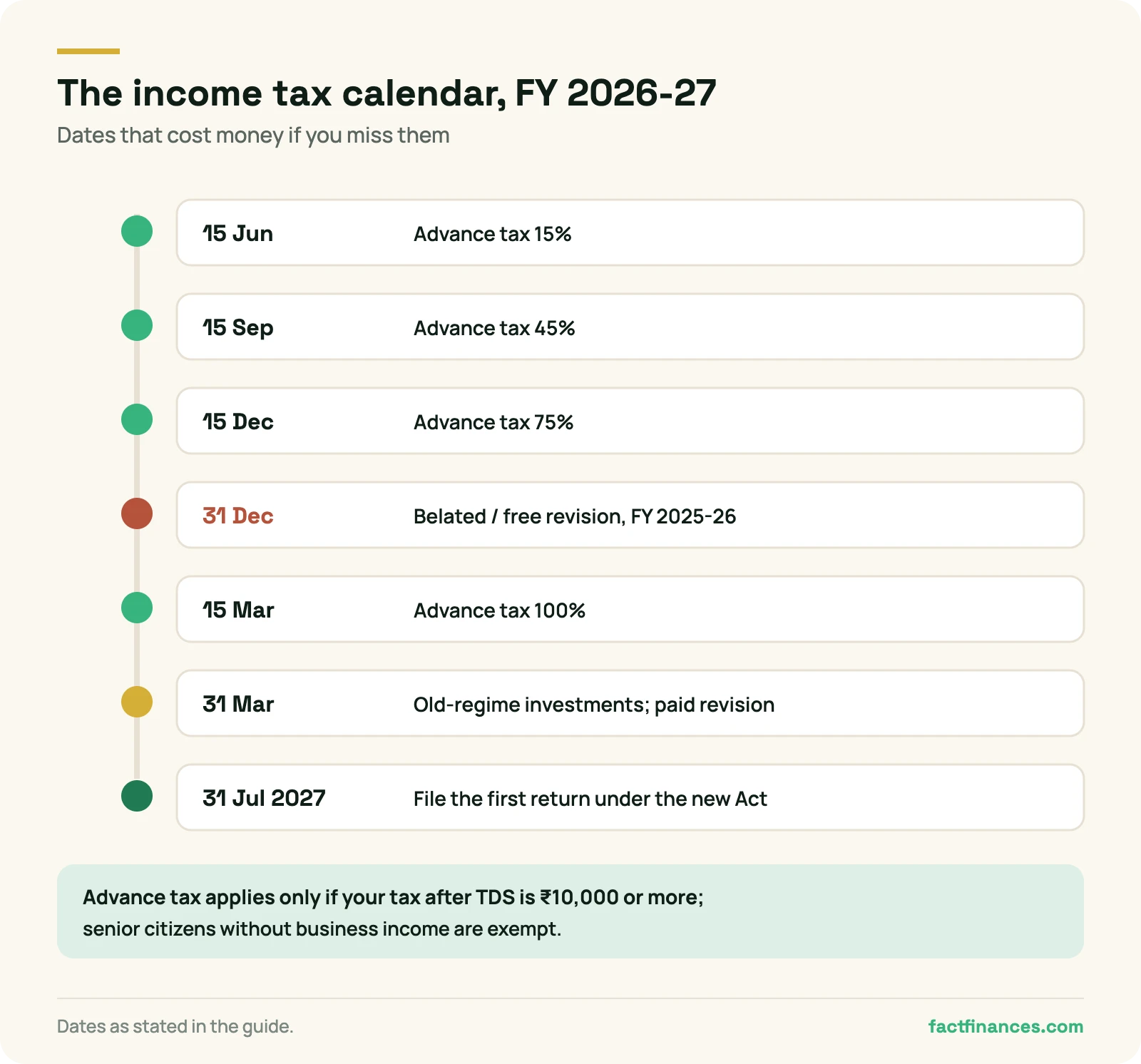
| 15 June, 15 September, 15 December, 15 March | Advance tax instalments (15%, 45%, 75%, 100%) if your tax after TDS is ₹10,000 or more. Senior citizens without business income are exempt. |
| 31 December 2026 | Last date for a belated return for FY 2025-26, and for a revised return without a fee. |
| 31 March 2027 | Last date to make old-regime investments for FY 2026-27, and to revise an FY 2025-26 return (with fee). |
| 31 July 2027 | Usual due date for most salaried people to file their first return under the 2025 Act (tax year 2026-27). |
Common Mistakes
Five income tax mistakes we see every year
1. Leaving interest income out of the return
Savings and FD interest are taxable and show up in your Annual Information Statement. Missing them is the most common trigger for a notice.
2. Assuming TDS means you are done
TDS is deducted at fixed rates. If your slab is higher, or you have other income, you owe more, and interest starts running.
3. Sticking with last year’s regime
A pay rise, a home loan or a move can change which regime is cheaper. Check each year.
4. Filing late
A late return costs a fee, locks salaried people into the new regime and wipes out the carry-forward of most losses.
5. Not e-verifying
A return not verified within 30 days is treated as never filed.
Talk It Through
Want your ITR filed correctly, without the guesswork?
We help salaried people, pensioners, investors and small businesses file their returns: choosing the cheaper regime, reconciling TDS with your AIS, reporting capital gains, and handling belated and revised returns. Tell us what you earned and we will tell you what we need. Ranchi, Deoghar and across India online.
Chat on WhatsApp Send a message · Old vs new regime calculator
Key takeaways
→ The Income-tax Act, 2025 applies from 1 April 2026; it renamed the year and renumbered sections and forms, but did not change tax rates for FY 2026-27.
→ Returns for FY 2025-26 are still filed under the 1961 Act. The belated return deadline is 31 December 2026.
→ In the new regime, income up to ₹12 lakh (₹12.75 lakh salary) is tax-free; the old regime only wins with large deductions.
→ Capital gains are taxed the same in both regimes and are not covered by the ₹12 lakh rebate.
→ Report every rupee of interest and check your AIS before filing.
Questions
Frequently asked questions
What is the Income-tax Act, 2025?
It is the law that replaced the Income-tax Act, 1961 from 1 April 2026. It uses simpler language, introduces the term “tax year”, and renumbers sections and forms, but keeps the tax rates and most rules the same.
What is a “tax year”?
The tax year is the year in which you earn the income, April to March. It replaces the old pairing of financial year and assessment year, so FY 2026-27 is simply tax year 2026-27.
Is income up to ₹12 lakh tax-free in 2026-27?
Yes, in the new regime, if it is income taxed at slab rates. A salaried person can earn ₹12.75 lakh and pay no tax after the ₹75,000 standard deduction. Capital gains taxed at special rates are not covered.
Which ITR form do I use for FY 2025-26?
The 1961-Act forms: ITR-1 for salary, pension and interest up to ₹50 lakh; ITR-2 if you have capital gains; ITR-3 or ITR-4 for business or professional income.
Is section 80C still there?
Yes, as section 123 of the new Act, with the same ₹1.5 lakh limit. It is available only in the old regime.
When will the new ITR forms come?
Returns under the 2025 Act start with tax year 2026-27, which is filed in 2027. The new forms will be notified before then.
Keep Learning
Next steps: Old vs new tax regime · Regime calculator · Missed the ITR deadline? · Section 80D
The bigger picture: Mutual fund taxation · How equity income is taxed · The complete guide to insurance in India
About the author
Ujjwal Tiwary
ARN-144500 · NISM Series V-A certified since 2018 · Ranchi & Deoghar, Jharkhand
Ujjwal Tiwary is an AMFI-registered mutual fund distributor (ARN-144500) based in Ranchi and Deoghar, Jharkhand, and has held the NISM Series V-A certification since 2018. He works with families on mutual funds, insurance and income tax returns, and writes or personally reviews every article on FactFinances. He is not a SEBI-registered investment adviser; nothing on this site is personalised advice.
Disclaimer: FactFinances provides educational content only. This article is general information and is not tax, legal or financial advice. It is based on the Income-tax Act, 1961 (which still governs returns for FY 2025-26 and earlier) and the Income-tax Act, 2025 (in force from 1 April 2026), as understood at the time of writing. Tax law, due dates and their interpretation can change, and your tax depends on your full facts; check the current position on the Income Tax Department portal or consult a chartered accountant before acting. FactFinances offers ITR filing assistance; reading this article places you under no obligation to use it.